Join us on a literary world trip!
Add this book to bookshelf
Grey
Write a new comment Default profile 50px
Grey
Subscribe to read the full book or read the first pages for free!
All characters reduced
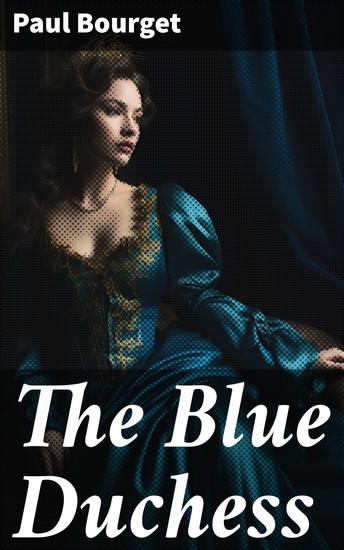
The Blue Duchess - Love and Betrayal in Decadent France: A Psychological Tale of Opulence and Deceit - cover

The Blue Duchess - Love and Betrayal in Decadent France: A Psychological Tale of Opulence and Deceit

Paul Bourget

Translator Ernest Tristan

Publisher: Good Press

  • 0
  • 0
  • 0

Summary

In "The Blue Duchess," Paul Bourget weaves a compelling narrative steeped in the complexities of human emotions and social dynamics. Set against the backdrop of early 20th-century Europe, the novel explores themes of love, betrayal, and societal expectations through the lens of his rich characterizations and intricate prose. Bourget's literary style showcases his impeccable psychological insight and a keen eye for detail, reflecting the influence of Naturalism and the emerging modernist sentiments of his time. This poignant work captures the essence of an era in transition, revealing the inner lives of its characters amid the rigid structures of their society. Paul Bourget, a noted French novelist and critic, was deeply influenced by his early experiences in a culturally rich milieu, which propelled him to explore the intricacies of the human psyche and the moral dilemmas of contemporary life. His background in philosophy and sociology provided him with a unique lens through which he examined the shifting moral landscapes of his time. Bourget's own encounters with the elite circles of Parisian society inform the depth and authenticity of the characters in "The Blue Duchess," bringing to life the contrasts between appearance and reality. Readers seeking a masterfully crafted exploration of human relationships will find "The Blue Duchess" an enriching experience. Bourget'Äôs novel invites reflection on the nature of desire and societal constraints while drawing the reader into a world where emotional truths emerge in silence. This book is essential for anyone interested in early modern literature and the sociocultural issues that continue to resonate today.
Available since: 11/02/2023.
Print length: 181 pages.

Other books that might interest you

  • The Raven - cover

    The Raven

    Edgar Allan Poe

    • 0
    • 0
    • 0
    The Raven by Edgar Allan Poe is one of literature's most iconic poems, weaving a haunting narrative of loss, despair, and the supernatural. In this mesmerizing and atmospheric tale, a grieving man, tormented by the memory of his lost love Lenore, finds himself visited by a mysterious raven late at night. As the raven perches above his chamber door, it speaks a single word: "Nevermore." 
    Poe's use of vivid imagery and melodic language captures the narrator’s descent into madness as he desperately seeks meaning in the raven’s cryptic response. Is it a messenger from beyond, or merely a cruel reminder of his sorrow? The poem masterfully explores themes of death, mourning, and the futility of seeking solace in the face of overwhelming grief. 
    This audiobook version of The Raven brings Poe's dark and melancholic vision to life, enveloping listeners in its eerie, gothic ambiance. With its rhythmic cadence and poignant storytelling, the poem remains a timeless work that resonates with anyone who has ever experienced the haunting echoes of lost love. 
    Perfect for fans of gothic poetry and classic literature, this rendition captures the essence of Poe’s masterful storytelling, making it an unforgettable listening experience. 
    Start Listening to The Raven today and immerse yourself in the chilling and poetic world of Edgar Allan Poe!
    Show book
  • The Murders in the Rue Morgue - cover

    The Murders in the Rue Morgue

    Edgar Allan Poe

    • 0
    • 0
    • 0
    The Murders in the Rue Morgue is a short story by Edgar Allan Poe published in Graham's Magazine in 1841. It has been recognized as the first modern detective story; Poe referred to it as one of his "tales of ratiocination". Two works that share some similarities predate Poe's stories, including Das Fräulein von Scuderi (1819) by E. T. A. Hoffmann and Zadig (1747) by Voltaire. C. Auguste Dupin is a man in Paris who solves the mystery of the brutal murder of two women. Numerous witnesses heard a suspect, though no one agrees on what language was spoken.     At the murder scene, Dupin finds a hair that does not appear to be human. As the first fictional detective, Poe's Dupin displays many traits which became literary conventions in subsequent fictional detectives, including Sherlock Holmes and Hercule Poirot. Many later characters, for example, follow Poe's model of the brilliant detective, his personal friend who serves as narrator, and the final revelation being presented before the reasoning that leads up to it. Dupin himself reappears in "The Mystery of Marie Rogêt" and "The Purloined Letter".
    Show book
  • The Eye of the Camera - From their pens to your ears genius in every story - cover

    The Eye of the Camera - From...

    Fred M. White

    • 0
    • 0
    • 0
    Richard Bernard Heldmann was born on 12th October 1857, in St Johns Wood, North London.  
    By his early 20’s Heldmann began publishing fiction for the myriad magazine publications that had sprung up and were eager for good well-written content.  
    In October 1882, Heldmann was promoted to co-editor of Union Jack, a popular magazine, but his association with the publication ended suddenly in June 1883.  It appears Heldman was prone to issuing forged cheques to finance his lifestyle.  In April 1884 he was sentenced to 18 months hard labour. 
    In order to be well away from the scandal and the damage that this had caused to his reputation Heldmann adopted a pseudonym on his release from jail.  Shortly thereafter the name ‘Richard Marsh’ began to appear in the literary periodicals.  The use of his mother’s maiden name as part of it seems both a release and a lifeline. 
    A stroke of very good fortune arrived with his novel ‘The Beetle’ published in 1897.  This would turn out to be his greatest commercial success and added some much-needed gravitas to his literary reputation.   
    Marsh was a prolific writer and wrote almost 80 volumes of fiction as well as many short stories, across many genres from horror and crime to romance and humour.   His unusual characters, plotting devices and other literary developments have identified his legacy as one of the best British writers of his time.   
    Richard Marsh died from heart disease in Haywards Heath in Sussex on 9th August 1915.  He was 57.
    Show book
  • Virginibus Puerisque II (Unabridged) - cover

    Virginibus Puerisque II...

    Robert Louis Stevenson

    • 0
    • 0
    • 0
    Robert Louis Balfour Stevenson was a Scottish novelist, poet, and travel writer, and a leading representative of English literature. He was greatly admired by many authors, including Jorge Luis Borges, Ernest Hemingway, Rudyard Kipling and Vladimir Nabokov.
    VIRGINIBUS PUERISQUE II: Hope, they say, deserts us at no period of our existence. From first to last, and in the face of smarting disillusions, we continue to expect good fortune, better health, and better conduct; and that so confidently, that we judge it needless to deserve them.
    Show book
  • Casting the Runes - cover

    Casting the Runes

    M. R. James

    • 0
    • 0
    • 0
    'I am about to let loose on the world a plague which could destroy all mankind'
    Casting the Runes originally appeared in M.R. James' second published collection of ghost stories (1911) and has significantly influenced the horror genre, inspiring later writers and filmmakers with its emphasis on atmosphere and psychological tension.
    
    When academic Edward Dunning dismisses a manuscript by the sinister Mr. Karswell, he unwittingly becomes the target of a deadly curse. Almost immediately, he starts to experience strange and inexplicable phenomena, and as these eerie events escalate, Dunning must unravel the mystery of the runes before time runs out.
    Casting the Runes is a chilling tale of occult revenge that highlights the author's masterful ability to build tension through a distinctive blend of scholarly realism and creeping dread.
    Montague Rhodes James (1862–1936) was a distinguished English medievalist scholar and academic, serving as Provost of King's College, Cambridge, and later Eton College. His ghost stories, widely regarded as the finest in the English language, have been widely influential on modern horror and many - including Oh, Whistle and I'll Come For You, My Lad,The Tractate Middoth, A View from a Hill and Casting the Runes (aka Night of the Demon) - have been adapted for the screen
    Show book
  • Snow-White and Rose-Red - Story Time Episode 22 (Unabridged) - cover

    Snow-White and Rose-Red - Story...

    Brothers Grimm

    • 0
    • 0
    • 0
    Snow-White and Rose-Red are two little girls living with their mother, a poor widow, in a small cottage by the woods. Snow-White is quiet and shy and prefers to spend her time indoors, doing housework and reading. Rose-Red is outspoken, lively and cheerful, and prefers to be outside.
    Show book