Begleiten Sie uns auf eine literarische Weltreise!
Buch zum Bücherregal hinzufügen
Grey
Einen neuen Kommentar schreiben Default profile 50px
Grey
Jetzt das ganze Buch im Abo oder die ersten Seiten gratis lesen!
All characters reduced
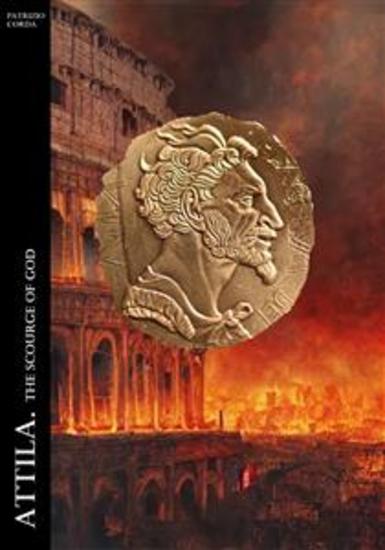
Attila The Scourge Of God - cover

Attila The Scourge Of God

Patrizio Corda

Verlag: Patrizio Corda

  • 0
  • 0
  • 0

Beschreibung

411 AD. - Attila only knows his own people, the Huns ruled by his uncle Rua.
Along with his brother Bleda, he is raised in a violent world in which his people migrate from one area
to another leading an existence of nomadism and hardship. But he does not yet know that Rua has relations
with the Western Roman Empire, the one really responsible for their predicament.
At a time when barbarian peoples are revolting in mass against an authority now weakened
and unable to defend itself, Attila will meet the only Roman worthy of respect for him: a young man named
Flavius Aetius.
But this will not prevent him, in the future, from aspiring to new conquests once he obtains the Hun crown.
And among his targets will end up the two empires of Rome, increasingly struggling to protect their
respective borders from multiple barbarian invasions.
It will be that ambition that will turn Attila into the man known as the Scourge of God, one of the most bloodthirsty rulers
that history has known and whose fame has survived to the present day.
Verfügbar seit: 02.11.2024.

Weitere Bücher, die Sie mögen werden

  • A Brief History of the Countryside in 100 Objects - cover

    A Brief History of the...

    Sally Coulthard

    • 0
    • 0
    • 0
    A Waterstones Best Book of 2024: Nature Writing 
    The untold story of rural Britain revealed through its artefacts 
    'A really lovely, fascinating book. I dived straight into this clever, joyous, celebration of nature, history, and – of course – the countryside.' Charles Spencer, author of The White Ship 
    For most of human history, we were rural folk.  
    Our daily lives were bound up with working the land, living within the rhythm of the seasons. We poured our energies into growing food, tending to animals and watching the weather. Family, friends and neighbours were often one and the same. Life revolved around the village and its key spaces and places – the church, the green, the school and the marketplace. 
    And yet rural life is oddly invisible our historical records. The daily routine of the peasant, the farmer or the craftsperson could never compete with the glamour of city life, war and royal drama. Lives went unrecorded, stories untold. 
    There is, though, one way in which we can learn about our rural past. The things we have left behind provide a connection that no document can match; physical artefacts are touchstones that breathe life into its history. From farming tools to children’s toys, domestic objects and strange curios, the everyday items of the past reveal fascinating insights into an often-forgotten way of life. Birth, death, celebration, work, crime, play, medicine, beliefs, diet and our relationship with nature can all be read from these remnants of our past. 
    From ancient artefacts to modern-day memorabilia, this startling book weaves a rich tapestry from the fragments of our rural past. 
    In her non-fiction book A Brief History of the Countryside in 100 Objects, Sally Coulthard explores the social and cultural dynamics of rural life in Europe. The book, steeped in anthropology and environmental conservation, emphasises the importance of regional studies and the protection of our environment. 
    For fans of Jane Cooper (The Lost Flock), Charles King (Every Valley), Lee Alan Dugatkin (Mr. Jefferson and the Giant Moose), James Rebanks (The Shepherd's View), and Clara Parkes (Vanishing Fleece). 
    HarperCollins 2024
    Zum Buch
  • Runes for Beginners - cover

    Runes for Beginners

    Melissa Smith

    • 0
    • 0
    • 0
    The Elder Futhark has been around for 2,000 years or more. Many historical cultures have practiced the casting of runes for divination, spells, magic, and rituals to help improve their lives.Throughout this book, I will help you begin your journey of enlightenment and show you the wonders that the runes have to offer. We will cover the rituals that will become the basis of all those that follow, and we will touch on the spells that will become a part of your everyday life.From Fehu to Othala, we will cover each rune meticulously and show you how to bring their wonderful energies into our modern world, where they are needed now more than ever.We will cover the Norse people that brought them to us and the magic and divination that was passed down through the generations. What you will learn is that magic has always been around you, but until now, it has remained just out of reach.You will learn how to choose the runes that suit you best, how to care for them, and of course, how to cast them and embrace their positive energies.So, let me take you to the starting point of your voyage and give you the tools you need to cast off on your journey of enlightenment.The Elder Futhark and the magic of our ancestors is free to take, you just need to open your mind a little.Would you like to know more? Scroll up, hit the "buy" button, and start this amazing journey!
    Zum Buch
  • Our Vietnam Wars Volume 2 - As told by more veterans who served - cover

    Our Vietnam Wars Volume 2 - As...

    William F. Brown

    • 0
    • 0
    • 0
    Want to know what Vietnam was really like? 
    From a Marine sniper in Hue, to a medevac dust-off pilot going into a hot LZ, Navy Corpsmen, A-6 pilots taking out bridges and SAM sites in North Vietnam, a nurse on the USS Repose, combat medics deep in the jungle, machine gunners in I-Corps, mechanics working on the rolling deck of a big carrier on Yankee Station, squad leaders on infantry sweeps in “the Arizona Territory,” truck convoys under fire, riverine patrol boats in the Delta, Coast Guard “Jolly Green” search and rescue helicopters pulling downed pilots from the jungle, tank platoons in an all-out armor assault, Loach pilots in hunter-killer teams, and many more -- from the Delta to the DMZ, this book puts you in their boots. 
    Some of us were drafted. Some enlisted. Some were true war heroes, but most were just trying to survive. As everyone “in-country” knew, Vietnam was all about luck, good or bad. If you were there, you understand. If you weren’t, grab a copy and start reading, anywhere in the book. The stories are like Doritos. Try a few and you won’t be able to stop. 
    Like any war, none of us who served had much if any control over our fates. We went where they told us to go, did what they told us to do, and over 58,200 of us paid the ultimate price. Now, 50 years later, the war continues to take its toll on many who did come home, with PTSD and Agent Orange induced diabetes, heart disease, neuropathy, leukemia, Hodgkin’s Disease, and many forms of cancer. As they say, “Vietnam is the gift that keeps on giving.” 
    This is the audio edition of Volume 2 of my popular 4-volume book series, Our Vietnam Wars. It was so titled because everyone who served there fought a different war depending on the year, our branch and unit, location, sex, race, and rank. This volume 60 Stories, 271 photographs you can't appreciate from just the audio book alone. The book has 4.6 Stars on 631 Amazon customer reviews.
    Zum Buch
  • People Power Change - Organizing for Democratic Renewal - cover

    People Power Change - Organizing...

    Marshall Ganz

    • 0
    • 0
    • 0
    At a moment in which our everyday practice of democracy has atrophied, and political, economic, and technological forces have weakened our capacity for collective action, People, Power, Change is a once-in-a-generation book for anyone who wants to create real and lasting change. 
     
    Marshall Ganz is one of the world’s leading authorities on democratic leadership, organizing, and action and this book is the culmination of his decades of teaching, research, and practice. In People, Power, Change Ganz offers students, educators, and organizers access to the craft he has learned, adapted, and shared over the last half-century of creating effective collective action. It is not a blueprint, but a road map.  
     
    Ganz explores the values, ideas, and craft core to the practice of organizing and offers an actionable framework for how to actually do it. He focuses the book on the creation and substance of relationships, the fuel of values and narrative, the resources and power of strategy, the necessity of structure, and the accountability of action. Across these five organizing practices, Ganz weaves in his personal experiences from a lifetime of organizing in iconic social movements and campaigns to illustrate how collective action actually works and to build the practices and skills that must be developed to do it with intention and with success. 
     
    “If there was ever a moment when this message needed to be heard, this is it! Read it, and then get to work!”—Bill McKibben, founder of 350.org and Third Act 
     
    This audiobook contains a supplemental PDF.
    Zum Buch
  • Extraterrestrial Prophecies & End-Time Warnings - Apocalyptic Texts on Cosmic Invasion or Salvation - cover

    Extraterrestrial Prophecies &...

    Various Ancient Writers, Tim...

    • 0
    • 0
    • 0
    What if a distant roar in the heavens is the sound of destiny approaching? 
    The Extraterrestrial Prophecies & End-Time Warnings audiobook delivers immersive narration layered with subtle atmospheric effects—thunder, distant choirs, and whispering winds—to bring each nightmare-or-hope vision to life: 
    •	2 Baruch & 3 Baruch – Lamentations over ruins, then soaring through stellar vaults. 
    •	4 Ezra (2 Esdras) – A prophet’s dialogue with the Most High and the appearance of a flying mountain-ship. 
    •	Apocalypse of Abraham – Fiery chariots, vigilant seraphim, and a foretaste of judgment. 
    •	The Vision of Ezra – Stations of the afterlife guarded by beings “whose faces flame like copper.” 
    •	Sibylline Oracles – Poetic orations of cosmic upheaval and renewal. 
    Brief scene-setting commentaries link the prophecies and highlight parallels to today’s extraterrestrial speculations—perfect for late-night listening or stargazing.
    Zum Buch
  • First Bull Run: The History of the Civil War’s First Major Battle - cover

    First Bull Run: The History of...

    Jonathan Gianos-Steinberg

    • 0
    • 0
    • 0
    After the Battle of Fort Sumter in April 1861 ignited the Civil War, many in the North expected a relatively quick victory, including President Abraham Lincoln. While that seems naïve in hindsight, given the knowledge that the war lasted over four years, these expectations seemed entirely realistic at the time due to the Union’s overwhelming economic advantages over the South. At the start of the war, the Union had a population of over 22 million, whereas the South had a population of 9 million, nearly 4 million of whom were slaves. Union states contained 90% of the manufacturing capacity of the country and 97% of the weapon manufacturing capacity. Union states also possessed over 70% of the total railroads in the pre-war United States at the start of the war, and the Union also controlled 80% of the shipbuilding capacity of the pre-war United States. 
    McDowell’s strategy during the First Battle of Bull Run was grand, and in many ways it was the forerunner of a tactic Robert E. Lee, Stonewall Jackson and James Longstreet executed brilliantly on nearly the same field during the Second Battle of Bull Run in August 1862. McDowell’s plan called for parts of his army to pin down General P.G.T. Beauregard’s Confederate soldiers in front while marching another wing of his army around the flank and into the enemy’s rear, rolling up the line. McDowell assumed the Confederates would be forced to abandon Manassas Junction and fall back to the next defensible line, the Rappahannock River. In July 1861, however, this proved far too difficult for his inexperienced troops to carry out effectively. 
    As the first major land battle of the Civil War, the First Battle of Bull Run made history in several ways. The two sides fought near the railroad junction at Manassas on July 21, 1861, just 25 miles away from Washington, which was close enough for many civilians from the nation’s capital to come and watch what they expected to be a rout of Confederate forces.
    Zum Buch