Rejoignez-nous pour un voyage dans le monde des livres!
Ajouter ce livre à l'électronique
Grey
Ecrivez un nouveau commentaire Default profile 50px
Grey
Abonnez-vous pour lire le livre complet ou lisez les premières pages gratuitement!
All characters reduced
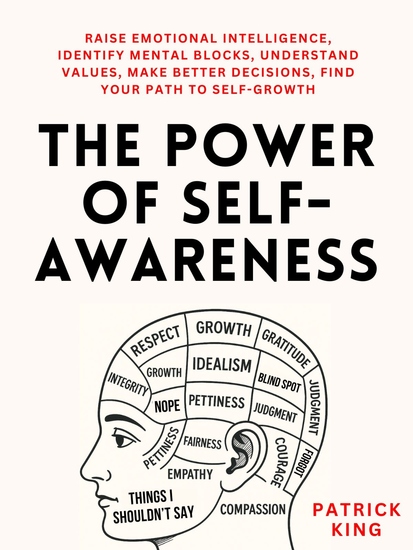
The Power of Self-Awareness - Raise Emotional Intelligence Identify Mental Blocks Understand Values Make Better Decisions Find Your Path to Self-Growth - cover

The Power of Self-Awareness - Raise Emotional Intelligence Identify Mental Blocks Understand Values Make Better Decisions Find Your Path to Self-Growth

Patrick King

Maison d'édition: Publishdrive

  • 0
  • 0
  • 0

Synopsis

Equal parts scientific, philosophical, and practical. Become your best self by first defining it.THIS BOOK takes you on a journey – not to an exotic destination, but inwards. It’s perilous, scary, and uncomfortable, but the end rewards will be fantastic. Self-awareness is not simply knowing your name; it’s knowing what makes you happy, what makes you sad, and the underlying beliefs and values that create those emotions.Most people look externally for answers to their problems, but that’s like putting a band-aid on top of a pothole. Everything that makes your life good or bad comes from within and it’s time to finally learn what lies beneath.The toughest skill of all: metacognition, which is thinking about your thinking.
 
Learn the keys to self-introspection and how a simple set of questions can answer your deepest problems.
 
The three levels of adult self-awareness and development.
 
Values, goals, beliefs, and how to orient yourself.
 
Why self-awareness is actually social awareness, and how it can help you socially
 
Empathy and social intelligence
 
The keys to avoiding self-delusion and self-sabotage.Patrick King is an internationally bestselling author and social skills coach. His writing draws of a variety of sources, from scientific research, academic experience, coaching, and real-life experience.Self awareness is social awareness. Know thyself and your relationships will benefit tenfold.Self-awareness is not just a journey about yourself, it involves the people around you. Understanding how your own emotions, values, and beliefs work will finally allow you to truly empathize with your friends, family, and significant other.To get to Point B, you must know what Point A is. Read this book to find your starting point, your end goal, and what must happen in between!
Disponible depuis: 07/05/2025.
Longueur d'impression: 201 pages.
D'autres livres qui pourraient vous intéresser

  • Self and Identity - The Basics - cover

    Self and Identity - The Basics

    Megan E. Birney

    • 0
    • 0
    • 0
    Self and Identity: The Basics is a jargon-free and accessible introduction that draws on key theories and ideas in social psychology to explore the ways that other people affect our thoughts, feelings, and behaviors. Highlighting selfhood as a function of identity, the book shows that it is our relationships with others in our social world that largely determine who we are. 


    "Who am I?" It's a question that most all humans have grappled with at some point or another. This book seeks to answer this question through relatable examples that show how psychological theory can be applied to our own lives. It considers the philosophical and psychological context in which ideas about selfhood have developed and reviews the ways that the people around us, and the groups that we belong to, affect who we are. Finally, these ideas are considered in the context of real-world phenomena and behaviors; for instance, how we use language, conflict between groups, and social influence. 


    This book is an ideal introduction for students of social psychology and related fields. It will be of interest to anyone who wants to gain social psychological insight into who they are and how others got them there.
    Voir livre
  • Zeus Grants Stupid Wishes - A No-Bullshit Guide to World Mythology - cover

    Zeus Grants Stupid Wishes - A...

    Cory O'Brien

    • 0
    • 0
    • 0
    Get this: Cronus liked to eat babies. 


    Narcissus probably should have just learned to masturbate. 


    Odin got construction discounts with bestiality. 


    Ganesh was the very definition of an unplanned pregnancy. 


    And Abraham was totally cool about stabbing his kid in the face. 


    All our lives, we've been fed watered-down versions of the classic myths. In reality, mythology is more screwed up than a schizophrenic shaman doing hits of unidentified . . . wait, it all makes sense now. In Zeus Grants Stupid Wishes, Cory O'Brien, creator of Myths RETOLD!, sets the stories straight. These are rude, crude, totally sacred texts told the way they were meant to be told. 


    Here are a few more gems to consider: Zeus once stuffed an unborn fetus inside his thigh to save its life after he exploded its mother by being too good in bed; the Egyptian universe was saved because Sekhmet got too hammered to keep murdering everyone; the Hindu universe is run by a married couple who only stop murdering in order to throw dance parties on the corpses of their enemies; the Norse goddess Freyja once consented to a four-dwarf gangbang in exchange; and there's more dysfunctional goodness where that came from.
    Voir livre
  • The Most Holy Trinosophia - cover

    The Most Holy Trinosophia

    Comte de Saint-Germain

    • 0
    • 0
    • 0
    La Très Sainte Trinosophie, The Most Holy Trinosophia, or The Most Holy Threefold Wisdom, is a French esoteric book, allegedly authored by Alessandro Cagliostro or the Count of St. Germain. Dated to the late 18th century, the 96-page book is divided into twelve sections representing the twelve zodiacal signs. The veiled content is said to refer to an allegorical initiation, detailing many Kabbalistic, alchemical and masonic mysteries. .
    Voir livre
  • Turning Points - Crisis and Change in Modern Britain from 1945 to Truss - cover

    Turning Points - Crisis and...

    Steve Richards

    • 0
    • 1
    • 0
    The Times Best Politics and Current Affairs Books of the YearAn entertaining and revealing history of modern British politics from Steve Richards, broadcaster, journalist, and author of The Prime Ministers We Never Had.'Through wonderful vignettes, Richards offers a masterful, clear-eyed and, above all, entertaining history of British politics. To pilot a better future, we need to learn how not to repeat the mistakes of the past. The book is a lesson in just that' – Will HuttonEvery few weeks in British politics, a columnist will reach for the word ‘unprecedented’ as a cabinet minister resigns or yet another inquiry is called. We have become so accustomed to turmoil that it is impossible to take a breath and see where we are headed. In this magisterial history, respected broadcaster and journalist Steve Richards puts the recent chaos into context and takes a step back to explore ten critical moments that have shaped modern Britain.From the Suez Crisis of 1956 to the Covid-19 pandemic, from 1945 to Thatcher, Richards argues that it is only with distance that we can perceive the tectonic plates shifting – and events that may seem earth-shattering in the moment might be a passing tremor with the perspective of history.With his trademark insight, forged over several decades as one of the UK’s foremost political commentators, Richards blends anecdote and analysis to explore the biggest events in British political history. A must-read for anyone seeking to understand our nation, this landmark work is enlightening and entertaining in equal measure.'An engaging canter through postwar Britain . . . shaped by a lifetime of reading' – Prospect
    Voir livre
  • Cleopatra’s Needles - The Lost Obelisks of Egypt - cover

    Cleopatra’s Needles - The Lost...

    PhD Bob Brier

    • 0
    • 0
    • 0
    In the half-century between 1831 and 1881 three massive obelisks left Egypt for new lands. Prior to these journeys, the last large obelisk moved was the Vatican obelisk in 1586—one of the great engineering achievements of the Renaissance. Roman emperors moved more than a dozen, but left no records of how they did it. The nineteenth-century engineers entrusted with transporting the obelisks across oceans had to invent new methods, far from certain that they would work. As the three obelisks, bound for Paris, London, and New York, sailed towards their new homes, the world held its breath. Newspapers reported the obelisks' daily progress, complete with illustrations of the heroic deeds of the engineers and crews struggling under nearly impossible conditions. When the obelisks arrived safely in their new homes, bands played Cleopatra's Needle Waltz and silver obelisk pencils dangled from fashionable ladies' necks. 


    This turbulent era, caught up in obelisk mania, is recreated by Bob Brier in all its glory. Amid tales of engineering dexterity and naval endurance, the individuals involved in transporting the obelisks and receiving them in their future homes are brought to life through their letters, diaries, and newspaper articles. This book will fascinate all those interested in Egypt, its iconic monuments, and the history of great endeavor.
    Voir livre
  • Showa Era - Empire War and the Post-War Transformation of Japan - cover

    Showa Era - Empire War and the...

    Rolf Hedger

    • 0
    • 0
    • 0
    The Showa Era began on December 25, 1926, with the ascension of Emperor Hirohito following the death of his father, Emperor Taisho. This period marked a critical turning point in Japan’s history, as the nation transitioned from the political turbulence of the Taisho democracy to a time of increasing militarism and nationalist sentiment. Although the early years of the Showa Era were characterized by economic struggles and political instability, they also set the stage for Japan’s dramatic expansion and eventual involvement in global conflict. 
    Emperor Hirohito’s rise to the throne was met with both hope and uncertainty. Many saw him as a symbol of continuity and strength, while others were concerned about the growing influence of the military in governmental affairs. Unlike his father, whose reign was defined by a parliamentary democracy, Hirohito’s early years as emperor witnessed the gradual erosion of democratic institutions. The shift toward a more authoritarian government was driven by widespread dissatisfaction with the parliamentary system and the belief that Japan needed strong leadership to navigate domestic and international challenges. 
    One of the most pressing issues Japan faced at the beginning of the Showa Era was economic instability. The global economy had already begun to weaken, and in 1929, the Wall Street Crash sent shockwaves through Japan’s financial system. The economic downturn led to mass unemployment, factory closures, and widespread poverty, exacerbating social tensions. Farmers, who made up a significant portion of Japan’s population, suffered greatly as the price of rice plummeted, leading to rural hardships that fueled growing resentment toward the government. In response, nationalist and ultraconservative factions gained popularity, advocating for territorial expansion as a means to secure resources and economic stability.
    Voir livre