
Rejoignez-nous pour un voyage dans le monde des livres!
Ajouter ce livre à l'électronique
Grey
Ecrivez un nouveau commentaire Default profile 50px
Grey
Abonnez-vous pour lire le livre complet ou lisez les premières pages gratuitement!
All characters reduced
Vice Presidents - The Veep's Guide to the American Presidency - cover

Vice Presidents - The Veep's Guide to the American Presidency

Pasquale De Marco

Maison d'édition: Publishdrive

  • 0
  • 0
  • 0

Synopsis

The vice presidency is one of the most unique and fascinating offices in the world. It is a position that is both powerful and powerless, important and insignificant, visible and invisible.

In **Vice Presidents: The Veep's Guide to the American Presidency**, political scientist Dr. Jane Doe takes a comprehensive look at the history, powers, and challenges of the vice presidency. Drawing on extensive research and interviews with former vice presidents and their staffs, Dr. Doe provides a behind-the-scenes look at this often misunderstood office.

Dr. Doe begins by examining the constitutional role of the vice president and how it has evolved over time. She then discusses the process by which vice presidents are selected and the challenges they face in working with the president. Dr. Doe also explores the vice president's relationship with Congress, the public, and the media.

One of the most important roles of the vice president is to be prepared to step into the presidency at a moment's notice. Dr. Doe examines the challenges of this transition and the impact it can have on the country. She also discusses the role of the vice president in times of crisis, such as the assassination of a president or a terrorist attack.

**Vice Presidents: The Veep's Guide to the American Presidency** is an essential read for anyone interested in American politics and history. It is a fascinating and informative look at one of the most important offices in the world.


If you like this book, write a review!
Disponible depuis: 02/06/2025.
Longueur d'impression: 165 pages.

D'autres livres qui pourraient vous intéresser

  • The Biggest Amphibious Operations of the World Wars - cover

    The Biggest Amphibious...

    Editors Charles River

    • 0
    • 0
    • 0
    A swift, sudden attack from the ocean, putting soldiers ashore on a hostile coast at some point weakly defended by the enemy, has been a powerful tactical and strategic tool since the late Bronze Age. Utilized by the Sea Peoples against New Kingdom Egypt and the Greek city-states in their internecine wars, amphibious warfare combined high mobility with a strong chance of complete surprise.  
    The technique continued in use through such periods as the early Medieval era, when Viking armies numbering up to 10,000 men struck suddenly and devastatingly from the sea using their highly seaworthy longships or “dragonships” (drekkar). At around the same time, the Normans carried out amphibious landings of invasion forces, including mounted men, in Muslim-occupied Sicily (1061) and Saxon England (1066).  
    As navies grew larger and the Spanish clashed with the Ottomans in the Mediterranean during the Renaissance, some military forces introduced specialized marines for the first time. These men, trained specially for landings carried out using ships’ boats, formed a part of many European navies from the 16th century onward.  
    World War I was the first truly industrial war, and it created a paradigm which reached its zenith with World War II and towards which virtually all equipment, innovation and training were dedicated throughout the Cold War and the remainder of the 20th century. To this day, modern warfare remains synonymous with tanks and mass infantry battles, although a confrontation of this nature has not occurred (except briefly during Operation Desert Storm) since World War II. 	World War II witnessed a sudden explosion in the scope and metamorphosis in the methods of amphibious warfare. With battlefields covering significant portions of the planetary surface, combined with the availability of the modern era’s powerful technology and vehicles, the mighty conflict witnessed unprecedented tactical and strategic amphibious operations.
    Voir livre
  • The Rough Riders - cover

    The Rough Riders

    Theodore Roosevelt

    • 0
    • 0
    • 0
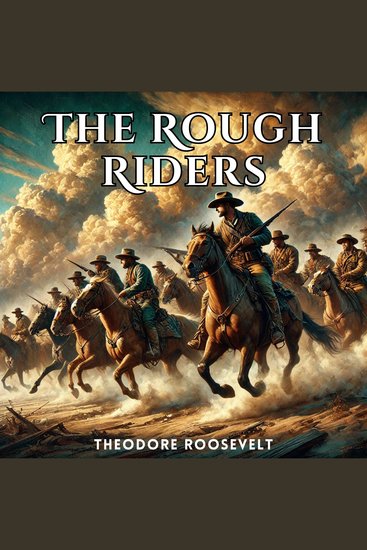
    Experience history in the making with Theodore Roosevelt’s The Rough Riders, a vivid and personal account of one of the most famous military regiments in American history. Roosevelt recounts the formation, training, and dramatic exploits of the Rough Riders, a volunteer cavalry unit that played a pivotal role in the Spanish-American War. From their recruitment of cowboys, miners, and Ivy League athletes to their heroic charge up San Juan Hill, Roosevelt’s firsthand narrative captures the courage, camaraderie, and chaos of battle with unmatched detail and passion. 
    Blending historical insight with Roosevelt’s unmistakable charisma, The Rough Riders is more than a war memoir—it’s a testament to the enduring spirit of American determination and leadership. Narrated with vigor and authenticity, this audiobook immerses listeners in the grit and glory of a defining moment in U.S. history. 
    Start listening to The Rough Riders today and march alongside one of America’s greatest leaders in his journey from soldier to statesman.
    Voir livre
  • Boring History Facts for Sleep - cover

    Boring History Facts for Sleep

    Soothing Knowledge

    • 0
    • 0
    • 0
    Settle down for the night with a calm journey through the quieter side of history. This audiobook shares simple, straightforward historical facts chosen to soothe the mind rather than stir it. Each fact is presented in a slow, steady tone, making it easy to let your thoughts drift away from daily worries. 
    You’ll hear about ancient empires, forgotten inventions, old customs, and small but fascinating details from different eras. These stories don’t demand attention or spark excitement. Instead, they serve as a gentle background, helping you ease into a peaceful state that supports natural sleep. 
    By focusing on plain details and simple narratives, the audiobook encourages your mind to slow down. The steady rhythm of each historical note helps quiet busy thoughts and invites you to relax. Perfect for unwinding at the end of the day, it can become a comforting part of your bedtime routine.
    Voir livre
  • North of America - Loyalists Indigenous Nations and the Borders of the Long American Revolution - cover

    North of America - Loyalists...

    Jeffers Lennox

    • 0
    • 0
    • 0
    The story of the Thirteen Colonies' struggle for independence from Britain is well known to every American schoolchild. But at the start of the Revolutionary War, there were more than thirteen British colonies in North America. Patriots were surrounded by Indigenous homelands and loyal provinces. Independence had its limits. 


    Upper Canada, Lower Canada, New Brunswick, Nova Scotia, Newfoundland, and especially the homelands that straddled colonial borders, were far less foreign to the men and women who established the United States than Canada is to those who live here now. These northern neighbors were far from inactive during the Revolution. The participation of the loyal British provinces and Indigenous nations that largely rejected the Revolution—as antagonists, opponents, or bystanders—shaped the progress of the conflict and influenced the American nation's early development. 


    In this book, historian Jeffers Lennox looks north, as so many Americans at that time did, and describes how Loyalists and Indigenous leaders frustrated Patriot ambitions, defended their territory, and acted as midwives to the birth of the United States while restricting and redirecting its continental aspirations.
    Voir livre
  • The Story of Witches - Folklore History and Superstition - cover

    The Story of Witches - Folklore...

    Willow Winsham

    • 0
    • 0
    • 0
    The witch – malevolent, magical, multi-faceted - has walked among us for centuries.
    Demonic and deviant or liberated and revered, in this enchantingly illustrated book, Willow Winsham explores the many guises of the witch across folklore, history and superstition.
    From Hekate to Baba Yaga, from shape-shifting hares to Macbeth, the book starts with a rich dive into the ideas of the witch in myth, legend and fairytale. Next follows an exploration of popular belief and superstition during the witch trials across Europe and the United States, one of the most tumultuous and bloody of our collective history. The last section brings us to more recent times, exploring how how the image and identity of the witch has been reclaimed and reinvented, the significance of the Wheel of the Year, the advent of Wicca and modern Witchcraft and beyond.
    Finally and most crucially, we are left with the vital question: what have we learned from the past and what is the best way to approach our – often terrible – shared history of the witch?
    Voir livre
  • The Comeback of Industrial Policy - The Next Geopolitical Great Game - cover

    The Comeback of Industrial...

    Alessandro Gili, Davide Tentori

    • 0
    • 0
    • 0
    Industrial policies are the key element underlying today's geopolitical scramble and a pillar of national security.
    Reacting to Western weaknesses and bottlenecks in the global supply chains, highlighted by multiple shocks such as the pandemic, the war in Ukraine, and the recent Israel-Hamas war, the US in first place and the EU later have started to introduce new industrial legislation aimed at making up for lost ground with respect to other industrial
    powerhouses, such as China. Besides being policy tools to accelerate the green and digital transitions, however, the US Inflation Reduction Act and the Net Zero Industry Act, as well as the US and the EU Chips Acts, entail subsidies, local content requirements and export controls targeted at strengthening the domestic industrial base for critical technologies, fostering strategic autonomy and de-risking from excessive foreign dependencies.
    This race poses risks for the weaponisation of industrial policies and fragmentation of international trade and also potentially jeopardises technological development. How can we strike a balance between economic security and efficiency? Which sectors are the most critical and which ones are the leading global powers pursuing? What will the consequences be for global value chains and international trade? Is it possible to reach an agreement on rules for a new level playing field to prevent economic competition turning into economic warfare?
    Voir livre