Begleiten Sie uns auf eine literarische Weltreise!
Buch zum Bücherregal hinzufügen
Grey
Einen neuen Kommentar schreiben Default profile 50px
Grey
Jetzt das ganze Buch im Abo oder die ersten Seiten gratis lesen!
All characters reduced
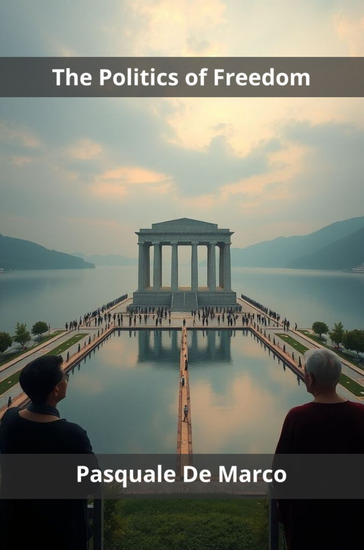
The Politics of Freedom - cover

The Politics of Freedom

Pasquale De Marco

Verlag: Publishdrive

  • 0
  • 0
  • 0

Beschreibung

In a world where freedom is often taken for granted, this book embarks on an intellectual journey to explore its profound significance and the challenges it faces in the modern era. With a comprehensive examination of the concept of freedom, this book offers a fresh perspective on the values that underpin free societies and the threats that confront them.

Through a historical, philosophical, and political lens, this book traces the evolution of freedom as a concept and its impact on societies throughout history. It delves into the diverse perspectives of ancient and modern thinkers, shedding light on the complexities and contradictions inherent in the pursuit of liberty.

In an era defined by globalization and interdependence, this book examines how technology, economic forces, and global governance mechanisms shape our understanding and experience of freedom. It explores the opportunities and risks presented by these interconnected systems, highlighting the need for a nuanced approach to safeguarding freedom in the 21st century.

Moreover, the book addresses the pressing threats to freedom posed by authoritarian regimes, the erosion of civil liberties, and the growing inequality that plagues societies worldwide. It analyzes these challenges and proposes strategies for preserving and expanding freedom in the face of adversity.

With a focus on empowering readers to engage in meaningful conversations about the future of freedom, this book provides a timely and thought-provoking exploration of one of humanity's most cherished values. It is an essential read for anyone seeking a deeper understanding of the foundations of freedom and the responsibilities we bear as citizens to protect and nurture it.

Join the journey to unravel the complexities of freedom and discover how we can work together to build a more just, equitable, and free world for generations to come.


If you like this book, write a review!
Verfügbar seit: 02.06.2025.
Drucklänge: 167 Seiten.


Weitere Bücher, die Sie mögen werden

  • Mayan Myths and Legends - Exploring the Spiritual World of the Maya - cover

    Mayan Myths and Legends -...

    Odessa Nightshade

    • 0
    • 0
    • 0
    The Maya civilization is one of the most enigmatic and awe-inspiring cultures of the ancient world. Flourishing for thousands of years in the dense jungles of Mesoamerica, the Maya built vast cities, developed a sophisticated writing system, and mapped the heavens with astonishing accuracy. Yet, beyond their architectural and scientific achievements, the Maya were a deeply spiritual people, weaving a rich tapestry of myths, legends, and sacred beliefs that connected them to the cosmos. Their mythology was not mere storytelling—it was a living force, shaping their rituals, governance, and daily existence.  
    At the heart of Maya spirituality was a complex pantheon of gods and supernatural beings, each governing different aspects of life, death, and the afterlife. Unlike many Western traditions that separate the divine from the earthly realm, the Maya believed that the gods were intimately involved in every facet of existence. Deities such as Itzamná, the creator god, and Chaac, the bringer of rain, were both revered and feared, their influence reflected in ceremonies, offerings, and astronomical observations. The legendary Popol Vuh, often referred to as the “Maya Bible,” preserved many of these sacred stories, including the epic journey of the Hero Twins, Hunahpú and Xbalanqué, who overcame the lords of the underworld, Xibalba, to restore cosmic order.  
    Maya mythology was deeply intertwined with their concept of time and destiny. Their intricate calendar system, which included the Tzolk’in (a sacred 260-day calendar) and the Long Count, was not merely a tool for marking days but a means of understanding cosmic cycles and divine will. Priests and scribes interpreted these calendars to determine auspicious dates for everything from coronations to warfare. Prophecies and celestial events were seen as messages from the gods, guiding the fate of individuals and entire kingdoms. 
    Zum Buch
  • Birmingham Campaign The: The History of the SCLC’s Non-Violent Protests in Alabama’s Biggest City - cover

    Birmingham Campaign The: The...

    Editors Charles River

    • 0
    • 0
    • 0
    Today every American is taught about watershed moments in the history of minorities’ struggles for civil rights over the course of American history: the Civil War, Brown v. Board of Education, Rosa Parks’ refusal to give up her seat, Dr. Martin Luther King, Jr.’s “I Have a Dream” speech, and the passage of the Civil Rights Act of 1964. Indeed, the use of the phrase “Civil Rights Movement” in America today almost invariably refers to the period of time from 1954-1964. 
    	However, the Civil Rights Movement actually came into existence long before it is presumed to have done so. The movement's primary work was slow, evolving, gradual and long-term. Its more glamorous moments, such as the Montgomery Bus Boycott (1955–1956), the Selma to Montgomery March (1965), and the March on Washington (1963), mainly were supplemental to the all-important grassroots work already going on in communities, churches, legislatures, and courts. The nascent stages of the movement actually began far earlier, among abolitionists and the writings and activism of Frederick Douglass and others.  
    	Beginning in the summer of 1962, King and the Southern Christian Leadership Conference (SCLC) began to express interest in targeting one of the South's most brutally segregated cities. Nicknamed “Bombingham,” the city had witnessed the bombing of over a dozen black homes and churches in the previous five years. A victory in Birmingham was a goal that would embolden the Civil Rights Movement like never before.
    Zum Buch
  • The Truht Is in Love - cover

    The Truht Is in Love

    Sergiy Zhuravlov

    • 0
    • 0
    • 0
    The narrative is based on real events during the unification of Spain. Spain, led by Ferdinand the Second and Isabella of Castile, soared to the height of its power. The policy of the cunning king bore rich fruit. The whole country was taken away from the king of Portugal. By deceit the southern fiefdoms were cut off from France. The master of southern Europe and northern Africa he - King Ferdinand, or rather by his hands and the instruction of Isabella, brought out of slumber and made all-powerful "Manu interpida" - the Inquisition. And now this mechanism was bringing into the king's treasury, first one-third, and now more than two-thirds of all the confiscated goods. And henceforth no one, whether grandee, marquis, or prince, could feel safe. Forsaken, beware - they are coming for you! Young Merinda, who did not wish to become Esteban Junior's mistress, was thrown into prison. Esteban the elder - the second man after the king - so wished. The sentence is ready, all that is left is to disfigure the maiden and then burn her at the stake. But something goes wrong. Fernando, an incorruptible knight of the Hospitaller Order, is in charge of the case. An obvious lie, not proof of guilt. All turn against Fernando the Inquisitor. Fernando has no choice but to save the girl at the cost of his career and even his life. He flees from pursuit along with Merinda. The couple is put on the wanted list. Whoever shelters or helps the fugitives ends up behind bars himself. The new inquisitor hires an assassin to find and kill the fugitives without publicity. The former favourite of the King of Spain, the Countess of Alba, writes a letter to his Highness and admits that she bore his daughter in secret. She asks the King for help in finding her daughter who has disappeared. The King entrusts his confidant, the Marquis Diego, with the task. The Marquis finds the trail - the King and Countess´ daughter is none other than Merinda! The King dismisses the false accusation. But the Inquisition's Purgatory flywheel is unwound. Merinda and Fernando are driven into the mountains and their doom is certain. The pair stand on a precipice above a precipice. The crossbowmen have them in their sights. The Marquis gets there in time. He stops the execution. He untwists the chain of false witnesses. This leads him to plot against the king. He writes a letter to the king and sends it with a messenger. On the way the messenger stops for a drink of water and water for his horse. He is killed by an assassin hired by the Inquisition. He reads the letter and sells it to the conspirators. He then sells the information to the Marquis that the conspirators have intercepted the letter. The Marquis learns through his agents that Admiral Esteban and his goons have followed the trail of Merinda and Fernando and wish to kill everyone. The plot is averted. The King accepts a payoff from the repentant accomplices. It turns out the murderer is not dead from the poison, seeking a meeting with the Marquis for revenge. Such a moment arrives. The Marquis is stunned. A lung is punctured. Merinda dismisses the court physicians. She saves the Marquis´ life herself with the help of herbal infusions and extracts of mould. Merynda is slandered by the physicians as a sorceress. The Queen throws the young Countess into prison. The King himself is powerless against the Queen. Merinda´s death is imminent. But then, passing through the cheering crowd of the townspeople, the King is tried to be killed by his old hater. The wound seems trifling. But after twenty-four hours, the king is taken ill and falls into unconsciousness. The queen realises that the court physicians are powerless, and so are the prayers. She decides to enlist Merinda's help. Nothing is more important to the king's daughter than saving her father's life. Two weeks later, the king is back on his feet. The queen is pleased with the king's recovery, but still wants to get rid of Merinda...
    Zum Buch
  • Foundations of the French Revolution - The Early Struggles for Change (3 in 1) - cover

    Foundations of the French...

    Amara Blackwood

    • 0
    • 0
    • 0
    This collection explores the early stages of the French Revolution, beginning with the calling of the Estates General—a rare and symbolic event that revealed deep societal fractures in 18th-century France. 
    The journey continues through the formation of the National Assembly, a bold move by the Third Estate that challenged the established order and set the groundwork for revolutionary governance. Finally, the book examines the Declaration of the Rights of Man and of the Citizen, a radical document that redefined liberty, equality, and the role of the individual in society. 
    Together, these three parts provide a powerful narrative of political awakening, civil resistance, and the birth of modern democratic ideals. Perfect for history lovers, students, and anyone curious about how ideas can reshape entire civilizations.
    Zum Buch
  • The Good Captain - A Personal Memoir of America at War - cover

    The Good Captain - A Personal...

    R.D. Hooker

    • 0
    • 0
    • 0
    The veteran soldier, Pentagon advisor and White House staffer recounts his long and distinguished military career in this acclaimed memoir. 
     
    A combat soldier and leader in five wars, R. D. Hooker also served as a White House staff member in four different administrations. He retired in 2010 as the most decorated colonel in the US Army. Beginning with his enlistment at 18 in 1975, this memoir chronicles his experiences in the post-Vietnam Army as a young paratrooper, West Point cadet, and combatant in the many military conflicts which followed.  
     
    Hooker served in Grenada, Somalia. Rwanda, Bosnia, and Kosovo. He played a key role in the response to 9/11 and returned to combat in Iraq and Afghanistan. He commanded a paratroop company, battalion and brigade and served in the continental US, Latin America, Europe, the Middle East, Africa and Southwest Asia. When not deployed, he taught at West Point and served in several high-level Pentagon assignments and in the White House in the administrations of George H. W. Bush, Bill Clinton, George W. Bush and Donald Trump. 
     
    In The Good Captain, Hooker recounts his storied career with insights and lessons learned through five different conflicts. He also describes each of these campaigns from a strategic and policy perspective informed by his White House and Pentagon experiences as well as years of academic training.
    Zum Buch
  • Map Addict: The Bestselling Tale of an Obsession - cover

    Map Addict: The Bestselling Tale...

    Mike Parker

    • 0
    • 0
    • 0
    'My name is Mike and I am a map addict. There, it's said…' 
    Maps not only show the world, they help it turn. On an average day, we will consult some form of map approximately a dozen times, often without even noticing: checking the A-Z, the road atlas or the Sat Nav, scanning the tube or bus map, a quick Google online or hours wasted flying over a virtual Earth, navigating a way around a shopping centre, watching the weather forecast, planning a walk or a trip, catching up on the news, booking a holiday or hotel. Maps pepper logos, advertisements, illustrations, books, web pages and newspaper and magazine articles: they are a cipher for every area of human existence. At a stroke, they convey precise information about topography, layout, history, politics and power. They are the unsung heroes of life: Map Addict sings their song. 
    There are some fine, dry tomes out there about the history and development of cartography: this is not one of them. Map Addict mixes wry observation with hard fact and considerable research, unearthing the offbeat, the unusual and the downright pedantic in a celebration of all things maps. In Map Addict, we learn the location of what has officially been named by the OS as the most boring square kilometre in the land; we visit the town fractured into dozens of little parcels of land split between two different countries and trek around many other weird borders of Britain and Europe; we test the theories that the new city of Milton Keynes was built to a pagan alignment and that women can't read maps. Combining history, travel, politics, memoir and oblique observation in a highly readable, and often very funny, style, Mike Parker confesses how his own impressive map collection was founded on a virulent teenage shoplifting habit, ponders how a good leftie can be so gung-ho about British cartographic imperialism and wages a one-man war against the moronic blandishments of the Sat Nav age. 
    Mike Parker's Map Addict is a non-fiction book that combines science, humour, and travelogues to provide a unique perspective on geography and culture. His essays are both historical and social, making this a popular choice among readers. 
    For fans of Tom Bullough (Sarn Helen), Gavin Ortlund (Why God Makes Sense in a World That Doesn't), Tim Hannigan (The Granite Kingdom), Chloe Dalton (Raising Hare), and Samantha Harvey (The Shapeless Unease). 
    HarperCollins 2023
    Zum Buch