Begleiten Sie uns auf eine literarische Weltreise!
Buch zum Bücherregal hinzufügen
Grey
Einen neuen Kommentar schreiben Default profile 50px
Grey
Jetzt das ganze Buch im Abo oder die ersten Seiten gratis lesen!
All characters reduced
The Paradigm Shift in Language Education - cover

The Paradigm Shift in Language Education

Pasquale De Marco

Verlag: Publishdrive

  • 0
  • 0
  • 0

Beschreibung

In a world where communication and collaboration across borders are essential, language education has never been more important. This comprehensive guide provides a roadmap for navigating the challenges and opportunities of language teaching in the 21st century.

Drawing on the latest research and best practices, this book offers a critical examination of the key issues and challenges in language education today. It explores the complex interplay between language, culture, and learning, and provides practical strategies for creating inclusive and effective learning environments.

With its engaging and accessible discussions, this book is an invaluable resource for language educators of all levels, from seasoned teachers to those new to the field. It offers insights into the cognitive and affective processes of language learning, the role of motivation and individual differences, and the importance of using authentic materials and integrating language and content.

The book also examines the changing role of technology in language learning, the assessment of language skills, and the importance of cultural competence. It emphasizes the need for reflective practice and action research, and provides guidance on how to become a reflective language teacher.

Through its insightful analysis and practical guidance, this book will inspire language educators to create learning experiences that are meaningful, engaging, and transformative. It is a must-read for anyone who wants to help learners communicate effectively, navigate diverse cultural contexts, and thrive in a globalized world.


If you like this book, write a review!
Verfügbar seit: 02.06.2025.
Drucklänge: 156 Seiten.

Weitere Bücher, die Sie mögen werden

  • Fighting After the War: A History of the Most Famous American Battles that Took Place after the Wars Had Ended - cover

    Fighting After the War: A...

    Editors Charles River

    • 0
    • 0
    • 0
    There are countless examples of battles that take place in wars after a peace treaty is signed. The last battle of the Civil War was a skirmish in Texas that Confederate forces won, nearly a month after Lee’s surrender at Appomattox. As fate would have it, the last fighting of the Civil War took place two days after Confederate President Jefferson Davis had been captured in Georgia 
    It’s certainly rare for the most famous battle of a war to take place after the peace treaty is signed, but luckily for Andrew Jackson, the War of 1812 was that unique exception. Less than a year after his victory in the Battle of Horseshoe Creek, Jackson led his forces into a more important battle at the Battle of New Orleans. The British hoped to grab as much of the land on the western frontier as they could, especially New Orleans, which had a prominent position on the Mississippi River for trading. With more than 8,000 soldiers aboard a British fleet sailing in from Jamaica in early January 1815, the attack on New Orleans promised to be a significant one, while Jackson’s men defended New Orleans with about half that number. This went on despite the fact that the two sides had signed the Treaty of Ghent on Christmas Eve 1814, which was supposed to end the war.  
    Despite the fact the French & Indian War had recently concluded, Pontiac led the first major attack of Pontiac’s War in May 1763, when he and 300 of his men attacked Fort Detroit in what is now the city by the same name. Unfortunately for his cause, Pontiac failed to gauge just how strong the British presence there was, and his attack was quickly repelled. On the other hand, he was not a man who gave up easily, so instead of retreating, he and his warriors would lay siege to the British stronghold. In the days that followed, word spread of his efforts, and in short order nearly 1,000 men from various tribes in the area had joined him.
    Zum Buch
  • Nazi Mind Control - cover

    Nazi Mind Control

    Raphael Terra

    • 0
    • 0
    • 0
    This audiobook has been recorded using Text to speech (TTS). 
     
    In the 1930's an entire nation was brainwashed. It was manipulated by masters of propaganda and the arcane arts. The result was the deaths of millions of people. The world was changed in just a few short years. 
     
    The men behind this massive scheme were members of the most evil and vile of political parties ever to have existed. We know them as the Nazis. 
     
    Their purpose was to bring about the rise of a so-called Aryan race. A race that would rule the world for a thousand years. This would be the third reich. 
     
    In-order to see the fulfilment of their grand scheme they needed to eradicate certain races from the globe and subjugate others. In-order to achieve this, they needed millions of people to believe and follow them and only them. And so they created a messiah, a God on Earth. His name was Adolf Hitler and he would become the master of manipulating the hearts and souls of man. 
     
    From mass hypnosis to blatant propaganda, from control of the media to eradicating the opposition. All methods were employed. 
     
    This is the story of how that incredible goal was actually brought to fruition and the methods used to control the minds of men. This is the story of Nazi Propaganda.
    Zum Buch
  • Loch Ness Monster The: The History and Legacy of the World’s Most Famous Cryptid - cover

    Loch Ness Monster The: The...

    Editors Charles River

    • 0
    • 0
    • 0
    Although cryptozoology is often scoffed at and widely considered a pseudoscience, one of the reasons it made men like Barnum rich and continues to fascinate people today is the fact that people realize they’ve only scratched the surface when it comes to identifying all the different forms of life on Earth. As Martin DelRio pointed out in The Loch Ness Monster, “Animals previously unknown to science have been found more than once in the past hundred years. For instance, there's the megamouth shark (megachasma pelagios), a fifteen-foot-long creature weighing nearly a ton. The first specimen was discovered on November 15, 1976, when it was found entangled in the drag anchor of a U.S. Navy ship. The new creature wasn't described scientifically until 1983…The megamouth remains the only species in its genus, and the only genus in its order.”  
    	While cryptids like Bigfoot and the Yeti have become popular in recent decades, none of them can touch the notoriety of the Loch Ness Monster, a large, unknown creature allegedly living in a loch in the Highlands of Scotland. Was it a relic dinosaur or perhaps an entirely new species? New photographs and new eyewitness sightings fueled a growing debate and transformed the Loch Ness Monster, also known as Nessie, into an instantly recognizable staple of pop culture, to the extent that hundreds of thousands of visitors came to Loch Ness every year in hopes of catching a glimpse of the loch’s famous inhabitant.  
    	The Loch Ness Monster remains an international brand and the best-known cryptid in the world, but after almost 100 years of fame and media attention, what do people really know about this cryptid, and is there any proof that there really is something large and unknown living in a remote Scottish loch? 
    Zum Buch
  • The Return of the State - And Why It Is Essential for Our Health Wealth and Happiness - cover

    The Return of the State - And...

    Graeme Garrard

    • 0
    • 0
    • 0
    A vigorous and timely defense of the state as a force for good 
    For decades now wealth and power have been shifting from states to markets. This experiment has been a failure for all but a privileged few. But this trend is beginning to reverse, accelerated by the COVID-19 pandemic, which has seen the state play the most direct and positive role in citizens’ everyday lives in living memory. 
    Graeme Garrard makes a powerful case for the state as our only realistic hope of countering the rising power of multinational corporations, organized crime, and international organizations that will always put their own interests first. Today, the state is essential to the health and welfare of everyone except the rich and powerful. Yet it is being rolled back and whittled away, leaving the well-being of most of us at the mercy of unaccountable private powers that are increasingly free from external control. As Garrard shows, the state is the only realistic way of promoting the public good in our time.
    Zum Buch
  • Once We Were Slaves - The Extraordinary Journey of a Multiracial Jewish Family - cover

    Once We Were Slaves - The...

    Laura Arnold Leibman

    • 0
    • 0
    • 0
    An obsessive genealogist and descendent of one of the most prominent Jewish families since the American Revolution, Blanche Moses firmly believed her maternal ancestors were Sephardic grandees. Yet she found herself at a dead end when it came to her grandmother's maternal line. Using family heirlooms to unlock the mystery of Moses's ancestors, Once We Were Slaves overturns the reclusive heiress's assumptions about her family history to reveal that her grandmother and great-uncle, Sarah and Isaac Brandon, actually began their lives as poor Christian slaves in Barbados. Tracing the siblings' extraordinary journey throughout the Atlantic World, Leibman examines artifacts they left behind in Barbados, Suriname, London, Philadelphia, and, finally, New York, to show how Sarah and Isaac were able to transform themselves and their lives, becoming free, wealthy, Jewish, and—at times—white. While their affluence made them unusual, their story mirrors that of the largely forgotten population of mixed African and Jewish ancestry that constituted as much as ten percent of the Jewish communities in which the siblings lived, and sheds new light on the fluidity of race—as well as on the role of religion in racial shift—in the first half of the nineteenth century.
    Zum Buch
  • Hitler's Spanish Legion - The Blue Division in Russia in WWII - cover

    Hitler's Spanish Legion - The...

    Gerald R Kleinfeld

    • 0
    • 0
    • 0
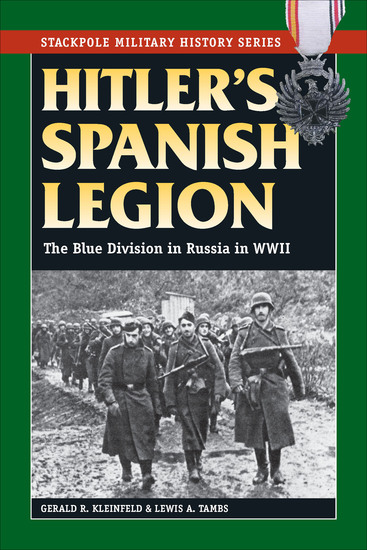
    A history of the 47,000 Spanish soldiers who volunteered to fight for Hitler in Russia during World War II. Although Spain claimed neutrality during World War II, 47,000 Spaniards volunteered to fight on behalf of the Third Reich. Known as the Blue Division, they battled the Soviets on the Eastern Front and played a key role in the pivotal siege of Leningrad. Set apart from the Wehrmacht by stark differences in culture, tactics, and command structure, these volunteers fought—many of them to the death—with courage and tenacity against strong opposition, extreme temperatures, and insufficient supplies for what they believed was their chance to secure Spain’s place in a new and changing Europe.
    Zum Buch