Rejoignez-nous pour un voyage dans le monde des livres!
Ajouter ce livre à l'électronique
Grey
Ecrivez un nouveau commentaire Default profile 50px
Grey
Abonnez-vous pour lire le livre complet ou lisez les premières pages gratuitement!
All characters reduced
The Evolutionary Roots of Cooperation - cover

The Evolutionary Roots of Cooperation

Pasquale De Marco

Maison d'édition: Publishdrive

  • 0
  • 0
  • 0

Synopsis

Cooperation is a fundamental part of human nature. We rely on each other for food, shelter, and protection. We work together to build communities, raise families, and achieve common goals. But how did cooperation evolve? Why are we so willing to help others, even at a cost to ourselves?

This book explores the evolutionary roots of cooperation. Drawing on the latest research in biology, psychology, and anthropology, it provides a comprehensive understanding of why we cooperate and how cooperation has shaped human history.

The book begins by examining the biological foundations of cooperation. It shows how our brains and bodies are wired for cooperation. It also discusses the role of emotions, hormones, and genes in promoting cooperative behavior.

The book then turns to the evolutionary origins of cooperation. It examines the role of kin selection, reciprocal altruism, and group selection in the evolution of cooperative behavior. It also discusses the impact of culture and institutions on cooperation.

Finally, the book considers the challenges to cooperation in the 21st century. It discusses the impact of technology, globalization, and inequality on cooperation. It also explores the role of education and the media in promoting cooperation.

**The Evolutionary Roots of Cooperation** is a groundbreaking book that provides a new understanding of cooperation. It is essential reading for anyone who wants to understand human nature and build a more cooperative world.


If you like this book, write a review!
Disponible depuis: 02/06/2025.
Longueur d'impression: 165 pages.

D'autres livres qui pourraient vous intéresser

  • Nobody Is Protected - How the Border Patrol Became the Most Dangerous Police Force in the United States - cover

    Nobody Is Protected - How the...

    Reece Jones

    • 0
    • 0
    • 0
    Late one July night in 2020, armed men, identified only by the word POLICE written across their uniforms, began snatching supporters of Black Lives Matter off the street in Portland, Oregon, and placing them in unmarked vans. These mysterious actions were not carried out by local law enforcement or even right-wing terrorists, but by the US Border Patrol. Why was the Border Patrol operating so far from the boundaries of the United States? What were they doing at a protest that had nothing to do with immigration or the border? 


    Nobody Is Protected: How the Border Patrol Became the Most Dangerous Police Force in the United States is the untold story of how, through a series of landmark but largely unknown decisions, the Supreme Court has dramatically curtailed the Fourth Amendment of the Constitution in service of policing borders. The Border Patrol exercises exceptional powers to conduct warrantless stops and interrogations within one hundred miles of land borders or coastlines, an area that includes nine of the ten largest cities and two thirds of the American population. 


    Mapping the Border Patrol's history from its bigoted and violent Wild West beginnings through the legal precedents that have unleashed today's militarized force, Reece Jones reveals the shocking true stories and characters behind its most dangerous policies.
    Voir livre
  • A Rare Recording of Lenin Trotsky and Stalin - cover

    A Rare Recording of Lenin...

    Josef Stalin, Leon Trotsky,...

    • 0
    • 0
    • 0
    Vladimir Lenin (April 22, 1870 - January 21, 1924) was a Russian revolutionary, politician and political theorist who was the founder and first head of government of Soviet Russia from 1917 until his death in 1924, and of the Soviet Union from 1922 until his death. The founder and leader of the Bolsheviks, Lenin led the October Revolution which established the world's first socialist state. His government won the Russian Civil War and consolidated power in a one-party state under the Communist Party. 


    Leon Trotsky (November 7, 1879 - August 21, 1940) was a Russian revolutionary, politician, and political theorist. He was a central figure in the 1905 Revolution, October Revolution, Russian Civil War, and establishment of the Soviet Union. Trotsky and Vladimir Lenin were widely considered the two most prominent Soviet figures, and Trotsky was "de facto" second-in-command during the early years of the Russian Soviet Republic.


    Josef Stalin, December 18, 1878 - March 5, 1953, was a Georgian revolutionary and Soviet politician who ruled the Soviet Union from the mid-1920s until his death in 1953. He served as the general secretary of the Communist Party of the Soviet Union from 1922 to 1952 and premier of the Soviet Union from 1941 to 1953. Despite initially governing the Soviet Union as part of a collective leadership, he eventually consolidated power to become the country's de facto dictator by the 1930s, and his policies became known as Stalinism.
    Voir livre
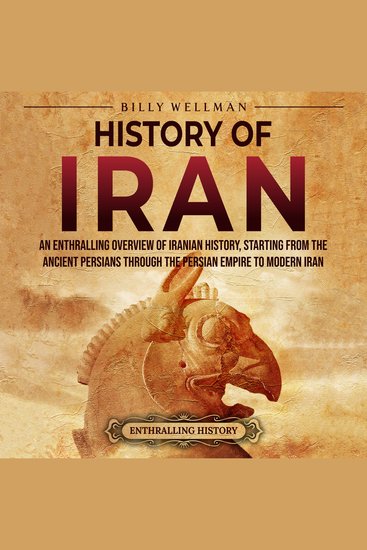
  • History of Iran: An Enthralling Overview of Iranian History Starting from the Ancient Persians through the Persian Empire to Modern Iran - cover

    History of Iran: An Enthralling...

    Billy Wellman

    • 0
    • 0
    • 0
    Full of exciting events, memorable actors, bloody conflicts, and thriving cultural accomplishments, the history of Iran is a pleasure to dive into for any curious mind. 
    From the prehistoric ages to the modern Islamic Republic, Iran has always maintained its prevalent position in history as one of the most vibrant, distinct, and diverse countries in the world. 
    Located in western Asia, sandwiched between the Caspian Sea and the Persian Gulf, the mountainous regions of the Zagros Mountains have long been home to a civilization whose marvelous development throughout history is like no other. 
    This audiobook seeks to explore the rich history of Iran, all the way from the first Iranian peoples to the creation of the modern nation-state we know today. It analyzes the transformation of the region’s inhabitants from a primitive society to a world superpower to a country centered around strong religious principles and beliefs. 
    Here’s just a small portion of what you will discover in this audiobook:Detailed descriptions of Iran’s demography, culture, and physical and political geographiesHistory of the first Iranian civilizations before 1000 BCEAn in-depth look at the rise and fall of different powerful dynasties in the ancient and early medieval periodsA journey through the Muslim Arab domination and the emergence of Islam as the prominent faithThe age of various empires until the early modern timesThe Qajar and Pahlavi monarchies and the birth of the Iranian nation-stateThe triumph of the Islamic Revolution under Ruhollah KhomeiniAnd much, much more! 
    Click the “add to cart” button to begin learning more about Iran today!
    Voir livre
  • Advent of Early Modern Warfare The: The History of the Transition from Medieval Military Tactics to the Age of Gunpowder - cover

    Advent of Early Modern Warfare...

    Editors Charles River

    • 0
    • 0
    • 0
    In the time period between the fall of Rome and the spread of the Renaissance across the European continent, many of today’s European nations were formed, the Catholic Church rose to great prominence, some of history’s most famous wars occurred, and a social class system was instituted that lasted over 1,000 years. A lot of activity took place during a period frequently labeled derogatively as the “Dark Ages,” and while that period of time is mostly referred to as the “Middle Ages” instead of the Dark Ages today, it has still retained the stigma of being a sort of lost period of time in which Western civilization made no worthwhile progress.  
    	If anything, the one aspect of the Middle Ages that has been romanticized is medieval warfare. Indeed, the Middle Ages have long sparked people’s imaginations thanks to imagery of armored knights battling on horseback and armies of men trying to breach the walls of formidable castles. What is generally forgotten is that medieval warfare was constantly adapting to the times as leaders adopted new techniques and technology, and common infantry became increasingly important throughout the period. Starting around 1000 CE, there was a gradual consolidation of power in the region after the fragmentation of the Early Middle Ages, and it brought about the rise of more centralized states that could field large armies. The Normans, one of the first groups to do this, were notable for their discipline and organization, and it’s little surprise that they were the last foreigners to successfully invade Britain under William the Conqueror in the mid 11th century.  
    	Meanwhile, political and technological progress led to continuous change of tactics and equipment. Cavalry became ascendant, only to be later replaced by infantry as their weapons improved. By the end of the period, warfare was radically changing thanks to the rise of gunpowder weapons such as the handgun and the bombard. 
    Voir livre
  • A Journey Through America - Patriotic Observations and Commentary - cover

    A Journey Through America -...

    Lawrence Kadish

    • 0
    • 0
    • 0
    A Journey Through America introduces insightful commentary on our American democracy. Author Lawrence Kadish draws from over eighty-five years of lived experience, allowing him to celebrate our nation's strengths, reflect on our self-inflicted errors, and draw attention to the challenges of a nation that remains humanity's last hope. 


    An astute and insightful observer of our nation's political experience, Lawrence Kadish draws on his decades of advocacy on behalf of a nation he loves to advance its founding principles. A Journey Through America offers cautionary advice, inspiring words, and a reminder that a great nation needs to remain strong and united in the face of challenges from within and abroad.
    Voir livre
  • Landslide - The inside story of the 2024 election - cover

    Landslide - The inside story of...

    Tim Ross, Rachel Wearmouth

    • 0
    • 0
    • 0
    On 22 May 2024, Rishi Sunak stood outside 10 Downing Street and announced an early election, in an attempt to catch his opponents by surprise. Just minutes later, Tory hearts sank, with images of the Prime Minister soaking in the rain instantly defining his hapless campaign. The next six weeks delivered more mistakes, a betting scandal, apocalyptic Tory polls, bitter backroom arguments and finally the worst result in the Conservative Party's 190-year history.
    Keir Starmer's Labour, meanwhile, stormed to victory with one of the biggest landslides on record after fourteen years in the wilderness. But the party won with its fewest votes in almost a decade, raising questions about how popular Starmer really was. Scotland's voters abandoned the SNP, Ed Davey's Lib Dems surged to their best election ever and Nigel Farage once again blew up the Conservative Party's plans.
    This gripping account by seasoned Westminster journalists Tim Ross and Rachel Wearmouth tells the full inside story of the key tactics and powerful forces that delivered the most seismic upheaval in a generation. What role did Starmer's character play in his party's success? How did Labour's election machine engineer such a devastatingly efficient vote? Was there anything Sunak could have done to avert disaster? What does it all mean for the future of Britain?
    Blending exclusive interviews and explosive accounts from key players, Landslide sets out to answer these questions and more, revealing a dramatic and sometimes disturbing picture of British politics at a turbulent time.
    Voir livre