Rejoignez-nous pour un voyage dans le monde des livres!
Ajouter ce livre à l'électronique
Grey
Ecrivez un nouveau commentaire Default profile 50px
Grey
Abonnez-vous pour lire le livre complet ou lisez les premières pages gratuitement!
All characters reduced
The Circle of Concepts - cover

The Circle of Concepts

Pasquale De Marco

Maison d'édition: Publishdrive

  • 0
  • 0
  • 0

Synopsis

In a world divided by political ideologies, "The Circle of Concepts: Understanding Liberalism and Conservatism" emerges as an illuminating guide to navigate the complex landscape of political thought. This comprehensive book delves into the core principles, historical roots, and philosophical foundations of liberalism and conservatism, providing readers with a deeper understanding of these influential ideologies.

With thought-provoking analysis and accessible language, "The Circle of Concepts" unravels the intricate tapestry of liberalism and conservatism. It explores the great debates that have shaped these ideologies, from the role of government and social issues to economic inequality and foreign policy. The book also examines the impact of liberalism and conservatism on society, tracing their influence on historical events, political movements, and cultural shifts.

More than just a theoretical exploration, "The Circle of Concepts" examines the practical implications of liberalism and conservatism in action. It delves into the policies and programs that have been implemented under liberal and conservative governments, highlighting their successes and failures. The book also investigates the challenges facing these ideologies in the 21st century, including the rise of populism, the impact of globalization, and the urgency of climate change.

With a keen eye for detail and a commitment to intellectual rigor, "The Circle of Concepts" offers a comprehensive overview of liberalism and conservatism. It is an indispensable resource for students, scholars, and anyone seeking to understand the forces that shape our political landscape. Whether you identify as a liberal, a conservative, or something in between, this book provides the tools to engage in informed and nuanced discussions about the future of our society.

"The Circle of Concepts" is more than just a book; it is an invitation to think critically about the world around us. It challenges readers to question their assumptions, consider different perspectives, and appreciate the complexity of political thought. By fostering a deeper understanding of liberalism and conservatism, this book empowers readers to become more informed and engaged citizens, capable of navigating the ever-changing landscape of politics with knowledge and empathy.


If you like this book, write a review!
Disponible depuis: 02/06/2025.
Longueur d'impression: 168 pages.

D'autres livres qui pourraient vous intéresser

  • Mapping the Great Game - Explorers Spies and Maps in 19th-Century Asia - cover

    Mapping the Great Game -...

    Riaz Dean

    • 0
    • 0
    • 0
    In the 19th century, the British and Russian empires were engaged in bitter rivalry for the acquisition of Southern Asian. Although India was the ultimate prize, most of the intrigue and action took place along its northern frontier in Afghanistan, Turkestan, and Tibet. Mapping the region and gaining knowledge of the enemy were crucial to the interests of both sides. 


    The Great Trigonometrical Survey of India began in the eighteenth century with the aim of creating a detailed map of the subcontinent. Under the leadership of George Everest—whose name was later bestowed to the world's tallest mountain—it mapped the Great Arc running from the country's southern tip to the Himalayas. Much of the work was done by Indian explorers known as Pundits. They were the first to reveal the mysteries of the forbidden city of Lhasa, and discover the true course of Tibet's mighty Tsangpo River. 


    These explorers performed essential information gathering for the British Empire and filled in large portions of the map of Asia. Their adventurous exploits are vividly recounted in Mapping the Great Game.
    Voir livre
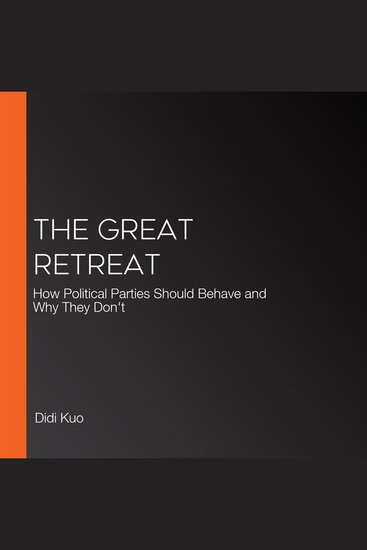
  • The Great Retreat - How Political Parties Should Behave and Why They Don't - cover

    The Great Retreat - How...

    Didi Kuo

    • 0
    • 0
    • 0
    Once a centralizing force of the democratic process, political parties have eroded over the past fifty years. Parties now rank among the most unpopular institutions in society—less trusted than business, the police, and the media. Identification with parties has plummeted, and even those who are loyal to a party report feeling that parties care more about special interests than about regular citizens. What does a "good" political party look like? Why do we urgently need them? And how do we get them? 


    The Great Retreat explores the development of political parties as democracy expanded across the West in the nineteenth century. It focuses in particular on mass parties, and the ways they served as intermediaries that fostered ties between citizens and governments. 


    For democracy to adapt to a new era of global capitalism, Kuo makes the case that we need strong intermediaries like mass parties—socially embedded institutions with deep connections to communities and citizens. Parties are essential to long-term democratic stability and economic growth, while the breakdown of party systems, on the other hand, has historically led to democratic collapse. As trust in political parties has plummeted, The Great Retreat provides a powerful defense of political parties—for without parties, democratic representation is impossible.
    Voir livre
  • Duct-tape Community - Hope for Neighborliness in an Unequal World - cover

    Duct-tape Community - Hope for...

    Jim Herbst

    • 0
    • 0
    • 0
    In a country of critics and where shouting and snarky tweets dominate public communication, neighborliness is in short supply.  Duct-tape Community - Hope for Neighborliness in an Unequal World finds it in the most unexpected places, from public housing janitors to farmers in overalls. Hope for better community can be found from the inspiring stories of the seemingly powerless and unknown. Duct-tape Community is a declaration that community takes two resolves: one to make the world a fairer place and a second to be neighborly in one that isn't.
    Voir livre
  • Beyond Neoliberalism and Neo-illiberalism - Economic Policies and Performance for Sustainable Democracy - cover

    Beyond Neoliberalism and...

    Markus Gabriel, Anna Katsman,...

    • 0
    • 0
    • 0
    In many countries, the political backlash against neoliberalism has mainly been a retreat from democracy, with a decline in independence of the judiciary and the monetary authorities, increased control of the media, and manipulation of elections for purposes of authoritarian control. The economic dynamics and the impact of neoliberalism, i.e. deregulation and liberalized markets, is just one cause of this authoritarian shift. The contributors to this volume examine the impact of neoliberal economic policies in relation to cultural and political factors and how these have promoted the recent authoritarian turn, as well as probing the economic policies and performance of the illiberal regimes.
    Voir livre
  • Humanism - Celebrating Human Potential and Values - cover

    Humanism - Celebrating Human...

    Hector Davidson

    • 0
    • 0
    • 0
    Humanism is a philosophical and ethical stance that emphasizes the value and agency of human beings, individually and collectively. At its core, humanism advocates for the belief that humans are capable of leading meaningful lives based on reason, ethics, and justice. It is grounded in the understanding that humans have the capacity for rational thought, empathy, and creativity, which are fundamental to the flourishing of individuals and societies. 
    The roots of humanism can be traced back to the classical civilizations of Greece and Rome, where the focus was on human potential and the pursuit of knowledge. However, it gained significant momentum during the Renaissance, a period marked by a renewed interest in classical antiquity and a shift away from religious dogma toward human-centered exploration. Renaissance thinkers, such as Petrarch and Erasmus, championed the importance of human dignity, education, and the ability to shape one's own destiny through knowledge and reason. These principles would later influence the development of modern humanist thought. 
    Unlike religious philosophies that place divine beings at the center of moral order, humanism is secular in nature. It does not rely on supernatural explanations or interventions, but rather promotes the idea that humans themselves are responsible for creating meaning and morality in their lives. Humanism calls for an ethical framework based on reason, scientific inquiry, and compassion, with the goal of improving human well-being and contributing to the common good.
    Voir livre
  • Five Major Reasons Africa is Poor - A Deep Introspection on the Perpetuating Factors and what we can do to Change Them - cover

    Five Major Reasons Africa is...

    Rev Walter Mwambazi

    • 0
    • 0
    • 0
    Africa is one of the oldest continents but hasn’t it struck you as absolutely odd how a continent endowed with such wealth in terms of both ground resource as well as human resource, unbelievably great weather and wonderful soil can have such unbelievably high levels of poverty? It is nothing short of preposterous. 
    What makes this worse for is the fact that 58 years later, Africa still grapples with so much challenges that make you wonder why it has taken us so long as a people to be emancipated in every way. 
    In 1963, on 1st May, leaders from all across free and colonized Africa gathered in Addis Ababa with a dream of seeing the African continent become one giant regional power. It has not happened yet – but however that does not take away the yearning every son and daughter of the soil has to see Pan Africanism materialize. 
    The purpose for this narrative by the author in this particular book is to add his voice and help ignite any smoldering rubble of broken dreams and disenchantment back to a blazing flame. 
    It is Mwambazi’s opinion that Africa has everything it needs to become the economic engine of the entire world and can and will surpass both the West and the East should its citizens awaken to their true potential. 
    Now here is the enigma, AFRICA DOESN’T NEED THE REST OF THE WORLD TO SURVIVE BUT THE WORLD NEEDS AFRICA TO SURVIVE. I believe the Second African Renaissance is upon us, but it will take A COLLECTIVE AWAKENING OF THE GIANT’S INDIVIDUAL COMPONENTS – ITS PEOPLE!
    Voir livre