Join us on a literary world trip!
Add this book to bookshelf
Grey
Write a new comment Default profile 50px
Grey
Subscribe to read the full book or read the first pages for free!
All characters reduced
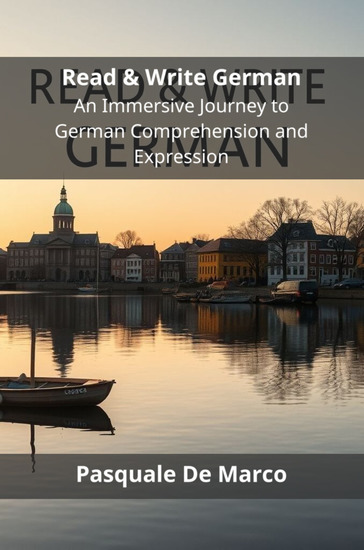
Read & Write German - An Immersive Journey to German Comprehension and Expression - cover

Read & Write German - An Immersive Journey to German Comprehension and Expression

Pasquale De Marco

Publisher: Publishdrive

  • 0
  • 0
  • 0

Summary

"Read & Write German: An Immersive Journey to German Comprehension and Expression" is the ultimate guide for language enthusiasts seeking to master the intricacies of the German language. Whether you're a complete beginner or an intermediate learner looking to refine your skills, this comprehensive resource will take you on a journey of linguistic discovery, unlocking the secrets of German grammar, vocabulary, and cultural nuances.

Within these pages, you will find a wealth of knowledge and practical guidance, meticulously organized into ten chapters that build upon each other, ensuring a smooth and progressive learning experience. Engage with interactive exercises, thought-provoking quizzes, and immersive cultural insights that bring the language to life and make the learning process both enjoyable and rewarding.

From the fundamentals of grammar and pronunciation to the complexities of sentence structure and idiomatic expressions, this book covers all aspects of the German language in a clear and accessible manner. You'll gain a solid foundation in the four key language skills: reading, writing, listening, and speaking. With each chapter, you'll expand your vocabulary, improve your fluency, and develop the confidence to communicate effectively in German.

"Read & Write German" goes beyond mere language instruction. It also delves into the rich cultural tapestry of the German-speaking world, exploring the works of renowned authors, the vibrant film and music scenes, and the traditions and perspectives that shape German society. This immersive approach provides a deeper understanding of the language and its context, fostering a genuine appreciation for German culture and heritage.

Whether your motivation is travel, business, or a love of languages, this book is your key to unlocking the world of German communication. With its comprehensive coverage, engaging activities, and cultural insights, "Read & Write German" is the perfect companion for your language-learning journey. Embark on this adventure today and discover the beauty and power of the German language.


If you like this book, write a review!
Available since: 06/02/2025.
Print length: 181 pages.

Other books that might interest you

  • Sundaland: The History of the Asian Landmass that Started Sinking After the Ice Age - cover

    Sundaland: The History of the...

    Editors Charles River

    • 0
    • 0
    • 0
    By the time the Pleistocene Epoch ended around 12,000 years ago, Homo sapiens had become one of the most significant species on the planet. 	It was also near the end of that period of time that modern humans began to gradually populate what would become Europe, Asia, and the Americas, eventually becoming the inheritors of the Paleolithic era and the only human species to make it into the Neolithic era. The process was long and difficult, and the survival of the species only happened through a combination of human tenacity and a fair amount of luck. As much as humans evolved during the Pleistocene, the topography, geography, and environment changed even more. 
    The cold Pleistocene temperatures lowered water levels across the planet, exposing land that was not there before or after the period. At the same time, significant regions of the planet were very different during the Pleistocene, including Southeast Asia, particularly the modern islands of Bali, Borneo, Sumatra, and the Malay Peninsula, roughly equivalent to parts of Indonesia, Malaysia, Myanmar, and Thailand. This region, which modern scholars refer to as Sunda or Sundaland, was unique because all of it was connected by land, meaning today’s islands were once part of a contiguous subcontinent, and in terms of the people, flora, and fauna, it was very different than it is today. If a modern traveler could somehow transport back to the Pleistocene, Sundaland would look nothing like modern Southeast Asia and would resemble as much of a lost world as something out of a science fiction novel.  
    Although much is still unknown about Sundaland, researchers have uncovered plenty of evidence bringing this lost world to life. As anthropologists and archaeologists developed new models and discovered ancient material culture, they learned that Sundaland played a significant role in the development of Neolithic Southeast Asia in many ways. 
    Show book
  • Attachment Unveiled: Understanding Relationship Dynamics - Exploring the Bonds That Shape Us - cover

    Attachment Unveiled:...

    AHMED MUSA

    • 0
    • 0
    • 0
    Attachment Unveiled: Understanding Relationship Dynamics - Exploring the Bonds That Shape Us explores the complex network of human interactions and how important attachment patterns are in determining how we interact with others. The main ideas of attachment theory are explained at the beginning of this interesting study, which follows how it changes from early childhood events to the complicated relationships adults have. 
    The book explains in detail the four main attachment styles—disorganized, avoidant, nervous, and secure—and how they greatly affect how we feel, act, and talk to others in different relationship settings. The author encourages readers to consider their attachment types and identify trends affecting their relationships through interesting anecdotes, realistic situations, and insightful assessments. 
    Furthermore, Attachment Unveiled provides doable tactics for creating stronger bonds, stressing the value of self-awareness, empathy, and clear communication. This book is very helpful for anyone who wants to learn more about the complicated nature of human connection, whether they want to make new relationships better, understand how things worked in the past, or build new relationships. By learning about the basic forces that shape our relationships, readers will be able to build deeper and more enjoyable ones.
    Show book
  • Mikhail Gorbachev: The Life and Legacy of the Soviet Union’s Last Leader - cover

    Mikhail Gorbachev: The Life and...

    Editors Charles River

    • 0
    • 0
    • 0
    After going through three elderly leaders in three years, Mikhail Gorbachev was chosen as the new General Secretary of the Soviet Union at the relatively youg age of 54 in March 1985. Gorbachev hoped to build the Soviet economy to relieve the persistent shortages of consumer goods it faced, which were caused by enormous military spending of the Soviet Union. Gorbachev tried to introduce some economic reforms, but they were blocked by communist hardliners. Gorbachev then came to the belief that the Soviet economy could not improved without political reform as well. 
    In comparison with other Soviet leaders, Gorbachev was leader of the USSR for a relatively short period, but the changes that took place under his leadership were monumental, including some that were intended and others that were unforeseen. Gorbachev oversaw the end of the Cold War and the peaceful transition away from communism in Central and Eastern Europe, and he ended the war in Afghanistan and many other proxy conflicts in the developing world. Gorbachev improved relations with the West and developed enough trust with President Ronald Reagan and President George H.W. Bush to decommission thousands of nuclear weapons. He also liberalized the political environment within the Soviet Union itself, increased accountability, and brought in a certain degree of democracy.  
    	Gorbachev was awarded the Nobel Peace Prize for these efforts in 1990, but his regime also left a legacy of turbulence and destruction in its wake. As a result of his policies, many Soviet people rose up against the status quo, demanding national self-determination and reviving old grievances. Gorbachev could not prevent the USSR from disbanding at the end of 1991, leaving much of the country’s economy in ruins and nationalist and ethnic conflicts that are still unresolved today.
    Show book
  • Influencing Hemingway - People and Places That Shaped His Life and Work - cover

    Influencing Hemingway - People...

    Nancy W Sindelar

    • 0
    • 0
    • 0
    Ernest Hemingway embraced adventure and courted glamorous friends while writing articles, novels, and short stories that captivated the world. Hemingway’s personal relationships and experiences influenced the content of his fiction, while the progression of places where the author chose to live and work shaped his style and rituals of writing. Whether revisiting the Italian front in A Farewell to Arms, recounting a Pamplona bull run in The Sun Also Rises, or depicting a Cuban fishing village in The Old Man and the Sea, setting played an important part in Hemingway’s fiction. The author also drew on real people—parents, friends, and fellow writers, among others—to create memorable characters in his short stories and novels.   In Influencing Hemingway: The People and Places That Shaped His Life and Work Nancy W. Sindelar introduces the reader to the individuals who played significant roles in Hemingway’s development as both a man and as an artist—as well as the environments that had a profound impact on the a
    Show book
  • The Guru Bagman and the Sceptic - A story of science sex and psychoanalysis - cover

    The Guru Bagman and the Sceptic...

    Seamus O'Mahony

    • 0
    • 0
    • 0
    A brilliantly witty book about the intertwined lives of psychoanalyst Ernest Jones, surgeon Wilfred Trotter and the guru of psychoanalysis, Sigmund Freud. 
     
    Welsh-born psychoanalyst Ernest Jones was Sigmund Freud's closest associate and most fervent disciple. Clever, self-confident and intensely ambitious, Jones promoted psychoanalysis as a kind of secular religion. Meanwhile, his intimate friend Wilfred Trotter - a celebrated surgeon who saved the life of George V, and who took on Freud as a patient during his London exile - refused to yield to the seductions of the new Freudianism. A quintessentially English figure, Trotter was unimpressed by slick medical careerists, distrusted grand theories and lacked pomposity and self-regard. 
     
    From the first psychoanalytic congress in Salzburg in 1908 to the illness of King George in the late 1920s and the meeting of Freud and Trotter in 1939, Seamus O'Mahony tells the story of these three figures and their intertwined lives with his customary wit and erudition. Not only the story of the development of psychoanalysis, this is a book about the sexual obsessions of intellectual and bohemian circles in London, Cambridge and Vienna, of Bloomsbury, of doctors in pursuit of wealth and fame. It covers a pivotal thirty years in European history, and reveals how and why the writings of a failed neurologist from Vienna became so influential.
    Show book
  • Righteous Mind The: Book Summary & Analysis - cover

    Righteous Mind The: Book Summary...

    Briefly Summaries

    • 0
    • 0
    • 0
    This is a concise summary and analysis of The Righteous Mind, by Jonathan Haidt. It is not the original book and is not affiliated with or endorsed by Jonathan Haidt. Ideal for those seeking a quick and insightful overview.
     
    Why do people on different sides of the political spectrum see the world so differently? This insightful book explores the psychological foundations of morality, revealing how our values, intuitions, and group loyalties shape our political beliefs. Drawing from psychology, anthropology, and evolutionary biology, the book argues that moral reasoning is driven more by intuition than by logic, and it challenges readers to understand—and even empathize with—opposing viewpoints. A must-read for anyone seeking to bridge political and ideological divides.
    Show book