Begleiten Sie uns auf eine literarische Weltreise!
Buch zum Bücherregal hinzufügen
Grey
Einen neuen Kommentar schreiben Default profile 50px
Grey
Jetzt das ganze Buch im Abo oder die ersten Seiten gratis lesen!
All characters reduced
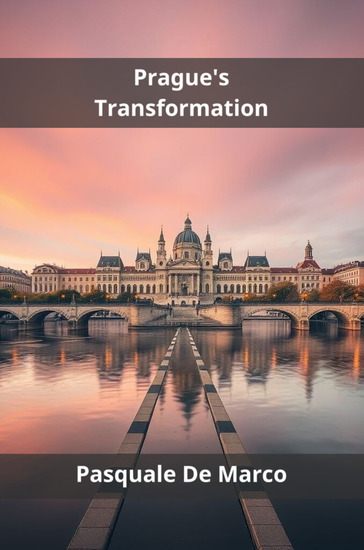
Prague's Transformation - cover

Prague's Transformation

Pasquale De Marco

Verlag: Publishdrive

  • 0
  • 0
  • 0

Beschreibung

In the heart of Europe, during the tumultuous year of 1968, a beacon of hope emerged from behind the Iron Curtain. Czechoslovakia, a nation yearning for change, embarked on a daring journey towards freedom and democracy, a movement that came to be known as the Prague Spring.

This book is a comprehensive exploration of this pivotal moment in history, providing a fresh perspective on the events that unfolded in Czechoslovakia and their profound impact on the world. Through meticulous research and analysis, the book delves into the factors that led to the Prague Spring, the reform movement led by Alexander Dubček, and the subsequent Soviet invasion that crushed the nation's aspirations.

Readers will gain a deeper understanding of the political, social, and cultural context of the Prague Spring, as well as the international repercussions of this transformative period. The book examines the role of the Warsaw Pact invasion in shaping the Cold War landscape and its lasting legacy on Czechoslovakia and Eastern Europe.

Beyond the historical narrative, the book also explores the enduring significance of the Prague Spring. It examines how the memory of this brief period of liberalization inspired resistance to communist rule and ultimately contributed to the Velvet Revolution of 1989, which led to the overthrow of communism in Czechoslovakia.

This book is a testament to the indomitable spirit of those who dared to challenge oppression. It is a story of courage, resilience, and the enduring power of hope. Through the Prague Spring, we are reminded of the fragility of freedom and the importance of standing up for our beliefs, even in the face of adversity.

With its captivating narrative, insightful analysis, and wealth of historical detail, this book is a must-read for anyone interested in modern European history, the Cold War, and the struggle for democracy and freedom.


If you like this book, write a review!
Verfügbar seit: 02.06.2025.
Drucklänge: 163 Seiten.

Weitere Bücher, die Sie mögen werden

  • Commander in Chief - Partisanship Nationalism and the Reconstruction of Congressional War Powers - cover

    Commander in Chief -...

    Casey B. K. Dominguez

    • 0
    • 0
    • 0
    The constitutional balance of war powers has shifted from Congress to the president over time. Today, presidents broadly define their constitutional authority as commander in chief. In the nineteenth century, however, Congress was the institution that claimed and defended expansive war powers authority. This discrepancy raises important questions: How, specifically, did Congress define the boundaries between presidential and congressional war powers in the early republic? Did that definition change? 


    Casey Dominguez's Commander in Chief systematically analyzes the authority that members of Congress ascribe to the president as commander in chief and the boundaries they put around that authority. 


    Dominguez shows that for more than a century members of Congress defined the commander in chief's authority narrowly. But in a wave of nationalism during the Spanish-American War, members of Congress began to argue that Congress owed deference to the commander in chief. They also tended to argue that a president of their own party should have broad war powers, while the powers of a president in the other party should be defined narrowly. Together, these two dynamics suggest that the conditions for presidentially dominated modern constitutional war powers were set at the turn of the twentieth century, far earlier than is often acknowledged.
    Zum Buch
  • Haunted Plano Texas - cover

    Haunted Plano Texas

    Mary Jacobus

    • 1
    • 1
    • 0
    From goat men to witch ladies and spooky little girls, dive into the haunted history of Plano, Texas.   Plano's old homes and businesses are rife with haunted history. Explore eerie urban legends like the Goat Man, the Clown Threat, and Ranch 111, where devil worshipers performed their rituals. The Evaporating Apparition spooked the staff at the Art Centre Theatre, while the grumpy spirit of an old rancher stalks the Masonic Lodge. Some specters are harmless, such as the Giggling Ghost, a little girl in the Cox Building with a penchant for peanut butter and pranks. Other figures own a more sinister reputation. The Witch Lady of Plano was feared by city youth and monitored by the FBI. Mary Jacobs examines the ghostly fallout of Plano's darkest moments, from the smallpox epidemic to the gruesome Muncey family murders.
    Zum Buch
  • Great Northern War The: The History of the Conflict that Made Russia the Dominant Empire in the Baltic - cover

    Great Northern War The: The...

    Editors Charles River

    • 0
    • 0
    • 0
    The Great Northern War, fought from 1700-1721, gets its name from the fact the war focused on the Baltic, but the battlefields extended into Germany and deep into Poland and Ukraine. Sweden was a military power with a small empire in the Baltic, while Russia was still a landlocked place, backward when compared to the rest of Europe, not very powerful, and highly xenophobic. The Poland-Lithuanian Commonwealth was still powerful, and the Cossacks were still free. Moreover, despite the fact the Ottoman Empire was weakened, it held sway in the Balkans and deep into Eastern Europe, and the Krim Tatars were still raiding into Ukraine, Russia, and Poland for slaves. The Great Northern War would involve the Ottomans and the Tatars as well. 
    	Given the length of the conflict, perhaps it’s not surprising that other Western European kingdoms ended up in the mix. Brandenburg-Prussia was involved in the later phases of the war - Frederick William was an elector of Brandenburg and had just been granted the right (by the Holy Roman Emperor) to call himself king in Prussia. He held both titles, but there was still a formal separation between Brandenburg and Prussia. Frederick William was strongly interested in acquiring some or all of Pomerania, a region on the Baltic coast, particularly in acquiring a port, which would eliminate paying Swedish tolls in Swedish-controlled ports. 
    	Ultimately, the most important aspect of the war is that it laid the foundations for the Russian Empire. By 1718, the Russians had conquered most of Finland, the port of Riga, and the Swedish city of Vyborg. These gains in the Baltic Sea strengthened the burgeoning Russian Empire and provided ports and access to the rich resources of Finland, including valuable meat and lumber. Peter also proved to be a rather benevolent conqueror, allowing these regions to maintain both their faith and culture.
    Zum Buch
  • Duncan's Ritual of Freemasonry - cover

    Duncan's Ritual of Freemasonry

    Malcolm C. Duncan

    • 0
    • 0
    • 0
    Duncan's Ritual of Freemasonry* by Malcolm C. Duncan is a classic and comprehensive guide that explores the intricate rituals and symbols of Freemasonry. Originally published in the 1860s, this book presents a detailed account of Masonic ceremonies across various degrees, including the Entered Apprentice, Fellow Craft, and Master Mason, as well as the higher degrees of the York Rite. Richly illustrated with symbols and hand signals, *Duncan's Ritual* offers insights into the fraternity’s age-old traditions, oaths, and allegorical teachings. Aimed at both Masons and curious readers, it provides a glimpse into the secretive world of Freemasonry, serving as a valuable historical reference on Masonic customs and the organization's spiritual and moral symbolism.
    Zum Buch
  • The Dung Beetles of Liberia - cover

    The Dung Beetles of Liberia

    Daniel V. Meier Jr

    • 0
    • 0
    • 0
    Liberia’s oligarchy: The beginning of the end.2019 Grand Prize Winner - Red City ReviewBased on the remarkable true account of a young American who landed in Liberia in 1961.The story weaves drama, dark comedy, and romance throughout a rich tapestry of narration - The San Francisco Book ReviewKEN VERRIER IS NOT HAPPY, NOR AT PEACE. He is experiencing the turbulence of Ishmael and the guilt of his brother's death. His sudden decision to drop out of college and deal with his demons shocks his family, his friends, and especially his girlfriend, soon to have been his fiancee. His destination: Liberia - The richest country in Africa both in monetary wealth and in natural resources.NOTHING COULD HAVE PREPARED HIM FOR THE EXPERIENCES HE WAS ABOUT TO LIVE THROUGH. Ken quickly realizes that he has arrived in a place where he understands very little of what is considered normal, where the dignity of life has little meaning, and where he can trust no one.Flying into the interior bush as a transport pilot, Ken learns quickly. He witnesses, first-hand, the disparate lives of the Liberian "Country People? and the "Congo People" also known as Americo-Liberians. These descendants of President Monroe's American Colonization Policy that sent freed slaves back to Africa in the 1800's have set up a strict hierarchical society not unlike the antebellum South.Author Dan Meier describes Ken's many escapades, spanning from horrifying to whimsical, with engaging and fast-moving narrative that ultimately describes a society upon which the wealthy are feeding and in which the poor are being buried.It's a novel that will stay with you long after the last word has been read.
    Zum Buch
  • Egyptian Mythology for Kids: Enthralling Myths and Legends of Gods Goddesses and Mythological Creatures - cover

    Egyptian Mythology for Kids:...

    Billy Wellman

    • 0
    • 0
    • 0
    Let’s travel back in time to learn about ancient Egyptian mythology! 
    Egyptian myths tell of gods who created and ruled over the lands of Egypt and the Nile. These gods ruled the sun, the moon, and the stars. They protected the souls of the dead as they traveled through the underworld. They rewarded the good and punished the evil. Some gods had a human form, and some had the bodies of humans and the heads of animals. Each of them has a story to tell. 
    Their stories can still be seen on the walls of tombs and pyramids. Museums around the world are filled with ancient Egyptian treasures and statues. 
    In this audiobook, you’ll be introduced to Ra, who created the world. Meet Osiris, the god of the dead. Learn about his wife, Isis, the goddess of magic and life. Each chapter is filled with exciting information about how these gods and goddesses influenced the ancient Egyptians’ lives. Each chapter also offers fun facts of these amazing deities. 
    So, let’s dive into Egyptian mythology and learn the answers to questions such asWhy did some Egyptian gods have human bodies and animal heads?What was the Great Sphinx, and why was it built?Why did Geb, the god of the earth, have green skin?What happened when Ra traveled to the underworld?Why did the ancient Egyptians fear the Eye of Ra?Is there really a Book of the Dead?Why was the Nile River so important to the Egyptians? 
    Every chapter ends with an activity that will test your knowledge of what you’ve read. Best of all, this book is told in a kid-friendly way. Let’s get started and explore the world of Egyptian myths, mighty shape-shifting gods and goddesses, and the afterlife! 
    Scroll up and click the “add to cart” button to learn more about ancient Egyptian mythology!
    Zum Buch