Join us on a literary world trip!
Add this book to bookshelf
Grey
Write a new comment Default profile 50px
Grey
Subscribe to read the full book or read the first pages for free!
All characters reduced
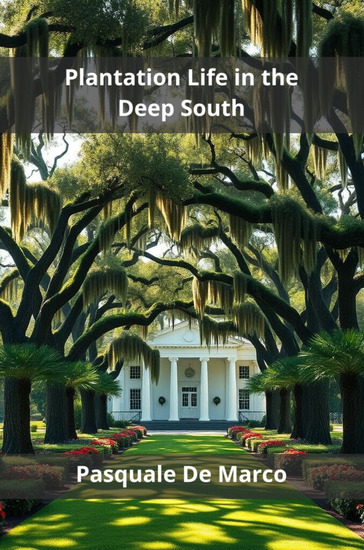
Plantation Life in the Deep South - cover

Plantation Life in the Deep South

Pasquale De Marco

Publisher: Publishdrive

  • 0
  • 0
  • 0

Summary

In the sprawling plantations of the Deep South, a world of wealth and power existed alongside unimaginable hardship and suffering. In this captivating book, we take a journey through the lives of those who lived and worked on these plantations, from the wealthy planters to the enslaved people who toiled in the fields.

We will explore the economic, social, and political forces that shaped plantation life, and we will examine the legacy of this system that continues to resonate today. Through the stories of those who lived and worked on plantations, we will gain a deeper understanding of this complex and controversial period in American history.

The plantation system was a major part of the Southern economy, and it played a significant role in the outbreak of the American Civil War. The war was fought over the issue of slavery, and it resulted in the abolition of slavery in the United States. However, the legacy of slavery and the plantation system continues to shape American society today.

This book offers a comprehensive look at plantation life in the Deep South. We will learn about the daily lives of planters and enslaved people, the crops that were grown on plantations, and the economic and political forces that shaped the plantation system. We will also explore the culture of the plantation, including the music, food, and religion of those who lived and worked there.

Through the stories of those who lived and worked on plantations, we will gain a deeper understanding of this complex and controversial period in American history. This book is essential reading for anyone interested in the history of the American South, the history of slavery, or the legacy of racism in the United States.


If you like this book, write a review!
Available since: 06/02/2025.
Print length: 161 pages.

Other books that might interest you

  • The Will to Power - Understanding Ambition Strength and Self-Overcoming - cover

    The Will to Power -...

    Friedrich Nietzsche, Tim Zengerink

    • 0
    • 0
    • 0
    What drives humanity to create, innovate, and dominate? How can we harness our inner strength to achieve greatness? 
    The Will to Power is Friedrich Nietzsche’s exploration of the fundamental force that drives all life: the will to power. More than a philosophical text, it is a bold examination of human nature, ambition, and the pursuit of meaning in a world shaped by chaos and conflict. 
    This modern translation brings Nietzsche’s ideas to today’s reader with clarity and accessibility while staying true to the depth of the original. He challenges us to rise above complacency, embrace struggle, and achieve self-overcoming through creativity, strength, and ambition. 
    What You’ll Discover: 
    - The Essence of Ambition and Power – Understand Nietzsche’s concept of the will to power as the driving force behind human action and creativity. 
    - Self-Mastery and Overcoming Challenges – Learn how to confront obstacles, harness inner strength, and reach your full potential. 
    - A New Perspective on Morality and Meaning – Challenge traditional values and forge your own path to fulfillment. 
    - Philosophy for Growth and Leadership – Apply Nietzsche’s insights to modern challenges in personal development, relationships, and leadership. 
    Imagine unlocking the strength to overcome adversity, redefine your purpose, and embrace life’s chaos with confidence and clarity. For more than a century, The Will to Power has shaped philosophical thought, offering timeless guidance on ambition, strength, and self-overcoming. 
    Start your journey today. Get your copy now and transform the way you think, act, and lead.
    Show book
  • Ancient Mesopotamia: An Enthralling Overview of Mesopotamian History Starting from Eridu through the Sumerians Akkadians Assyrians Hittites and Persians to Alexander the Great - cover

    Ancient Mesopotamia: An...

    Enthralling History

    • 0
    • 0
    • 0
    How much do you know about the “cradle of civilization?” Come explore the legacy of the brilliant ancient Mesopotamians who transformed the world. 
    Ancient Mesopotamia’s legacy was truly revolutionary. Childlike pictures scratched into wet clay evolved into the first written language. The Mesopotamians wrote the first epic poems, the first hymns, the first histories, and the first law codes. They developed the first wheel for transportation; simple carts that hauled bricks or produce morphed into chariots racing along at thirty-five miles per hour. 
    They gazed at the sky and mapped it, observing the planets’ retrograde motions and predicting lunar and solar eclipses. They developed the concept of time, measurements, basic counting, higher math, and hydraulic engineering. 
    Mesopotamia gave birth to the world’s first great empires—the Akkadians, Assyrians, Babylonians, and Achaemenids—which stretched over three continents. 
    A glimpse at the questions this overview unpacks includes:How old is the world’s first city?How did the Eridu Genesis compare to Noah and the ark?How fast was the world’s first postal system?How many times did Babylon’s patron god Marduk get stolen?How did Hammurabi’s law code compare to the Law of Moses?Who calculated pi (π) to the value of 3.125 and understood the Pythagorean theorem twelve centuries before Pythagoras was born?Did Xerxes really have a million men in his army?Which empire encompassed 44 percent of the world’s population?What eunuch poisoned most of the Persian royal family?And much, much more! 
    Get this audiobook now to learn the stories of incredible ancient Mesopotamia!
    Show book
  • Radical Equations - Civil Rights from Mississippi to the Algebra Project - cover

    Radical Equations - Civil Rights...

    Robert P. Moses, Jr. Charles E....

    • 0
    • 0
    • 0
    At a time when popular solutions to the educational plight of poor children of color are imposed from the outside, the acclaimed Algebra Project and its founder, Robert Moses, offer a vision of school reform based in the power of communities. Founded on the belief that math-science literacy is a prerequisite for full citizenship in society, the Project works with entire communities—parents, teachers, and especially students—to create a culture of literacy around algebra, a crucial stepping-stone to college math and opportunity. 


    Telling the story of this remarkable program, Robert Moses draws on lessons from the 1960s Southern voter registration he famously helped organize: "Everyone said sharecroppers didn't want to vote. It wasn't until we got them demanding to vote that we got attention. Today, when kids are falling wholesale through the cracks, people say they don't want to learn. We have to get the kids themselves to demand what everyone says they don't want." 


    We see the Algebra Project organizing community by community. Older kids serve as coaches for younger students and build a self-sustained tradition of leadership. And we see the remarkable success stories of schools like the predominately poor Hart School in Bessemer, Alabama, which outscored the city's middle-class flagship school in just three years.
    Show book
  • Spain - What Everyone Needs to Know(r)
2nd Edition - cover

    Spain - What Everyone Needs to...

    William Chislett

    • 0
    • 0
    • 0
    In Spain: What Everyone Needs to Know®, a timely addition to Oxford's What Everyone Needs to Know® series, veteran journalist William Chislett provides political and historical context for Spain's current economic and political predicament. Chislett recounts the country's fascinating and often turbulent history, beginning with the Muslim conquest in 711 and ending with the nation's deep economic crisis, sparked by the spectacular collapse of its real estate and construction sectors in 2010. He explains the country's transition from dictatorship to democracy and covers such issues as the creation of a welfare state, the influx of immigrants, internal strife from the separatist Catalan region, the effects of stringent austerity measures, the strengths and weaknesses of the economy, and how the country can create a more sustainable economic model for the future. In a concise, question-and-answer format that allows listeners to quickly access areas of particular interest, the book addresses a wide range of questions, including: What was the legacy of the Muslim presence between 711 and 1492? How did the Spanish Empire Arise? What were the causes of the 1936-39 Civil War? Why did the Socialists win a landslide victory in the 1982 election? What was the impact of European Economic Community membership? What is the violent Basque separatist group ETA? And more.
    Show book
  • Emperor Nero - The Treacherous Lustful Cruel Emperor Who Killed His Own Mother - cover

    Emperor Nero - The Treacherous...

    Kelly Mass

    • 0
    • 0
    • 0
    Nero Claudius Caesar Augustus Germanicus, the fifth and final emperor of the Julio-Claudian dynasty, ruled the Roman Empire from AD 54 to 68. He was thrust into the highest seat of power at the age of sixteen after being adopted by Emperor Claudius, his stepfather. While Nero enjoyed popularity among the lower classes and the Praetorian Guard, who benefited from his patronage, the Roman aristocracy and Senate viewed him with contempt. Ancient historians portray him as a tyrannical and self-indulgent ruler, notorious for his extravagance, cruelty, and disregard for tradition. His reign ended in disgrace when the Senate declared him a public enemy, leading to his suicide at the age of thirty.  
    Born in AD 37 in the coastal town of Antium, Nero was the son of Gnaeus Domitius Ahenobarbus and Agrippina the Younger, a great-granddaughter of Emperor Augustus. His father died when he was only two years old, and his mother soon remarried, securing a position of influence at the imperial court. When Agrippina married Emperor Claudius, she maneuvered to have her son adopted as his heir, ultimately sidelining Claudius’ biological son, Britannicus. Following Claudius’ suspicious death in AD 54—widely believed to have been orchestrated by Agrippina—Nero ascended the throne with the backing of the Senate and the powerful Praetorian Guard.  
    In the early years of his reign, Nero was heavily influenced by a triad of advisers: his ambitious mother Agrippina, the philosopher and statesman Seneca the Younger, and the Praetorian prefect Sextus Afranius Burrus. Initially, the empire benefited from their guidance, as Nero enacted policies that were generally seen as moderate and pragmatic. However, as he grew older, he sought to rule independently, resenting the influence of his mother.
    Show book
  • Made-Up - A True Story of Beauty Culture under Late Capitalism - cover

    Made-Up - A True Story of Beauty...

    Daphné B.

    • 0
    • 0
    • 0
    A nuanced, feminist, and deeply personal take on beauty culture and YouTube consumerism, in the tradition of Maggie Nelson’s Bluets
    		 
    As Daphné B. obsessively watches YouTube makeup tutorials and haunts Sephora’s website, she’s increasingly troubled by the ways in which this obsession contradicts her anti-capitalist and intersectional feminist politics. In this poetic treatise, she rejects the false binaries of traditional beauty standards and delves into the celebrities and influencers, from Kylie to Grimes, and the poets and philosophers, from Anne Boyer to Audre Lorde, who have shaped the reflection she sees in the mirror. At once confessional and essayistic, Made-Up is a meditation on the makeup that colours, that obscures, that highlights who we are and who we wish we could be.
    		 
    The original French-language edition was a cult hit in Quebec. Translated by Alex Manley—like Daphné, a Montreal poet and essayist—the book’s English-language text crackles with life, retaining the flair and verve of the original, and ensuring that a book on beauty is no less beautiful than its subject matter.
    Show book