Rejoignez-nous pour un voyage dans le monde des livres!
Ajouter ce livre à l'électronique
Grey
Ecrivez un nouveau commentaire Default profile 50px
Grey
Abonnez-vous pour lire le livre complet ou lisez les premières pages gratuitement!
All characters reduced
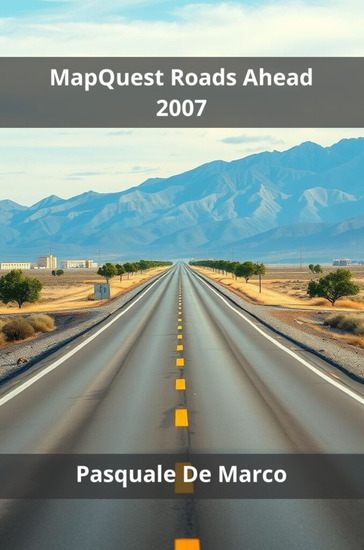
MapQuest Roads Ahead 2007 - cover

MapQuest Roads Ahead 2007

Pasquale De Marco

Maison d'édition: Publishdrive

  • 0
  • 0
  • 0

Synopsis

In "MapQuest Roads Ahead 2007," embark on a captivating journey of self-discovery and exploration. This book transcends mere travelogues, delving into the heart of human experiences and the transformative power of the open road. Through a tapestry of personal narratives and evocative descriptions, readers are invited to navigate the highways of history, embrace the diversity of cultures, and venture off the beaten path to discover hidden gems.

With each turn of the page, "MapQuest Roads Ahead 2007" unveils the transformative nature of travel. Whether navigating life's twists and turns or embarking on a physical journey, the stories shared in this book inspire readers to embrace change, challenge their boundaries, and embark on a quest for personal growth.

Travel becomes a catalyst for resilience and self-discovery as readers witness fellow travelers overcoming adversity, finding strength in vulnerability, and forging new paths forward. The open road beckons as a sanctuary for self-reflection, a place where dreams intersect with reality, and the symphony of experiences awaits.

"MapQuest Roads Ahead 2007" celebrates the beauty of diversity and the interconnectedness of humanity. Through encounters with diverse cultures and traditions, readers gain a deeper appreciation for the richness of our shared heritage and the importance of fostering unity and understanding.

This book is more than a travel guide; it's an invitation to embark on a journey of self-discovery, to explore the hidden depths of one's own potential, and to embrace the transformative power of the open road. With its captivating narratives and inspiring insights, "MapQuest Roads Ahead 2007" ignites a passion for exploration and leaves readers with a renewed sense of wonder and appreciation for the world around them.


If you like this book, write a review!
Disponible depuis: 02/06/2025.
Longueur d'impression: 163 pages.

D'autres livres qui pourraient vous intéresser

  • The Rise and Fall of the Egyptian Empire - A Historical Overview - cover

    The Rise and Fall of the...

    Omar Khalil

    • 0
    • 0
    • 0
    The origins of Ancient Egypt trace back to a time when the Nile River served as the lifeline for scattered communities that gradually developed into one of the world’s first great civilizations. The unification of Upper and Lower Egypt around 3100 BCE marked a turning point, traditionally credited to King Narmer (also known as Menes). This consolidation of power not only brought political unity but also forged a shared identity among the people along the Nile, creating the foundation for the dynastic rule that would follow for centuries. 
    Geography played a central role in shaping early Egyptian civilization. The Nile River, flowing from south to north, provided a reliable source of water and fertile soil through its annual inundation. These floods deposited nutrient-rich silt on the riverbanks, enabling agriculture to flourish in an otherwise arid environment. Settlements grew along the river, connected by the waterway, which also served as a route for trade and communication. Natural barriers such as deserts and the Mediterranean Sea offered protection from external invasions, allowing Egyptian culture to evolve with limited outside interference in its formative years. 
    The Early Dynastic Period (c. 3100–2686 BCE) saw the establishment of the first centralized state under pharaonic rule. Kings were not merely political leaders but were also regarded as divine beings, intermediaries between the gods and the people. This belief in divine kingship helped maintain stability and order in a society where religion permeated all aspects of life. Temples, tombs, and other ceremonial structures began to emerge during this era, laying the groundwork for the grand architectural achievements of later periods.
    Voir livre
  • The Shocking Truth about Consumerism - cover

    The Shocking Truth about...

    Zoey Fraisers

    • 0
    • 0
    • 0
    Consumerism, as we know it today, is the result of centuries of societal, economic, and psychological evolution. Its roots can be traced back to the Industrial Revolution of the late 18th and early 19th centuries, a period that marked a profound transformation in the way goods were produced and consumed. Before this era, most economies were primarily agrarian, and consumption was limited to meeting basic needs. However, the advent of mechanized production brought about mass manufacturing, reducing costs and making goods more widely accessible. This shift laid the groundwork for the rise of consumer culture. 
    The Industrial Revolution not only increased the availability of products but also introduced the idea of consumer choice. As markets grew, competition among producers intensified, leading to innovations in marketing and branding. Businesses began to recognize the importance of distinguishing their products through unique features or emotional appeal, planting the seeds of modern advertising. By the late 19th century, print advertisements were appearing in newspapers and magazines, offering visions of a better, more glamorous life through the purchase of specific goods. 
    At its core, consumerism thrives on the tension between desire and need. Unlike basic survival needs, desires are shaped by cultural, social, and psychological factors. Early advertisers tapped into this distinction, framing products as solutions to problems or as pathways to happiness and status. This psychological shift was crucial in transforming consumption from a practical activity into an aspirational pursuit.
    Voir livre
  • Heian Period - The Golden Age of Art Literature and Aristocratic Rule - cover

    Heian Period - The Golden Age of...

    Rolf Hedger

    • 0
    • 0
    • 0
    The Heian Period, spanning from 794 to 1185 CE, marks one of the most culturally rich and politically significant eras in Japanese history. This chapter lays the groundwork for understanding the historical context, political dynamics, and societal structure that defined the early stages of the Heian era. The period officially began when Emperor Kanmu moved the imperial capital from Nara to Heian-kyō, present-day Kyoto. This relocation was intended to establish a new seat of power free from the influence of powerful Buddhist monasteries that had grown too entwined with politics in Nara. 
    The move to Heian-kyō signified more than a change in geography—it was the beginning of a new political and cultural identity. The city was meticulously planned, modeled after the Chinese capital of Chang’an, with a grid-like structure that reflected a vision of order and centralized authority. However, over time, the influence of the emperor waned as powerful aristocratic families, particularly the Fujiwara clan, rose to prominence. By marrying their daughters into the imperial family and acting as regents, the Fujiwara effectively controlled the court, shaping policy and governance from behind the scenes. 
    The political landscape of early Heian Japan was one of ceremonial grandeur and subtle manipulation. Real power resided in the hands of a few elite families, and the imperial court became increasingly detached from the provinces. This created a division between the cultured, refined life of the capital and the often turbulent realities of rural Japan, where local warrior clans began to assert their own authority.
    Voir livre
  • Flavour with Benefits: France - cover

    Flavour with Benefits: France

    Cathy Connally, Charley Best

    • 0
    • 0
    • 0
    Flavour with Benefits: France will inspire you to plan the trip of your dreams and indulge in flavours that deliver a pleasant surprise. Would you love to escape on a romantic journey? Your ticket is between the covers of the stunning Flavour with Benefits: France. Now more than ever, we yearn to travel again. The descriptions of the French countryside will inspire you to book your next trip. Co-author Cathy Connally narrates this heartwarming book. Hear stories about intrepid women while traveling on a whimsical circuitous trip through France. Learn about a five-year-old girl and how an artichoke was prescribed for an ailment rather than a pill. Hear about courageous men and women who sacrificed so their families could be safe. Be impressed with the women who built the champagne industry in France but could not vote. Learn about healthier takes on iconic French foods while hearing about flavours and benefits of each recipe. Visit the gastronomic capital of France, Lyon and the women who invented this cuisine and achieved three Michelin stars. Vicariously sail the sea near Cassis and visit Provence and Marseille, the second largest city. Wander the ancient streets of Arles and get lost in its meandering alleyways. Visit castles and take in expansive views. Co-authors, Cathy Connally and Charley Best, are obsessed with developing new approaches to iconic flavours served with a side-dish of travel. Flavour with Benefits: France is the first book in the series. www.flavourwithbenefits.com Instagram @flavourwithbenefitsFlavour with Benefits: France is a finalist in the 2021 Foreword Indies Book Awards in Travel. https://www.forewordreviews.com/awards/books/flavour-with-benefits-france/
    Voir livre
  • McCormicks Creek State Park - Camping Hiking and History of McCormick's Creek State Park - cover

    McCormicks Creek State Park -...

    Paul Wonning

    • 0
    • 0
    • 0
    Established as Indiana's first state park in 1916, McCormick's Creek State Park offers rugged hiking, a waterfall, an inn and an excellent campground. 
    McCormick's Creek Falls 
    McCormick's Creek Falls cascades down a ten foot drop into the canyon, providing a lovely backdrop to the forest behind it. Easily visible from an overlook, the adventurous can hike down into the canyon on Trail 3 for a closer look. 
    Hikers will find over 14 miles of hiking, ranging from rugged to handicap accessible. 
    Camping 
    Campers have the choice of 189 electric sites and 32 primitive sites. The modern campground comfort stations have hot showers and toilets. 
    McCormick's Creek Fire Tower 
    Visitors can climb the McCormick's Creek Fire Tower for a commanding view of the surrounding countryside. 
    Owen County Tourism Guide 
    Indiana's Owen County has more than just the state park. Cataract Falls, Indiana's largest waterfall, is nearby as are many other nature preserves and an historic theater in Spencer, Indiana called the Tivoli Theatre. The book, McCormick's Creek State Park can serve as your ideal travel guide for Owen County. 
    Voir livre
  • The Evolution of Peru's Economy - A Historical Perspective - cover

    The Evolution of Peru's Economy...

    Anya Solace

    • 0
    • 0
    • 0
    Peru’s economy has undergone a remarkable transformation over the centuries, shaped by geography, cultural heritage, and global economic forces. From the highly organized economic structures of pre-Colonial civilizations to the challenges of modern globalization, Peru’s development reflects a complex interplay of resource management, foreign influence, and domestic policies. Understanding the evolution of Peru’s economy requires a historical perspective that highlights the fundamental shifts in trade, industry, and governance that have defined the nation’s financial landscape.  
      
    The economic foundations of Peru were deeply influenced by its diverse geography and rich natural resources. The Andes, Amazon rainforest, and coastal plains provided a variety of ecosystems that supported agriculture, mining, and trade. Long before Spanish colonization, the Andean civilizations, particularly the Incas, developed sophisticated economic systems that relied on communal labor, redistribution networks, and agricultural innovations. These early economic structures created a foundation for productivity and social organization that persisted even after European intervention.  
      
    The arrival of the Spanish in the 16th century drastically altered Peru’s economic trajectory. The colonial period introduced extractive systems, such as the encomienda and mita, which forced indigenous populations into labor-intensive industries, particularly silver mining. This period established Peru as a key contributor to the Spanish Empire’s wealth but also entrenched an economic model centered on resource extraction and dependency on European markets. The restrictions imposed by Spain limited Peru’s economic autonomy, setting the stage for struggles following independence. 
    Voir livre