Begleiten Sie uns auf eine literarische Weltreise!
Buch zum Bücherregal hinzufügen
Grey
Einen neuen Kommentar schreiben Default profile 50px
Grey
Jetzt das ganze Buch im Abo oder die ersten Seiten gratis lesen!
All characters reduced
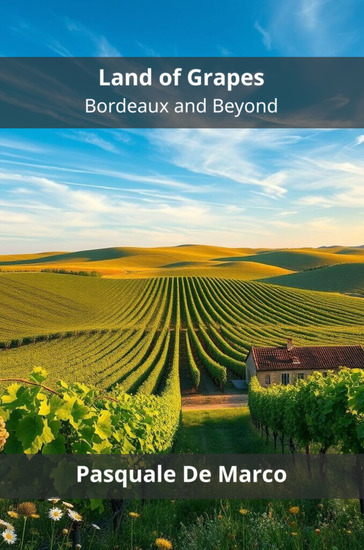
Land of Grapes - Bordeaux and Beyond - cover

Land of Grapes - Bordeaux and Beyond

Pasquale De Marco

Verlag: Publishdrive

  • 0
  • 0
  • 0

Beschreibung

Bordeaux, a legendary wine region in southwestern France, has captivated wine lovers for centuries with its iconic wines and rich history. In this comprehensive guide, we take you on a journey through the vineyards, cellars, and appellations of Bordeaux, exploring the unique terroir, grape varieties, and winemaking techniques that make this region so special.

From the rolling hills of the Médoc to the sun-drenched vineyards of the Right Bank, Bordeaux is a region of diverse terroirs that produce a wide range of wines, from the powerful and structured reds of the Left Bank to the elegant and velvety reds of the Right Bank. We will guide you through the different appellations of Bordeaux, from the prestigious first growths of the Médoc to the hidden gems of the Côtes de Castillon.

Beyond the vineyards, we will delve into the winemaking techniques that have made Bordeaux wines so renowned. We will discover the secrets behind the region's signature blending process, which creates wines of unparalleled complexity and elegance. We will also explore the intricate aging process, which can take place in oak barrels for years or even decades.

No discussion of Bordeaux would be complete without a tasting of the region's many acclaimed wines. We will provide tips on how to taste and enjoy Bordeaux wines, so you can experience their full potential. We will also guide you through the different food pairings that can enhance the flavors of Bordeaux wines, from classic pairings like steak and frites to more adventurous pairings like sushi and sashimi.

Whether you are a seasoned wine enthusiast or just starting to explore the world of wine, this book is your essential guide to Bordeaux. With its in-depth exploration of the region's history, culture, and wines, this book will help you discover the many wonders of Bordeaux and its wines.

**Inside this book, you will find:**

* A comprehensive overview of the history, culture, and viniculture of Bordeaux
* Detailed profiles of the region's appellations, grape varieties, and winemaking techniques
* Tips on how to taste and enjoy Bordeaux wines
* Food pairing suggestions for Bordeaux wines
* A guide to visiting Bordeaux, including recommended wineries, restaurants, and hotels

With its stunning photography and informative text, this book is the perfect companion for anyone who wants to learn more about Bordeaux and its wines.


If you like this book, write a review!
Verfügbar seit: 02.06.2025.
Drucklänge: 165 Seiten.
Weitere Bücher, die Sie mögen werden

  • The Shocking Truth about Artificial Intelligence - cover

    The Shocking Truth about...

    Zoey Fraisers

    • 0
    • 0
    • 0
    Artificial Intelligence (AI) has become one of the most discussed and transformative technologies of the modern era. While its roots trace back to early theoretical concepts and the works of pioneers like Alan Turing and John McCarthy, AI today represents a far more advanced reality. At its core, AI is the simulation of human intelligence in machines, particularly systems designed to think and learn like humans. This can include tasks such as problem-solving, pattern recognition, language processing, and even decision-making. 
    The concept of AI has evolved significantly over the past few decades. In the 1950s, Turing’s “Imitation Game,” later known as the Turing Test, set the stage for AI development by proposing that machines could exhibit intelligent behavior equivalent to that of humans. AI research started slow, plagued by limited computing power and a lack of understanding of the human brain's complexities. However, breakthroughs in machine learning, neural networks, and data processing have allowed AI to progress rapidly, particularly over the last two decades. 
    As AI becomes an integral part of daily life, its impact is undeniable. From virtual assistants like Siri and Alexa to self-driving cars, AI is increasingly present in everything from business operations to personal devices. Major corporations and governments are investing heavily in AI research, not only for its commercial potential but also for its ability to solve complex global challenges, from improving healthcare to addressing climate change.
    Zum Buch
  • 5 Books for Every DevOps Professional - cover

    5 Books for Every DevOps...

    Tom Henricksen

    • 0
    • 0
    • 0
    If you want to jump into the DevOps space you need to understand the lingo. Here are 5 you must be familiar with:The GoalThe Phoenix ProjectContinuous DeliveryThe DevOps HandbookAccelerate  
    These five are summarized here to give you the DevOps terminology and understanding.
    Zum Buch
  • Piping Design for Industrial Facilities - Understanding Codes and Standards - cover

    Piping Design for Industrial...

    Bill Huitt

    • 0
    • 0
    • 0
    About the Class  
    This 6.5hr course will provide the piping designer and engineer with the broad, but specific information they need to perform their job more efficiently and effectively. It will provide a better understanding of regulatory compliance, system ratings, and leak testing requirements. The attendee will gain the information they need in order to better understand pipe specifications, the piping design process, and its various elements in the preparation and execution of a project. 
    The course will be delivered in three sessions. Each session will be divided further into subject matter parts, providing somewhat convenient increments for a momentary pause or a lengthy break. 
    What will you learn in this course?Session 1 sets the stage by introducing the student to the history of codes and standards, how to interpret codes, and learning how they are developed what is done to avoid conflicting rules between codes.Session 2 steps through the ASME B31.3 Process Piping code chapter by a chapter explaining key points of each chapter. It then touches on code boundaries and project planning.Session 3 pulls it all together to step the student through developing pipe material specifications, selecting flange ratings, various design elements, welding, fabrication, examination, inspection, testing, installation, leak testing, and turnover documentation.
    Zum Buch
  • Why We Haven't Found Aliens Yet - Theories on the Great Silence in the Universe - cover

    Why We Haven't Found Aliens Yet...

    John Harpoon

    • 0
    • 0
    • 0
    The question of why we have yet to discover extraterrestrial life remains one of the most profound mysteries in science. Despite decades of research, powerful telescopes, and countless efforts to detect signals from distant worlds, the universe has remained eerily silent. This paradox has led scientists and thinkers to develop a range of theories that attempt to explain why humanity appears to be alone in the cosmos.  
    One of the most well-known ideas is the Fermi Paradox, which questions why, given the vastness of the universe and the high probability of other life forms, we have yet to encounter any signs of intelligent beings. The paradox highlights a troubling disconnect between the presumed abundance of alien civilizations and our complete lack of evidence for their existence. This has spurred a wave of speculation, ranging from the possibility that advanced civilizations self-destruct before they can communicate, to the unsettling notion that extraterrestrials deliberately avoid contact with less advanced species.   
    Technological limitations may also play a role in this silence. While humanity has made significant strides in space exploration and communication technologies, our methods may be inadequate for detecting extraterrestrial signals. The vastness of space presents enormous challenges, with signals potentially becoming too weak or distorted to identify by the time they reach Earth. Furthermore, the technology alien civilizations may use to communicate could be entirely different from our own, rendering our search methods ineffective. 
    Zum Buch
  • From Swamp to Wetland - The Creation of Everglades National Park - cover

    From Swamp to Wetland - The...

    Chris Wilhelm

    • 0
    • 0
    • 0
    This book chronicles the creation of Everglades National Park, the largest subtropical wilderness in the United States. Prior to the park's creation, the Everglades was seen as a reviled and useless swamp, unfit for typical recreational or development projects. 


    Park advocates drew on new ideas concerning the value of biota and ecology, the importance of wilderness, and the need to protect habitats, marine ecosystems, and plant life to redefine the Everglades. Using these ideas, the Everglades began to be recognized as an ecologically valuable and fragile wetland—and thus a region in need of protective status. 


    While these new ideas foreshadowed the later emergence of modern environmentalism, tourism and the economic desires of Florida's business and political elites also impacted the park's future. These groups saw the Everglades' unique biology and ecology as a foundation on which to build a tourism empire. 


    Yet, even after the park's creation, conservative landowners successfully fought to limit the park and saw it as a threat to their own economic freedoms. The battle to save the swamp's biodiversity continues, and Everglades Park stands at the center of ongoing restoration efforts.
    Zum Buch
  • Does Coffee Cause Cancer? - And 8 More Myths About the Food We Eat - cover

    Does Coffee Cause Cancer? - And...

    Dr. Christopher Labos

    • 0
    • 0
    • 0
    In this fascinating, refreshingly clarifying book about food, food myths, and how sloppy science perpetuates misconceptions about food, a medical doctor on his way to a conference gets drawn into conversations that answer the following questions: Does vitamin C prevent the common cold? And if it works, why does it only work in Canadian soldiers, ultramarathon runners, and skiers? Was red meat really declared a carcinogen by the WHO? Does that mean I should become a vegetarian? And who decides what gets labeled as red meat and white meat? Is salt really not that bad for you and did a group of researchers really want to experiment on prisoners to prove the point? Does coffee cause cancer or heart attacks? Why did a California court say coffee needed a warning label? Is red wine really good for your heart, and what makes the French Paradox such a paradox? Why did the New England Journal of Medicine link eating chocolate with winning a Nobel Prize? Why were eggs once bad for you but now good for you again? Does that mean I don't need to worry about cholesterol? Should I be taking vitamin D?
    Zum Buch