Rejoignez-nous pour un voyage dans le monde des livres!
Ajouter ce livre à l'électronique
Grey
Ecrivez un nouveau commentaire Default profile 50px
Grey
Abonnez-vous pour lire le livre complet ou lisez les premières pages gratuitement!
All characters reduced
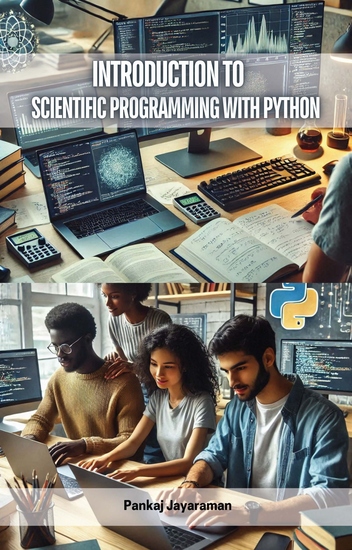
Introduction to Scientific Programming with Python - cover

Introduction to Scientific Programming with Python

Pankaj Jayaraman

Maison d'édition: Educohack Press

  • 0
  • 0
  • 0

Synopsis

"Introduction to Scientific Programming with Python" offers an immersive exploration into the dynamic field of scientific programming using Python. We cater to a diverse audience, serving as an entry point for novices and a valuable resource for seasoned practitioners in scientific computing.
Python's popularity in scientific circles stems from its readability, versatility, and extensive libraries for numerical computing, data analysis, and visualization. We cover fundamental programming concepts and gradually introduce advanced techniques specific to scientific applications.
From mastering Python basics to exploring advanced topics like machine learning and symbolic mathematics, each chapter provides a structured and hands-on learning experience. Real-world case studies, practical examples, and exercises ensure readers grasp theoretical concepts and gain practical skills.
Throughout the book, Python becomes a tool of empowerment, enabling readers to unravel complex scientific data, model intricate phenomena, and contribute meaningfully to their fields. "Introduction to Scientific Programming with Python" is an invaluable companion for harnessing Python's potential in scientific inquiry and discovery.
By the end, readers will have a robust foundation in Python and the confidence to apply scientific programming methodologies to real-world problems. This book unlocks the door to a world where Python drives exploration, discovery, and innovation in science.
Disponible depuis: 20/02/2025.
Longueur d'impression: 294 pages.


D'autres livres qui pourraient vous intéresser

  • The Science of Computing - Algorithms and Data Structures - cover

    The Science of Computing -...

    Craig Dames

    • 0
    • 0
    • 0
    Computing has become an integral part of modern society, shaping various industries, scientific research, and everyday life. At its core, computing involves the use of computers and algorithms to process data, solve problems, and automate tasks. This chapter provides an overview of computing and the fundamental principles of computational thinking, which form the foundation for problem-solving in the digital age. 
    Computing encompasses both hardware and software components. Hardware refers to the physical devices, such as processors, memory units, and input/output devices, that perform computational tasks. Software, on the other hand, consists of programs and algorithms that instruct hardware on how to process information. The evolution of computing has led to significant advancements, from early mechanical calculators to modern high-performance computing systems capable of handling vast amounts of data. 
    Computational thinking is a problem-solving approach that involves breaking down complex problems into manageable parts, recognizing patterns, and developing step-by-step solutions. It consists of several key principles, including decomposition, abstraction, pattern recognition, and algorithm design. Decomposition involves dividing a problem into smaller, more manageable sub-problems. Abstraction focuses on identifying relevant details while ignoring unnecessary complexity. Pattern recognition allows problem solvers to identify similarities between different problems, enabling efficient solutions. Algorithm design involves creating a set of well-defined steps to achieve a specific outcome.
    Voir livre
  • How Not to Fit In: An Unapologetic Guide to Navigating Autism and ADHD - cover

    How Not to Fit In: An...

    Jess Joy, Charlotte Mia

    • 0
    • 0
    • 0
    ’The lack of information around how ADHD and autism shows up in adults means that many of us have been assuming we were anxious, not working hard enough, or just entirely failing altogether.’ – Jess Joy and Charlotte Mia 
    Written by two late-diagnosed neurodivergent women and the founders of fast-growing online community @IAmPayingAttention, HOW NOT TO FIT IN is an handbook-meets-rallying cry. 
    Foregrounding real experiences with autism and ADHD, this book explores the journey of discovering, accepting and flourishing with your neurodivergent brain. It explores why getting diagnosis can be so fraught and gendered, and how to navigate a world which centres neurotypical brains in the realms of relationships, careers, friendships and finances. 
    By reading this book, you’ll:Start to understand why so many people are being diagnosed with ADHD and autism right nowLearn the impact that not knowing your own brain can have on your mental healthFind the confidence to ask for accommodations and adjustments at work – without apologisingHave the chance to note down how this journey is evolving for you in chapter-by-chapter workbook sections.… and, most importantly, get to know yourself and your needs better. 
    Featuring the latest research and thinking on neurodivergence, contributions from dozens of experts and the real stories of people just like you, this innovative book – which has been written and designed especially for *spicy* brains – is essential reading for anyone whose brain seems to see the world in a different way. 
    This non-fiction book is a beacon of hope for those struggling with neurodivergence, offering a fresh perspective on disabilities and behavioural patterns. It's a testament to personal growth and self-esteem, providing an education on the intricacies of neurology. 
    For fans of Dr Luke Beardon (Aspies on Mental Health), and Kat Brown (It's Not A Bloody Trend). 
    HarperCollins 2024
    Voir livre
  • Decision Making in Aviation - cover

    Decision Making in Aviation

    Facundo Conforti

    • 0
    • 0
    • 0
    This audiobook is narrated by an AI Voice.   
    Decision-making in the cockpit has a direct relationship with the safety of operations. But not only does it affect pilots of all levels, but it also involves many more people involved in the process. 
    	Decision-making is a process, and as such, it requires a series of logical steps to achieve the goal. This process occurs unconsciously in our brain in a fraction of a second. As human beings, we constantly make decisions, we decide what to eat, what clothes to wear, with which hand we caress our hair, or simply on which side we turn our heads when we hear a sound and react to this stimulus. All these actions are preceded by an unconscious process of the brain where in a fraction of a second all the options were analyzed and the most appropriate one was chosen. 
    	In aviation, the pilot constantly makes operational decisions, from the first hour of flight to the last at the end of his career. In this work, we will analyze all the variables that could affect the decision-making process, seeking to learn the tools to minimize the error during this process. An indispensable book for every pilot, regardless of their level of experience.
    Voir livre
  • Classical Electrodynamics - Advanced Study of Electromagnetic Theory - cover

    Classical Electrodynamics -...

    Mark Hedges

    • 0
    • 0
    • 0
    Electromagnetic theory is one of the fundamental pillars of physics, providing the framework for understanding electric and magnetic fields and their interactions. It is essential not only for classical physics but also for modern advancements in engineering, communications, and quantum mechanics. This chapter introduces the historical development of electrodynamics and the significance of Maxwell’s equations, which form the foundation of classical electromagnetism. 
    The origins of electromagnetic theory can be traced back to early observations of static electricity and magnetism. The ancient Greeks, particularly Thales of Miletus, noted that rubbing amber could attract small objects, laying the groundwork for electrostatics. By the 17th century, William Gilbert’s studies on magnetism and Benjamin Franklin’s experiments on electricity further developed the understanding of electric and magnetic phenomena. The 18th and 19th centuries saw rapid progress, with Charles-Augustin de Coulomb formulating the inverse-square law of electrostatics and André-Marie Ampère discovering the relationship between current and magnetic fields. Michael Faraday’s groundbreaking work on electromagnetic induction demonstrated that a changing magnetic field could induce an electric current, setting the stage for the unification of electricity and magnetism.
    Voir livre
  • Healing Water Sounds: Babbling Brooks & Flowing Rivers for Deep Sleep Meditation & Stress Relief - Nature’s Serenity—Tranquil Waters to Soothe Your Mind Calm Your Soul & Guide You into Restful Sleep - cover

    Healing Water Sounds: Babbling...

    Mindful Moments - Nature Sounds...

    • 0
    • 0
    • 0
    Healing Water Sounds: Babbling Brooks & Flowing Rivers for Deep Sleep, Meditation & Stress Relief


    Close your eyes and let the world melt away. Imagine a gentle stream winding through a lush green valley, its crystal-clear waters whispering secrets only nature knows. The steady, soothing flow of a river carries away the weight of your thoughts, while the soft babbling of a brook wraps around you like a warm embrace.


    This is not just another background sound—this is a sanctuary, a return to something primal and pure. A place where your mind slows, your heart softens, and your breath deepens. Whether you’re seeking deep, uninterrupted sleep, a moment of peaceful meditation, or simply an escape from the noise of modern life, these flowing waters will guide you back to your natural rhythm.


    Why This  Audiobook?
     
    - Authentic, untouched nature – no artificial enhancements, just the pure voice of water.- Scientifically proven to calm the nervous system – let the steady flow ease stress and quiet the mind.
     
    - Perfect for sleep, meditation, focus, or simply unwinding – let these waters carry you to a place of stillness.


    Let go. Listen. Breathe. Be.
    Voir livre
  • The Blue Revolution - Hunting Harvesting and Farming Seafood in the Information Age - cover

    The Blue Revolution - Hunting...

    Nicholas Sullivan

    • 0
    • 0
    • 0
    Overfishing. For the world's oceans, it's long been a worrisome problem with few answers. But as older fishing fleets retire and new technologies develop, a better, more sustainable way to farm this popular protein has emerged to profoundly shift the balance. The Blue Revolution tells the story of the recent transformation of commercial fishing: an encouraging change from maximizing volume through unrestrained wild hunting to maximizing value through controlled harvesting and farming. 


    Nicholas P. Sullivan presents this new way of thinking about fish, food, and oceans by profiling the people and policies transforming an aging industry into one that is "post-industrial"—fueled by "sea-foodies" and locavores interested in sustainable, traceable, quality seafood. He discusses the global challenges to preserving healthy oceans, including conservation mechanisms, the impact of climate change, and unregulated and criminal fishing in international waters. 


    In a fast-growing world where more people are eating more fish than ever before, The Blue Revolution brings encouraging news for conservationists and seafood lovers about the transformation of an industry historically averse to change, and it presents fresh inspiration for entrepreneurs and investors eager for new opportunities in a blue-green economy.
    Voir livre