Join us on a literary world trip!
Add this book to bookshelf
Grey
Write a new comment Default profile 50px
Grey
Subscribe to read the full book or read the first pages for free!
All characters reduced
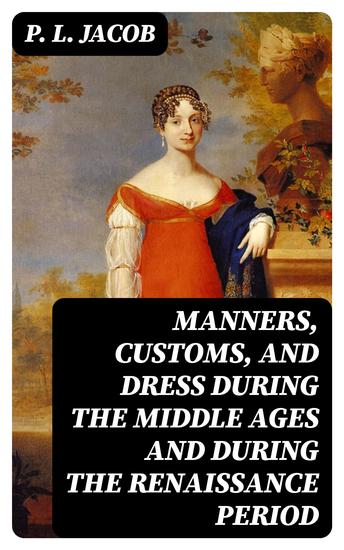
Manners Customs and Dress During the Middle Ages and During the Renaissance Period - cover

Manners Customs and Dress During the Middle Ages and During the Renaissance Period

P. L. Jacob

Publisher: DigiCat

  • 0
  • 0
  • 0

Summary

In "Manners, Customs, and Dress During the Middle Ages and During the Renaissance Period," P. L. Jacob meticulously explores the intricate tapestry of social practices, cultural norms, and fashion that defined European society from the 5th to the 17th century. Employing a rich narrative style interwoven with vivid descriptions and scholarly insights, Jacob contextualizes each era within broader social and political frameworks. This work serves not only as a historical account but also as a valuable resource for understanding the evolution of manners and attire, illustrating how these elements reflect shifting societal values and class structures. P. L. Jacob, a prominent historian and scholar, draws upon extensive research and primary sources to illuminate everyday life in these transformative centuries. His background in cultural history and anthropology informs his approach, allowing him to delve deeply into the interplay between social customs and economic conditions. This scholarly rigor is evident throughout the text, as Jacob navigates through historical references, providing readers with a comprehensive look at the daily lives of individuals across various strata of society. This book is highly recommended for anyone interested in social history, fashion studies, or the cultural dynamics of the Middle Ages and Renaissance. Jacob's work is an essential addition to the libraries of both academic scholars and casual readers, offering a captivating glimpse into the past that reveals the profound influence of manners and dress on identity and social interaction.
Available since: 09/15/2022.
Print length: 524 pages.

Other books that might interest you

  • Summary of Shomari Wills’s Black Fortunes - cover

    Summary of Shomari Wills’s Black...

    Falcon Press

    • 0
    • 0
    • 0
    Buy now to get the main key ideas from Shomari Wills’s Black Fortunes 
      
    Journalist Shomari Wills’s great-great-uncle, John Mott Drew, was a millionaire. His father had been a slave, and his story made Shomari realize that African Americans’ early achievements are often little known. At the time, it was revolutionary for an African American to become rich. In Black Fortunes (2018), Shomari tells the success stories of America’s first black millionaires, including Mary Ellen Pleasant, Robert Reed Church, O.W. Gurley, Hannah Elias, Annie Turnbo Malone, and Madam C.J. Walker. They were often attacked and demonized for their race and achievements, but this did not stop them from securing their legacy. They built towns, cultures, and helped change the course of history for black people. 
     
    Show book
  • Gestapo - The Story Behind Hitler's Machine of Terror - cover

    Gestapo - The Story Behind...

    Lucas Saul

    • 0
    • 0
    • 0
    Formed in 1933, the Gestapo became one of the most feared state forces of the Third Reich before and during World War II. 
     
    Chronicling the history of the organization, from its origins to the brutal and horrific offences that it perpetrated on hundreds of thousands of people, to its eventual downfall, Gestapo is a compelling tale of power and destruction taken to their most terrifying extremes. Familiar in films as the ominous men wearing black leather trench coats seen arresting people on the flimsiest of pretexts, the true story of the Geheime Staatspolizei (or Gestapo for short) is even more frightening. 
     
    Drawing on numerous sources, Gestapo explores how this secret state police force was born on 26 April 1933, the creation of Hermann Göring. Together with the Kriminalpolizei and the Sicherheitsdienst, the Gestapo would enforce a reign of terror on Germany and across much of Europe. Containing profiles of key figures and chilling tales of its death squads' sadistic efficiency - from the torture of Resistance members to mass murder in collaboration with the Einsatzgruppen - Gestapo shows how the organization thrived on Hitler's insecurity until, as the Allies triumphed, its members were eventually rounded up and, as far as possible, brought to justice.
    Show book
  • Yuan Dynasty - Mongol Rule and the Blending of Cultures - cover

    Yuan Dynasty - Mongol Rule and...

    Rolf Hedger

    • 0
    • 0
    • 0
    The Yuan Dynasty emerged from the ambitions of Kublai Khan, the grandson of Genghis Khan, who sought to consolidate Mongol rule over China. Before the establishment of the Yuan, the Mongols had waged a relentless military campaign against the Song Dynasty, the ruling power in southern China. After decades of conflict, Kublai Khan successfully defeated the Song in 1279, marking the first time in history that all of China was under foreign rule. His ascension to the throne not only signified the dominance of the Mongols but also introduced a new era of governance that blended Mongol traditions with Chinese administration. 
    Kublai Khan declared himself emperor in 1271 and named his dynasty "Yuan," meaning "Great Origin," a term rooted in Chinese philosophy and symbolic of the vast scope of Mongol rule. Unlike his predecessors, who maintained a nomadic lifestyle, Kublai recognized the necessity of adopting Chinese customs to effectively govern a vast and diverse population. He moved the capital from Karakorum to Dadu, present-day Beijing, reinforcing his commitment to ruling as a Chinese emperor while still maintaining Mongol authority. His reign sought to balance the military-driven expansion of his ancestors with the complexities of ruling a settled, bureaucratic society. 
    Despite his efforts to integrate into Chinese political traditions, Kublai faced challenges in legitimizing his rule. Many Han Chinese viewed the Mongols as outsiders and resisted their authority. To solidify his claim, Kublai adopted Confucian principles and retained elements of the Chinese imperial structure, appointing Chinese officials in lower government positions while keeping key positions reserved for Mongols and trusted foreign allies. This approach ensured Mongol dominance while utilizing the administrative expertise of the Chinese.
    Show book
  • Master and Margarita by Mikhail Bulgakov The (Book Analysis) - Detailed Summary Analysis and Reading Guide - cover

    Master and Margarita by Mikhail...

    Bright Summaries

    • 0
    • 0
    • 0
    Unlock the more straightforward side of The Master and Margarita with this concise and insightful summary and analysis!This engaging summary presents an analysis of The Master and Margarita by Mikhail Bulgakov, which is widely considered to the author's masterpiece and one of the finest novels of the 20th century. Through three interwoven narrative strands, namely Pontius Pilate's persecution of the man who would later be known as Jesus Christ, a love story set in Moscow in the 1930s and the Devil's visit to that city, the novel delivers biting satire and explores weighty themes such as the interplay between good and evil and the importance of spiritual and intellectual freedom. Due to pervasive censorship in the Soviet Union, the novel was not published until almost 30 years after its author's death, and is now the work on which his reputation rests. Indeed, although Bulgakov died in poverty and obscurity, his writing now enjoys popular and critical acclaim around the world.Find out everything you need to know about The Master and Margarita in a fraction of the time!This in-depth and informative reading guide brings you:• A complete plot summary• Character studies• Key themes and symbols• Questions for further reflectionWhy choose BrightSummaries.com?Available in print and digital format, our publications are designed to accompany you on your reading journey. The clear and concise style makes for easy understanding, providing the perfect opportunity to improve your literary knowledge in no time.See the very best of literature in a whole new light with BrightSummaries.com!
    Show book
  • Beyond Racial Division - A Unifying Alternative to Colorblindness and Antiracism - cover

    Beyond Racial Division - A...

    George A. Yancey

    • 0
    • 0
    • 0
    Efforts at colorblindness and antiracism have not been very effective in addressing racial tensions in the United States. 


    Colorblindness ignores the realities of race and the history of injustice. On the other hand, antiracism centers racial concerns and in so doing often alienates people who need to be involved in the process. Sociologist George Yancey offers an alternative approach to racial relations where all parties contribute and are mutually accountable to one another for societal well-being. He provides empirical rationale for how collaborative conversations in a mutual accountability model can reduce racial division. History and societal complexity mean that different participants may have different kinds of responsibility, but all are involved in seeking the common good for all to thrive. Avoiding unilateral decisions that close off dialogue, Yancey casts a vision for moving beyond racial alienation toward a lifestyle and movement of collaborative conversation and mutuality.
    Show book
  • Clara: From Victorian Governess to Lady of Pleasure - cover

    Clara: From Victorian Governess...

    Dorian Shellan

    • 0
    • 0
    • 0
    While working in the Chester household as a governess, the innocent Clara becomes sexually involved with Herbert Chester, her employer. Then, when the beautiful Catherine, Herbert's sister-in-law and secret lover, comes to stay at the house, Catherine introduces Clara into the pleasures of being with a woman.  On learning how the women are enjoying each other, Herbert encourages them into a threesome with him. This spurs jealousy in Catherine, however, and Clara is dismissed. 
    Now sexually awakened and excited by life in London, Clara has no desire to return to work as a governess and contemplates what form of employment best suits her ambitions. Her friend, Anna Quinlan, suggests the ideal solution. Anna is Madame Q and runs The Nunnery, an exclusive brothel catering only to the most select clientele. Tempted by a generous salary, room, board, freedom and independence, will Clara accept and become one of Madame Q's ladies of pleasure?
    Show book