Rejoignez-nous pour un voyage dans le monde des livres!
Ajouter ce livre à l'électronique
Grey
Ecrivez un nouveau commentaire Default profile 50px
Grey
Abonnez-vous pour lire le livre complet ou lisez les premières pages gratuitement!
All characters reduced
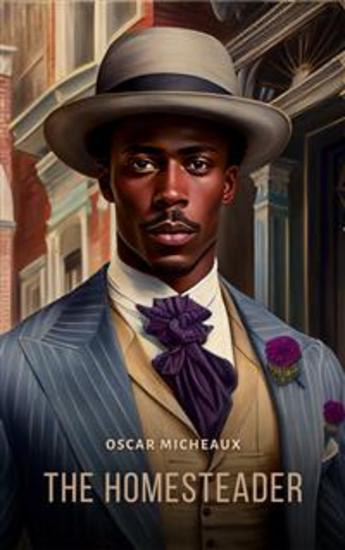
The Homesteader - A Novel - cover

The Homesteader - A Novel

Oscar Micheaux

Maison d'édition: Interactive Media

  • 0
  • 0
  • 0

Synopsis

Oscar Micheaux's novel, The Homesteader, is a work of fiction that explores the complexities of racial identity in the early 20th century. Through its narrative structure and character development, the text offers a nuanced examination of how the concept of race was constructed and perpetuated through cultural and economic structures. At its core, the novel serves as an exploration into how racial identity can both challenge and affirm traditional understandings of power dynamics.
Disponible depuis: 20/01/2023.
Longueur d'impression: 440 pages.

D'autres livres qui pourraient vous intéresser

  • Pride and Prejudice - cover

    Pride and Prejudice

    Jane Austin

    • 0
    • 0
    • 0
    Step into the refined world of the English countryside in Jane Austen’s beloved novel, Pride and Prejudice. This timeless tale follows the headstrong Elizabeth Bennet as she navigates the complexities of love, family, and social expectations. When she meets the enigmatic Mr. Darcy, Elizabeth must confront her own pride and prejudices as their relationship develops in unexpected ways. 
    Narrated by Susan Edni, this audiobook brings the wit, charm, and emotion of Austen’s work to life. Edni’s performance captures the elegance of Regency England, drawing listeners into Elizabeth’s journey and the lively dynamics of the Bennet family. Her narration beautifully conveys the humor, romance, and social tension that make this novel a classic. 
    Perfect for fans of romance, historical fiction, and literature, Pride and Prejudice is a captivating story of love and growth. With its enduring themes and unforgettable characters, this audiobook will charm listeners of all ages and offer a fresh experience of Austen’s cherished masterpiece.
    Voir livre
  • Great Expectations - cover

    Great Expectations

    Charles Dickens

    • 0
    • 0
    • 0
    Great Expectations, written by Charles Dickens and first published in 1861, is a classic novel that follows the life of an orphaned boy named Pip. Through a series of unexpected events, Pip embarks upon a journey of self-discovery and maturity. Along the way, he meets a variety of colorful characters and learns valuable life lessons. Great Expectations is an uplifting story of hope, perseverance, and the power of redemption. It is a timeless tale of courage and determination that will continue to inspire generations to come. 
    Dickens was born in Portsmouth, England, and lived in London for much of his life. He was the second of eight children and had a difficult childhood. He was forced to leave school at the age of twelve and start working at a factory to help support his family. Despite his difficult circumstances, Dickens was an avid reader and a talented writer. He began publishing his works in 1833, and quickly gained fame and popularity. 
    Throughout his career, Dickens wrote some of the most influential works of the 19th century, exploring themes of morality, poverty, and social justice. He was also an outspoken critic of Victorian-era injustices, particularly those experienced by the poor. His works were often seen as critiques of the social and political issues of his time. 
    Dickens' popularity has endured over the years and his works are still widely read today. His novels have been adapted and re-imagined countless times, and his characters and stories have become part of the English literary canon. He is remembered as one of the most influential authors of all time, and his works have shaped generations of readers.
    Voir livre
  • Tales Of Space And Time - cover

    Tales Of Space And Time

    H.G Wells

    • 0
    • 0
    • 0
    "Tales of Space and Time" is a collection of science fiction short stories written by H.G. Wells and first published in 1899. The collection features a range of imaginative and speculative stories that explore themes of space exploration, time travel, and the possibilities and consequences of scientific advancements. 
     
    The stories in "Tales of Space and Time" showcase Wells' visionary imagination and his ability to weave intricate narratives that combine scientific concepts with social commentary. Among the notable stories in the collection is "The Crystal Egg," which tells the tale of a mysterious crystal that allows its owner to peer into the Martian landscape. Another well-known story is "The Star," which depicts the cataclysmic consequences of a massive celestial body approaching Earth. 
     
    Wells' writing in "Tales of Space and Time" not only presents exciting adventures and futuristic concepts but also delves into deeper philosophical questions. The stories reflect Wells' concerns about the potential dangers of unbridled scientific progress, the impact of advanced technology on society, and the ethical implications of human exploration and discovery. 
     
    As with much of Wells' science fiction, "Tales of Space and Time" has had a lasting impact on the genre and has influenced subsequent writers and filmmakers. The collection demonstrates Wells' skill in blending scientific speculation with social commentary, providing readers with both thrilling escapism and thought-provoking themes to contemplate.
    Voir livre
  • To the Lighthouse - cover

    To the Lighthouse

    Virginia Woolf

    • 0
    • 0
    • 0
    Set on an island off the Scottish coast, To the Lighthouse minutely examines the fleeting impressions of a large cast of family, friends, lovers, and hangers-on. Who can we be, Virginia Woolf invites us to ask, if no one can ever know our hearts - if they're unknowable even to ourselves? To the Lighthouse remains one of the most important Modernist novels, exquisitely composed by one of the most gifted writers of the Modernist movement.
    The opening section follows the passage of a day with a thwarted objective: to go to the nearby lighthouse. The concluding section revisits this expedition a decade later, when so much is irrevocably changed, as a chance to glimpse interpersonal understandings and connections. The novel provides a brilliant example of stream-of-consciousness writing, and raises questions that provoke us still: questions about whether children are the fullest realization of one's posterity, how women artists are regarded socially, and how money and status enable - or close off - networks, relationships, and the dreams we hold most dear.
    As masterful as its technique is, however, the lasting value of this novel for twenty-first-century readers may be its sharp representation of the emotional labor that people - particularly women - perform in order to manage the needs and expectations of others. Woolf wrote in an age when women's participation in society was tightly restricted by class norms and stultifying domesticity. Nearly a century later, scholars still have a great deal to say about Mrs. Ramsay, Lily Briscoe, and the tension between Mr. Ramsay and his son James.
    Woolf's fifth novel, and one of her most successful books both critically and commercially, To the Lighthouse was originally published in 1927, simultaneously in England and the United States. Due to a quirk in the management and correction of the proofs, according to scholar Hans Walter Gabler, the two editions were "not identical, since in a significant number of instances Virginia Woolf marked up the first proofs differently" for her two publishers.
    Voir livre
  • Wheels of Chance The (Unabridged) - cover

    Wheels of Chance The (Unabridged)

    H. G. Wells

    • 0
    • 0
    • 0
    A humorous account of a young man's cycling holiday in the south of England. By the author of The Time Machine, The Invisible Man and The War of the Worlds.
    Voir livre
  • Nameless City The (Unabridged) - cover

    Nameless City The (Unabridged)

    H. P. Lovecraft

    • 0
    • 0
    • 0
    The unnamed narrator of the story goes into the middle of the Arabian Peninsula to seek out and enter a lost city. After hearing a clanging seemingly coming from deep inside the earth, the narrator inspects mysterious carvings and ruins until nightfall. The next day, the narrator discovers a cliff riddled with low-ceilinged buildings, unfit for human use. While he attends to his suddenly nervous camel, the narrator discovers a somewhat larger temple, with altars, painted murals, and a small staircase going down. After he descends, his torch dies, and he crawls on his hands and knees until he enters a hallway with small wooden coffins containing bizarre reptiles inside of them lining the walls. The narrator notices a large amount of light coming from an unknown source. After crawling to it on his hands and knees, he sees a large brass door with a descent into a misty portal. He then hears moaning coming from the coffin passage, and feels a strong wind coming from the passage, trying to pull him down. Against all odds, he resists, and sees what appear to be reptiles with a body shaped like a cross between a crocodile and a seal with a strange head common to neither of them, involving a protruding forehead, horns, lack of a nose, and an alligator-like jaw crawling behind the lit portal. The wind dies down after the last of it flows down into the light, when suddenly the door closes behind the narrator, leaving him in the dark.
    Voir livre