Join us on a literary world trip!
Add this book to bookshelf
Grey
Write a new comment Default profile 50px
Grey
Subscribe to read the full book or read the first pages for free!
All characters reduced
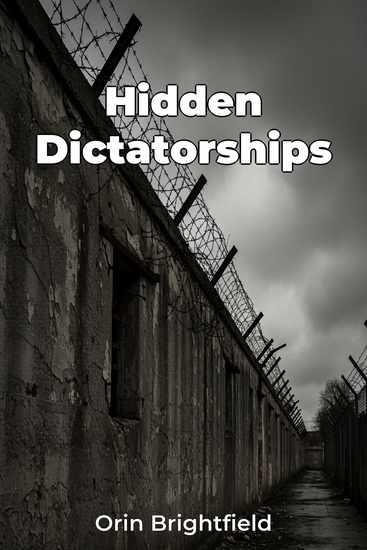
Hidden Dictatorships - cover

Hidden Dictatorships

Orin Brightfield

Translator A Ai

Publisher: Publifye

  • 0
  • 0
  • 0

Summary

Hidden Dictatorships explores the subtle mechanisms through which authoritarian regimes maintain power, often evading international attention. It delves into how these lesser-known dictatorships utilize sophisticated control tactics and propaganda, especially in the digital age. The book examines these regimes' impact on society, highlighting how they differ from more overt forms of tyranny. Understanding these hidden forms of oppression is crucial, as they often undermine seemingly stable societies through insidious means such as economic coercion.

 
The book is structured to first introduce the concept of "hidden" dictatorships, differentiating them from more visible authoritarian rule. It then examines specific case studies, illustrating how these regimes operate through methods like digital surveillance and the manipulation of civil society. Finally, it analyzes the long-term societal impacts, including the erosion of democratic institutions and the suppression of independent thought.

 
The book argues that these regimes survive by adapting and innovating their tactics to circumvent global scrutiny, challenging traditional understandings of dictatorship. By focusing on covert authoritarianism and dictatorship tactics, this book offers a unique comparative approach, examining common threads across seemingly disparate regimes. The insights presented have practical applications for policymakers and activists working to promote democracy and human rights, offering strategies to counter authoritarianism and support civil society. It is a valuable resource for anyone interested in political history, world history, and the dynamics of authoritarianism in the modern world.
Available since: 03/21/2025.
Print length: 71 pages.

Other books that might interest you

  • How Ableism Fuels Racism - Dismantling the Hierarchy of Bodies in the Church - cover

    How Ableism Fuels Racism -...

    Lamar Hardwick

    • 0
    • 0
    • 0
    Publishers Weekly starred review 


    "Marshaling fine-grained historical detail and scrupulous analysis, Hardwick persuades." —Publishers Weekly (starred review) 


    As a Black autistic pastor and disability scholar, Lamar Hardwick lives at the intersection of disability, race, and religion. Tied to this reality, he heeded the call to write How Ableism Fuels Racism to help Christian communities engage in critical conversations about race by addressing issues of ableism. 


    Hardwick believes that ableism—the idea that certain bodies are better than others—and the disability discrimination fueled by this perspective are the root causes of racial bias and injustice in American culture and in the church. Here, he uses historical records, biblical interpretation, and disability studies to examine how ableism in America led to the creation of images, idols, and institutions that perpetuate both disability and racial discrimination. 


    He then goes a step further, calling the church into action to address the deep-seated issues of ableism that started it all and offering practical steps to help listeners dismantle ableism and racism both in attitude and practice.
    Show book
  • Kyshtym Disaster The: The Controversial History of the Nuclear Meltdown Hidden by the Soviet Union - cover

    Kyshtym Disaster The: The...

    Charles River Editors

    • 0
    • 0
    • 0
    For decades, it was believed that the first major accident at a nuclear power plant took place at Three Mile Island in Pennsylvania in 1979, which took nearly 15 years and $1 billion to fully clean up after that disaster. However, Three Mile Island paled in comparison to Chernobyl, which to this day remains the most notorious nuclear accident in history. Located in the Ukraine, the Chernobyl power plant was undergoing experiments in the early morning hours of April 26, 1986 when it suffered a series of explosions in one of its nuclear reactors, killing over 30 people at the plant and spread radioactive fallout across a wide swath of the Soviet Union. Although the Soviets would try to cover up just how disastrous the accident at Chernobyl was, it was impossible to hide the full extent of the damage given that radioactive material was affecting Western Europe as well. All told, the accident caused an estimated $18 billion in damages, forced the evacuation of everybody nearby, and continues to produce adverse health effects that are still being felt in the region.  
    	The disasters emphatically demonstrated the dangers of nuclear power plants, and it brought about new regulations across the world in an effort to make the use of nuclear energy safer. Meanwhile, scientists and scholars are still studying the effects of the radiation on people exposed to the disasters and continue to come up with estimates of just how deadly they were. 
    	As it turned out, however, Chernobyl was not the first major nuclear disaster that the Soviets tried to hide. In 1957, a nuclear disaster occurred in an area near the Ural Mountains, far to the east of Moscow and to the north of the border with Kazakhstan, and to this day, it is a disaster few have heard of, even though it was the world’s worst nuclear disaster until Chernobyl. For those aware of it, it is now known as the Kyshtym disaster. 
    Show book
  • The World Is Always Coming to an End - Pulling Together and Apart in a Chicago Neighborhood - cover

    The World Is Always Coming to an...

    Carlo Rotella

    • 0
    • 0
    • 0
    An urban neighborhood remakes itself every day—and unmakes itself, too. Houses and stores and streets define it in one way. But it’s also people—the people who make it their home, some eagerly, others grudgingly. A neighborhood can thrive or it can decline, and neighbors move in and move out. Sometimes they stay but withdraw behind fences and burglar alarms. If a neighborhood becomes no longer a place of sociability and street life, but of privacy indoors and fearful distrust outdoors, is it still a neighborhood? 
      
    In the late 1960s and 1970s Carlo Rotella grew up in Chicago’s South Shore neighborhood—a place of neat bungalow blocks and desolate commercial strips, and sharp, sometimes painful social contrasts. In the decades since, the hollowing out of the middle class has left residents confronting—or avoiding—each other across an expanding gap that makes it ever harder for them to recognize each other as neighbors. Rotella tells the stories that reveal how that happened—stories of deindustrialization and street life; stories of gorgeous apartments with vistas onto Lake Michigan and of Section 8 housing vouchers held by the poor. 
     
    Blending journalism, memoir, and archival research, The World Is Always Coming to an End uses the story of one American neighborhood to challenge our assumptions about what neighborhoods are, and to think anew about what they might be if we can bridge gaps and commit anew to the people who share them with us. Tomorrow is another ending.
    Show book
  • Breaking Bread - A Memoir - cover

    Breaking Bread - A Memoir

    Jonathan Jansen

    • 0
    • 0
    • 0
    Professor. Pundit. Public nuisance. In his columns, books and on social media, Jonathan Jansen is prolific, and he likes to speak his mind about schools and universities, race, politics and our complex South African society. 
      
    He has brought incisive analysis, compassion and a sense of humour to some of the most controversial issues in our country for many years. And now, in this memoir, Jansen goes back to his early years: growing up in a loving, fiercely evangelical family on the Cape Flats, being put on the road to purpose by an inspiring school teacher and becoming the first of his generation to go to university. Journey with Jansen as he finds his passion for teaching high school and becomes a leading academic and thinker amid great transformation in post-apartheid South Africa. 
      
    His gift for story-telling and his interactions with people from different walks of life offer moving insights into the intricacies of South African society, insights that are filled with wisdom and leadership lessons. Jansen’s patchwork of memories tells a bigger story than that of his own life. It’s a tale of learning the value of ‘breaking bread’ with others, of finding mutual recognition in our different fears and faiths, our fumbles and fortitude, our hurts and our hopes.
    Show book
  • Visibility Interrupted - Rural Queer Life and the Politics of Unbecoming - cover

    Visibility Interrupted - Rural...

    Carly Thomsen

    • 0
    • 0
    • 0
    Today most LGBTQ rights supporters take for granted the virtue of being "out, loud, and proud." Most also assume that it would be terrible to be LGBTQ in a rural place. By considering moments in which queerness and rurality come into contact, Visibility Interrupted argues that both positions are wrong. In the first monograph on LGBTQ women in the rural Midwest, Carly Thomsen deconstructs the image of the rural as a flat, homogenous, and anachronistic place where LGBTQ people necessarily suffer. And she suggests that visibility is not liberation and will not lead to liberation. 


    Far from being an unambiguous good, argues Thomsen, visibility politics can, in fact, preclude collective action. They also advance metronormativity, postraciality, and capitalism. To make these interventions, Thomsen develops the theory of unbecoming: interrogating the relationship between that which we celebrate and that which we find disdainful—the past, the rural, politics—is crucial for developing alternative subjectivities and politics. Unbecoming precedes becoming. Drawing from critical race studies, disability studies, and queer Marxism, in addition to feminist and queer studies, the insights of this book will be useful to scholars theorizing issues far beyond sexuality and place and to social justice activists who want to move beyond visibility.
    Show book
  • All the Rage - Why We Feel Anger and How to Use It - cover

    All the Rage - Why We Feel Anger...

    Josh Cohen

    • 0
    • 0
    • 0
    Anger is all around us, from divisive social media arguments and heightened political divides to road rage and personal spats; from Black Lives Matter and climate justice movements to Trump, incels, and white supremacists. When it materializes, it seems to cry out for recognition and response. It affects our bodies and can transition into violence. It can be inherited through the generations; it can manifest in criminal acts. What should we do with it, and can it ever be put to good use?Drawing on case studies of patients, developments in neuropsychology, literature, philosophy, and recent political events, acclaimed author and psychoanalyst Josh Cohen identifies the different forms of anger, including the most untrammeled and elemental fury, the more cynical anger that works towards political unrest, and the questioning anger of political protest. Rather than an emotion to ignore, he argues that anger is a primary human feeling. It maps itself onto every aspect of our intimate lives while politically and culturally shaping our world.In a time of intense dissatisfactions and spiraling divisions, and with anger a dominating force, All the Rage offers a new and original understanding of anger, so we may better handle the rage within us.
    Show book