Rejoignez-nous pour un voyage dans le monde des livres!
Ajouter ce livre à l'électronique
Grey
Ecrivez un nouveau commentaire Default profile 50px
Grey
Abonnez-vous pour lire le livre complet ou lisez les premières pages gratuitement!
All characters reduced
Bangkok Streets - cover

Bangkok Streets

Oliver Scott

Traducteur A AI

Maison d'édition: Publifye

  • 0
  • 0
  • 0

Synopsis

"Bangkok Streets" vividly explores Thailand's capital, revealing its evolution through history, globalization's impact, and the lives of its residents. The book navigates Bangkok's chaotic charm, blending iconic temples with modern skyscrapers, and traditional crafts with contemporary markets. From its humble beginnings as a trading post to its current status, Bangkok's story is etched into its streets, shaped by royal patronage, western influences, and political shifts. The book argues that Bangkok's identity is a dynamic negotiation between tradition and modernity. It unfolds across three sections: historical roots, contemporary landscape, and the everyday lives of Bangkok's residents. Through diverse sources, including archival documents and personal interviews, "Bangkok Streets" offers an intimate glimpse into the city's heart, making it valuable for those interested in urban history, Southeast Asian culture, and the dynamics of globalization.
Disponible depuis: 20/02/2025.
Longueur d'impression: 62 pages.

D'autres livres qui pourraient vous intéresser

  • The Fight for Privacy - Protecting Dignity Identity and Love in the Digital Age - cover

    The Fight for Privacy -...

    Danielle Keats Citron

    • 0
    • 0
    • 0
    Privacy is disappearing. From our sex lives to our workout routines, the details of our lives once relegated to pen and paper have joined the slipstream of new technology. As a MacArthur fellow and distinguished professor of law at the University of Virginia, acclaimed civil rights advocate Danielle Citron has spent decades working with lawmakers and stakeholders across the globe to protect what she calls intimate privacy—encompassing our bodies, health, gender, and relationships. When intimate privacy becomes data, corporations know exactly when to flash that ad for a new drug or pregnancy test. Social and political forces know how to manipulate what you think and who you trust, leveraging sensitive secrets and deepfake videos to ruin or silence opponents. And as new technologies invite new violations, people have power over one another like never before, from revenge porn to blackmail, attaching life-altering risks to growing up, dating online, or falling in love. 


    A masterful new look at privacy in the twenty-first century, The Fight for Privacy takes the focus off Silicon Valley moguls to investigate the price we pay as technology migrates deeper into every aspect of our lives: entering our bedrooms and our bathrooms and our midnight texts; our relationships with friends, family, lovers, and kids; and even our relationship with ourselves.
    Voir livre
  • Teaching on Days After - Educating for Equity in the Wake of Injustice - cover

    Teaching on Days After -...

    Alyssa Hadley Dunn

    • 0
    • 0
    • 0
    What should teachers do on the days after major events, tragedies, and traumas, especially when injustice is involved? This beautifully written book features teacher narratives and youth-authored student spotlights that reveal what classrooms do and can look like in the wake of these critical moments. Dunn incisively argues for the importance of equitable commitments, humanizing dialogue, sociopolitical awareness, and a rejection of so-called pedagogical neutrality across all grade levels and content areas. Teaching on Days After can be used to support current classroom teachers and to better structure teacher education to help preservice teachers think ahead to their future classrooms. 


    Book Features: 


    ● Narratives from teachers and students that represent a diverse range of identities, locations, grade levels, and content areas. 


    ● Examples of days after that teachers remember, including 9/11, elections, natural disasters, gun violence, police brutality, social uprisings, Supreme Court decisions, immigration policies, and more. 


    ● Examples of days after that K–12 and college-aged students remember, including what their teachers did and didn't do.
    Voir livre
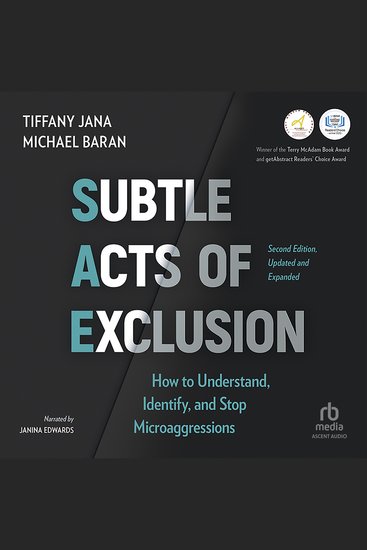
  • Subtle Acts of Exclusion - How to Understand Identify and Stop Microaggressions - cover

    Subtle Acts of Exclusion - How...

    Anonyme

    • 0
    • 0
    • 0
    The first practical handbook that helps individuals and organizations recognize and prevent microaggressions so that all employees can feel a sense of belonging. 
     
    Our workplaces and society are growing more diverse, but are we supporting inclusive cultures? While overt racism, sexism, ableism, and other forms of discrimination are relatively easy to spot, we cannot neglect the subtler everyday actions that normalize exclusion. Many have heard the term microaggression, but not everyone fully understands what they are or how to recognize them and stop them from happening. 
     
    In this book, Tiffany Jana and Michael Baran offer a clearer, more accessible term, subtle acts of exclusion, or SAEs, to emphasize the purpose and effects of these actions. After all, people generally aren't trying to be aggressive-usually they're trying to say something nice, learn more about a person, be funny, or build closeness. But whether in the form of exaggerated stereotypes, backhanded compliments, unfounded assumptions, or objectification, SAE are damaging to our coworkers, friends, and acquaintances. Jana and Baran give simple and clear tools to identify and address such acts, offering scripts and action plans for everybody involved: the subject, initiator, and observer. Knowing how to have these conversations in an open-minded, honest way will help us build trust and create stronger workplaces and healthier, happier people and communities.
    Voir livre
  • A Little Cocaine to Loosen My Tongue - cover

    A Little Cocaine to Loosen My...

    Sigmund Freud

    • 0
    • 0
    • 0
    In the 1880s, Freud discovered cocaine and became enthusiastic about what was not yet considered a party drug. Favoring the use of cocaine in the treatment of neurasthenia, as an energizer, or as an anesthetic, Freud made a creative and fashionable use of it, heralding practices that our society knows well. Several surprising texts are gathered here on cocaine. Freud recounts the use of coca in history, particularly in South America, from where it was imported. In Cocaine Addiction and Cocaine Phobia, the inventor of psychoanalysis defended coca against its accusers as a dangerous product. Finally, in the letters to Martha Bernays, his future wife, we discover an intimate and loving Freud, telling how he escaped boring dinners thanks to his dear magic substance.
    Voir livre
  • History of China - Specific Events Causes and Consequences - cover

    History of China - Specific...

    Kelly Mass

    • 0
    • 0
    • 0
    This is a combo of 5 titles with different topics related to Chinese history. The topics are the following: 
    Ancient China: It’s hard to cover all of China’s vast history in a short book, but for the sake of leaving out details, we will still give it a try. In this guide, you will be able to learn more about the most important turning events, eras, dynasties, leaders, wars, and cultural aspects of ancient China. 
    Chinese Mythology: Chinese folklore is mythology from the geographical area now called China that has been given orally or documented. Several myths from different local and cultural customs are included in Chinese folklore. Much of folklore includes thrilling stories including impressive characters and beings, the use of magic powers, and normally occurs in a mythologically unique area or time. 
    Confucius: Confucius was a Chinese thinker and political leader who was considered as the apotheosis of Chinese sages. Confucius' theories and philosophy, commonly seen as one of the most essential and prominent individuals in human history, created the structure of East Asian civilization and civilization, and stay appropriate across China and East Asia today. Confucianism, his philosophical theories, highlighted personal and governmental morality, social connection precision, justice, generosity, and genuineness. 
    Mao Zedong: Mao Zedong has had a tremendous impact on the Chinese nation. During his Great Leap Forward, he was responsible for more deaths than both Hitler and Stalin, making him the biggest mass murderer in history. What happened during the Great Leap Forward? Why did so many farmers starve to death? And what else did Mao Zedong do during his reign? 
    Portuguese Macau: Macau is known as the Las Vegas of China. It attracts many tourists every year, and it has a unique set of laws and history behind it. How did it become this way? Well, one of the reasons is that it used to be part of the Portuguese Empire.
    Voir livre
  • The Digital Paradigm Shift - A Groundbreaking Machine's Impact on Civilization - cover

    The Digital Paradigm Shift - A...

    John Harpoon

    • 0
    • 0
    • 0
    The journey into the digital age began with the spark of human ingenuity and the desire to simplify complex tasks. Early civilizations laid the groundwork for computation by devising systems to manage trade, record history, and calculate astronomical events. These early tools, such as the abacus and mechanical calculators, may seem rudimentary by modern standards, yet they were the building blocks of a monumental transformation. 
    In the late 19th and early 20th centuries, the seeds of the digital age began to take root. Pioneers like Charles Babbage and Ada Lovelace envisioned the potential of programmable machines long before the technology to build them existed. Lovelace's notes on Babbage's Analytical Engine contained the first algorithm intended for implementation on a machine, earning her recognition as the world’s first computer programmer. Their ideas laid a conceptual foundation that would inspire future innovators. 
    The advent of World War II catalyzed the development of modern computing. The need for advanced cryptography, ballistics calculations, and logistical coordination drove governments and researchers to invest in computational technologies. Alan Turing, often referred to as the father of computer science, developed the Turing Machine, a theoretical construct that became a cornerstone of computer science. His work at Bletchley Park, cracking the German Enigma code, not only shortened the war but also showcased the immense potential of automated computation.
    Voir livre