Begleiten Sie uns auf eine literarische Weltreise!
Buch zum Bücherregal hinzufügen
Grey
Einen neuen Kommentar schreiben Default profile 50px
Grey
Jetzt das ganze Buch im Abo oder die ersten Seiten gratis lesen!
All characters reduced
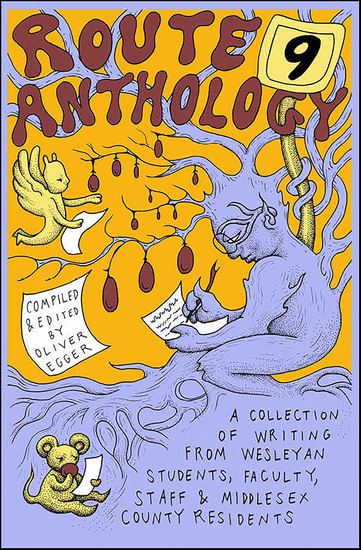
The Route 9 Anthology - A Collection of Writing from Wesleyan Students Faculty Staff & Middlesex County Residents - cover

The Route 9 Anthology - A Collection of Writing from Wesleyan Students Faculty Staff & Middlesex County Residents

Oliver Egger

Verlag: Wesleyan University Press

  • 0
  • 0
  • 0

Beschreibung

The Route Nine Anthology is a collection of poetry and prose from Wesleyan students, faculty, staff, and Middlesex County residents. It is the first collection of prose dedicated specifically to bridging the literary divide between the Wesleyan and Middlesex County communities.
Verfügbar seit: 05.09.2022.
Drucklänge: 62 Seiten.

Weitere Bücher, die Sie mögen werden

  • Joy Us - LGBTQ+ poetry - cover

    Joy Us - LGBTQ+ poetry

    Cherry Potts, Jeremy Dixon

    • 0
    • 0
    • 0
    Arachne Press has long been a champion of LGBTQ+ writers, but we've never before published an anthology of LGBTQ+ poetry. These are joyful poems that celebrate all that is best about our community/ies and lives. This is not an 'explain it to the straights' book, this is for us. LGBTQ+ readers can open this book at random and find a moment of poetic queer joy for themselves, however big or small.
    Featuring contributions from: Abhi Alexander Williams Annie Kerr Aoife Mannix Becky Brookfield Cherry Potts Conway Emmett Dean Atta Desree Elizabeth Chadwick Pywell Elizabeth Gibson Garnett 'Ratte' Frost Helen Bowie Jane Aldous Jeremy Dixon John McCullough Joshua Linney Joshua Jones Joy Howard JP Seabright K. Angel Kate Foley Khakan Qureshi, BEM Laurie B. Lawrence Wilson Lydia Fulleylove Maria Jastrzębska Mwelwa Chilekwa P Burton-Morgan Rab Green Rick Dove Robert Hamberger Sophia Blackwell Steph Morris Tanya Erin Sheehan Tom McLaughlin Vron McIntyre Zo Copeland
    Zum Buch
  • Harbour Grids - cover

    Harbour Grids

    Zane Koss

    • 0
    • 0
    • 0
    Harbour Grids is a long poem in four parts that investigates ideas of community and belonging. Beginning as a meditation on the surface of New York Harbor, the poem radiates outward through issues of labour, location, history, belonging, and subjectivity. How do we experience our complex relations to the world we live in? Harbour Grids seeks to answer this question by combining the sonic texture and investigative poetics of Daphne Marlatt, the improvisatory spirit and ethical engagement of Fred Wah, the experimental attention to the structures of language of Nasser Hussain, and the dazzling sense of visual space of Jordan Abel.
    Zum Buch
  • Manland - cover

    Manland

    Peter Raynard

    • 0
    • 0
    • 0
    Peter Raynard's Manland is a bold, brilliant and outspoken new collection of poems that scrutinise men and manhood, mental health, working class lives and disability. Aloud and alive with music, wit, anger and rebellion, this is an accomplished, politically-aware and vital book.
    Raynard is a skilled observer, and these razor-sharp poems document parenthood through the lens of a stay-at-home dad, attempt to tell the truth about men and depression, study our cultural, social and medical relationships with drugs and drug-taking, and lay bare the realities of life at the sharpest edges of society. By turns frank, painful and bleakly funny, this humane and brilliant book encompasses pride and prejudices, the bonds between lads and dads, the toxic pressures of masculinity and the way illness and poverty irrevocably shape lives.
    Zum Buch
  • The Tragedy of King Lear - cover

    The Tragedy of King Lear

    William Shakespeare

    • 0
    • 0
    • 0
    King Lear is a tragedy written by William Shakespeare. It tells the tale of a king who bequeaths his power and land to two of his three daughters, after they declare their love for him in an extremely fawning and obsequious manner. His third daughter gets nothing, because she will not flatter him as her sisters had done. When he feels disrespected by the two daughters who now have his wealth and power, he becomes furious to the point of madness. He eventually becomes tenderly reconciled to his third daughter, just before tragedy strikes her and then the king.
    Derived from the legend of Leir of Britain, a mythological pre-Roman Celtic king, the play has been widely adapted for the stage and motion pictures, with the title role coveted by many of the world's most accomplished actors. 
    The first attribution to Shakespeare of this play, originally drafted in 1605 or 1606 at the latest with its first known performance on St. Stephen's Day in 1606, was a 1608 publication in a quarto of uncertain provenance, in which the play is listed as a history; it may be an early draft or simply reflect the first performance text. The Tragedy of King Lear, a revised version that is better tailored for performance, was included in the 1623 First Folio. Modern editors usually conflate the two, though some insist that each version has its own individual integrity that should be preserved.
    Among the most significant works William Shakespeare: Hamlet, Othello, King Lear, Macbeth, Orpheus, Romeo and Juliet, Julius Caesar, Troilus and Cressida, The Tempest, Venus and Adonis, Antony and Cleopatra, Measure for Measure, The Winter's Tale and many more.
    Zum Buch
  • Cymbeline King of Britain - cover

    Cymbeline King of Britain

    William Shakespeare

    • 0
    • 0
    • 0
    Cymbeline, also known as The Tragedie of Cymbeline or Cymbeline, King of Britain, is a play by William Shakespeare set in Ancient Britain (c. 10–14)[a] and based on legends that formed part of the Matter of Britain concerning the early Celtic British King Cunobeline. Although listed as a tragedy in the First Folio, modern critics often classify Cymbeline as a romance or even a comedy. Like Othello and The Winter's Tale, it deals with the themes of innocence and jealousy. While the precise date of composition remains unknown, the play was certainly produced as early as 1611.
    Cymbeline, the Roman Empire's vassal king of Britain, once had two sons, Guiderius and Arvirargus, but they were stolen twenty years earlier as infants by an exiled traitor named Belarius. Cymbeline discovers that his only child left, his daughter Imogen (or Innogen), has secretly married her lover Posthumus Leonatus, a member of Cymbeline's court. The lovers have exchanged jewellery as tokens: Imogen with a bracelet, and Posthumus with a ring. Cymbeline dismisses the marriage and banishes Posthumus since Imogen — as Cymbeline's only child — must produce a fully royal-blooded heir to succeed to the British throne. In the meantime, Cymbeline's Queen is conspiring to have Cloten (her cloddish and arrogant son by an earlier marriage) married to Imogen to secure her bloodline. The Queen is also plotting to murder both Imogen and Cymbeline, procuring what she believes to be deadly poison from the court doctor. The doctor, Cornelius, is suspicious and switches the poison with a harmless sleeping potion. The Queen passes the "poison" along to Pisanio, Posthumus and Imogen's loving servant — the latter is led to believe it is a medicinal drug. No longer able to be with her banished Posthumus, Imogen secludes herself in her chambers, away from Cloten's aggressive advances.
    Although the play is named Julius Caesar, Brutus speaks more than four times as many lines as the title character; and the central psychological drama of the play focuses on Brutus' struggle between the conflicting demands of honour, patriotism, and friendship. 
    Among the most significant works William Shakespeare: Hamlet, Othello, King Lear, Macbeth, Orpheus, Romeo and Juliet, Julius Caesar, Troilus and Cressida, The Tempest, Venus and Adonis, Antony and Cleopatra, Measure for Measure, The Winter's Tale and many more.
    Zum Buch
  • Then the War - And Selected Poems 2007-2020 - cover

    Then the War - And Selected...

    Caryl Phillips

    • 0
    • 0
    • 0
    "In much of the best contemporary poetry, beauty of thought is at least as important as beauty of language. Carl Phillips, here reading his own Pulitzer Prize-winning collection, has an ample supply of both, but it is the thinking behind each poem that makes it possible for the language to have power." - AudioFileWINNER OF THE 2023 PULITZER PRIZE IN POETRYA new collection of poems from one of America’s most essential, celebrated, and enduring poets, Carl Phillips's Then the WarI’m a song, changing. I’m a light rain falling through a vast darkness toward a different darkness.Carl Phillips has aptly described his work as an “ongoing quest”; Then the War is the next step in that meaningful process of self-discovery for both the poet and his reader. The new poems, written in a time of rising racial conflict in the United States, with its attendant violence and uncertainty, find Phillips entering deeper into the landscape he has made his own: a forest of intimacy, queerness, and moral inquiry, where the farther we go, the more difficult it is to remember why or where we started. Then the War includes a generous selection of Phillips’s work from the previous thirteen years, as well as his recent lyric prose memoir, “Among the Trees,” and his chapbook, Star Map with Action Figures.Ultimately, Phillips refuses pessimism, arguing for tenderness and human connection as profound forces for revolution and conjuring a spell against indifference and the easy escapes of nostalgia. Then the War is luminous testimony to the power of self-reckoning and to Carl Phillips as an ever-changing, necessary voice in contemporary poetry.
    Zum Buch