Begleiten Sie uns auf eine literarische Weltreise!
Buch zum Bücherregal hinzufügen
Grey
Einen neuen Kommentar schreiben Default profile 50px
Grey
Jetzt das ganze Buch im Abo oder die ersten Seiten gratis lesen!
All characters reduced
Photojournalism Lies - cover

Photojournalism Lies

Octavia Marchand

Übersetzer A AI

Verlag: Publifye

  • 0
  • 0
  • 0

Beschreibung

Photojournalism Lies uncovers the troubling reality of manipulated news photography and its impact on public trust and political landscapes. The book reveals that photo manipulation, ranging from staging to digital alterations, has a long history and is often driven by political agendas seeking to shape narratives and influence public opinion. One key insight is how these manipulations, even subtle ones like misleading captions, can erode media credibility and incite social unrest.

 
The book presents its findings through a structured approach, beginning with foundational concepts of visual rhetoric and the history of photo manipulation. It progresses by examining specific case studies categorized by manipulation type, such as cropping, altering content, and staging. Finally, it analyzes the profound effects of these manipulated images on public trust, political movements, and international relations, providing readers with practical tools to critically evaluate photojournalistic content.

 
By focusing on the why and the consequences of photo manipulation, rather than just the how, Photojournalism Lies offers a unique framework for understanding the motivations and impact of these deceptive practices. Drawing from diverse sources like archival photographs and journalistic investigations, the book connects to fields like political science, sociology, and ethics, enriching the discussion and providing multiple lenses through which manipulation can be understood.
Verfügbar seit: 26.02.2025.
Drucklänge: 73 Seiten.

Weitere Bücher, die Sie mögen werden

  • The Politics of Obedience - A Discourse on Voluntary Servitude - cover

    The Politics of Obedience - A...

    Etienne de la Botie

    • 0
    • 0
    • 0
    In this seminal work of political philosophy, Boetie asks one of the most obvious questions of political theory: why is it that a minority of rulers can remain in power over a majority of subjects who pay all the taxes? 
    The answer might be quite surprising to us all. The conclusion is that the people tend to enslave themselves, to let themselves be governed by tyrants. 
    Liberty is the natural condition of the people. Servitude, however, is fostered when people are raised in subjection. People are trained to adore rulers. While freedom is forgotten by many, there are always some who will never submit. 
    What is the answer then? 
    The author brilliantly and obviously outlines these points in the pages that follow in a way that is illuminating and also simple. It is we who enslave ourselves at the beck and call of 'authority'. Enjoy this classic work that roots sovereignty into philosophy and demonstrates how simply the tides can change.
    Zum Buch
  • Iron Legacy - Childhood Trauma and Adult Transformation - cover

    Iron Legacy - Childhood Trauma...

    Donna Bevan-Lee

    • 0
    • 0
    • 0
    Donna Bevan-Lee had a tough childhood. When her father was feeling playful, he roped her by the foot like a rodeo calf, yanking her to the ground every time the rope connected. In darker moods, he did far worse, his brutality excused by a complicit church. The abuse she suffered had profound and lasting consequences. 
    Too many adults have similar histories. Roughly a quarter of American children experience complex trauma resulting from abuse, neglect, catastrophic illness, or other adversity. Because such trauma affects the developing brain, it's not something we outgrow; it permanently alters our thoughts, feelings, perceptions, and behavior, often without our awareness. It derails our plans, sabotages our relationships, and convinces us that we're unworthy of happiness. It makes us vulnerable to addiction, obesity. depression, anxiety, chronic illness, and early death. It is a challenge like no other. 
    Dr. Bevan-Lee met the challenge of her childhood and helped other survivors to meet theirs. Now she has distilled her history. cutting-edge research, and four decades of clinical experience into a book for adult survivors of childhood trauma. Full of up-to-date information, practical help, compelling stories, and clear-eyed encouragement, this book is a comprehensive guide to recognizing and overcoming childhood trauma, written by someone who has been there.
    Zum Buch
  • The Battle of Tours - Defending Christendom - cover

    The Battle of Tours - Defending...

    Harris Ropes

    • 0
    • 0
    • 0
    The Umayyad Caliphate emerged as one of the most powerful empires in the early Islamic world, expanding its influence across vast territories from the Middle East to North Africa and into Europe. Following the death of Prophet Muhammad, the Islamic world underwent a rapid transformation, with the Rashidun Caliphs overseeing the initial expansion. However, it was under the Umayyads, beginning in 661 CE, that the Islamic empire reached unprecedented heights, establishing a vast and organized dominion. Their rule was characterized by military conquests, administrative advancements, and cultural integration, making them a formidable force in the medieval world. 
    One of the most defining aspects of Umayyad expansion was its push into Western Europe. After successfully conquering the Iberian Peninsula in 711 CE, the Muslim forces, primarily composed of Berbers and Arabs, established Al-Andalus under the leadership of governors appointed by the Umayyad Caliphate. The conquest of the Visigothic Kingdom was swift, with key victories such as the Battle of Guadalete opening the doors for further advances northward. By the early 8th century, the Umayyads had consolidated control over much of present-day Spain and Portugal, making their presence in Europe a significant political and military reality. 
    As the Umayyads strengthened their hold over Iberia, their attention turned toward the Frankish territories. The Islamic forces, seeking to expand their influence beyond the Pyrenees, launched several incursions into the southern regions of Gaul. These raids, initially aimed at securing wealth and resources, gradually evolved into more ambitious campaigns of territorial expansion. The city of Narbonne fell under Muslim control in 719 CE, serving as a critical stronghold for future campaigns. From there, the Umayyads pushed further into Aquitaine, where they encountered resistance from the local Christian rulers, most notably Duke Odo of Aquitaine.
    Zum Buch
  • Whispers of Betrayal - Love Letters That Changed Everything - cover

    Whispers of Betrayal - Love...

    Adela Edgecombe

    • 0
    • 0
    • 0
    On a journey of discovery into her parents history of love and fame in war torn Italy, Adela Edgecombe discovered a secret deception within love letters and from family who had been tight-lipped about the scandals for decades.            Bestselling author Jincy Willett describes the story as follows: "Since every human personality is at root mysterious, all families present us with an abundance of mysteries, the chief of which is often how marriages ever happened in the first place. In her family memoir, Adela Edgecombe tackles that mystery head-on, uncovering a web of circumstances peculiar to place and time. The place is the Province of Salerno, Italy; the time,1944, the depths of World War II. A young American GI meets an impoverished Italian family, grows to care for them, and, as he leaves for the front, promises a nine-year-old child that one day he will return and help them. And does the man, against all odds, keep that promise? Judging from the fairy-tale wedding that took place in Passiano in 1951 and was featured in Life Magazine, it would seem so.           "Edgecombe explores that fairy tale moment, how it came to pass, and what followed after. She digs fearlessly into the mystery of an unhappy marriage that began with such photogenic joy and hope. Read Whispers of Betrayal for a well-researched, surprising, and moving tale which reminds us that the casualties of war are many and varied."
    Zum Buch
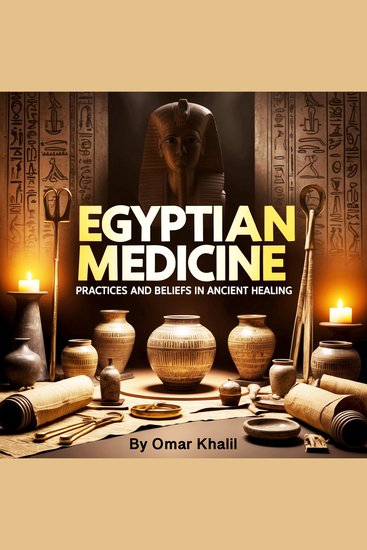
  • Egyptian Medicine - Practices and Beliefs in Ancient Healing - cover

    Egyptian Medicine - Practices...

    Omar Khalil

    • 0
    • 0
    • 0
    The origins of Egyptian medicine trace back to the earliest periods of ancient Egypt, where the intertwining of practical knowledge and spiritual beliefs laid the foundation for one of the most advanced medical systems of the ancient world. As early as the Pre-Dynastic period, evidence of rudimentary medical practices reveals that Egyptians were already exploring ways to treat injuries and ailments using natural resources available in their environment. 
    Religion played a fundamental role in shaping the practice of medicine in ancient Egypt. The Egyptians believed that the gods held power over health and illness, with many deities associated with specific aspects of healing. For instance, Sekhmet, the lioness goddess, was both a bringer of plague and a healer, while Thoth, the god of wisdom, was revered as a patron of physicians. Temples dedicated to these deities often served as centers for both worship and healing, where priests acted as both spiritual leaders and medical practitioners. 
    Early medical practices were closely linked to mythology, with illnesses often attributed to divine displeasure or the influence of malevolent spirits. Healing rituals and incantations were designed to restore the balance between the individual and the divine order, highlighting the Egyptian belief in a holistic approach to health. The blending of prayer, magic, and practical remedies reflects a medical philosophy that considered both the physical and spiritual dimensions of wellness.
    Zum Buch
  • Tsunami Days - cover

    Tsunami Days

    John Barnie

    • 0
    • 0
    • 0
    "We need more writers with bite. We have lived in the flatlands too long," writes John Barnie in one of his 'observations' ('Art in the Flatlands'). And bite he delivers.
    
    Ranging across politics, history, culture, ecological disaster, the meaning of truth, poetry, what we mean by identity and more… Barnie shares a window onto the world that is both erudite and particular. Leaning towards pessimism in a darkening world, these observations are often provocative, not from any bullish desire to antagonise, but as the result of mining a rationalist line of thought with an honesty and consistency that is applied as much to the author as to his subjects. There is a clarity here that some may find uncomfortable, but the aim is always dialogue above agreement; intellectual engagement above cheap solutions and sentimentality.
    
    Barnie asks us to think, consider and dig deeper, but most of all he asks that we "…live richly among our secondary self-created meanings, while recognising them for what they are. To face without flinching the nullity of the great void." ('Varieties of Meaning')
    Tsunami Days is a vital collection of essays for those prepared to engage with its unflinching observations.
    Zum Buch