Begleiten Sie uns auf eine literarische Weltreise!
Buch zum Bücherregal hinzufügen
Grey
Einen neuen Kommentar schreiben Default profile 50px
Grey
Jetzt das ganze Buch im Abo oder die ersten Seiten gratis lesen!
All characters reduced
Live Streaming - cover

Live Streaming

Ocean Ecosoft

Übersetzer A AI

Verlag: Publifye

  • 0
  • 0
  • 0

Beschreibung

Live Streaming explores how real-time video has reshaped our digital landscape, impacting social media, gaming, and online entertainment. It delves into the democratization of live video, examining its technological evolution and societal consequences. The book highlights the rise of digital authenticity, fostering unfiltered connections, but also addresses challenges like content moderation and privacy. Live streaming has become integral to social interaction, business communication, and the global economy.

 
The book examines the technology and platforms enabling live streaming, the social dynamics including influencers and online communities, and the economic models underpinning it. It provides a balanced perspective, acknowledging transformative potential while addressing inherent challenges. For example, live streaming allows instant global connections, yet necessitates vigilant content oversight to prevent misuse.

 
The book progresses from introducing core technologies to exploring social dynamics, analyzing economic models, and discussing ethical considerations. Using quantitative data, qualitative analysis, and interviews, it avoids technological determinism, emphasizing the interplay between technology, human agency, and social context. This makes it a valuable resource for understanding the forces shaping contemporary society.
Verfügbar seit: 26.02.2025.
Drucklänge: 85 Seiten.


Weitere Bücher, die Sie mögen werden

  • Reaching the Moon: The History of the NASA Programs that Led to the Successful Apollo Missions - cover

    Reaching the Moon: The History...

    Editors Charles River

    • 0
    • 0
    • 0
    The Apollo Program is the most famous and celebrated in American history, but the first successful landing of men on the Moon during Apollo 11 had complicated roots dating back over a decade, and it also involved one of NASA’s most infamous tragedies. From 1959-1963, the United States worked toward putting satellites and humans into orbit via the Mercury program, but Eisenhower’s administration was already designing plans for the Apollo program by 1960, a year before the first Russian orbited the Earth and two years before John Glenn became the first American to orbit the Earth. 
    At the same time, America would begin missions to the Moon as early as 1958. On March 27, 1958, Secretary of Defense Neil McElroy announced a lunar project for the International Geophysical Year, consisting of three Air Force launches followed by two Army launches of a JPL-designed lunar probe. ARPA directed the Air Force to launch its probes "as soon as possible consistent with the requirement that a minimal amount of useful data concerning the Moon be obtained." 
    Throughout the 1960s, NASA would spend tens of billions on missions to the Moon, the most expensive peacetime program in American history to that point, and Apollo was only made possible by the tests conducted through earlier missions, including the historic Ranger Program. Conceived as an early part of the attempt to land a man on the Moon, Ranger was designed to photograph the lunar surface in preparation for future landings. Until Ranger, images of the Moon were only available through Earth-based telescopes, which lacked the detail necessary to determine safe sites for landing a spacecraft. Ranger aimed to fill in that gap of knowledge, and like many of NASA’s missions during the 1960s, the program exemplified both the successes and the failures of the agency’s early years.
    Zum Buch
  • EU GDPR – An international guide to compliance - cover

    EU GDPR – An international guide...

    Alan Calder

    • 0
    • 0
    • 0
    A clear, concise primer on the GDPRThe GDPR aims to unify data protection and ease the flow of personal data across the EU. It applies to every organisation in the world that handles EU residents' personal data.While the GDPR is not law in countries outside the EU, it is effectively part of the legislative environment for organisations that do business with the EU. This is enforced through a combination of international trade law and business pressure – after all, a partner in the EU is unlikely to want to risk engaging with a company in the US, Australia or Singapore (or anywhere else) that will put them at risk.EU GDPR – An international guide to compliance is the ideal resource for anyone wanting a clear primer on the principles of data protection and their obligations under the GDPR.A concise pocket guide, it will help you understand:- The terms and definitions used in the GDPR, including explanations;- The key requirements of the GDPR, including:- Which fines apply to which Articles;- The principles that should be applied to any collection and processing of personal data;- The Regulation's applicability;- Data subjects' rights;- Data protection impact assessments;- The data protection officer role and whether you need one;- Data breaches, and notifying supervisory authorities and data subjects; and- Obligations for international data transfers.- How to comply with the Regulation, including:- Understanding your data, and where and how it is used (e.g. Cloud suppliers, physical records);- The documentation you must maintain (such as statements of the information you collect and process, records of data subject consent, processes for protecting personal data); and- The "appropriate technical and organisational measures" you need to take to ensure compliance with the Regulation.- A full index of the Regulation, enabling you to find relevant Articles quickly and easily.Supplemental material While most of the EU GDPR's requirements are broadly unchanged in the UK GDPR, the context is quite different and will have knock-on effects. You may need to update contracts regarding EU–UK data transfers, incorporate standard contractual clauses into existing agreements, and update your policies, processes and procedural documentation as a result of these changes.  We have published a supplement that sets out specific extra or amended information for this pocket guide. Click here to download the supplement. About the authorAlan Calder is the Group CEO of GRC International Group plc, the AIM-listed company that owns IT Governance Ltd. He is an internationally acknowledged cyber security expert, and a leading author on information security and IT governance issues. He co-wrote the definitive compliance guide IT Governance: An International Guide to Data Security and ISO27001/ISO27002, which is the basis for the Open University's postgraduate course on information security, and has been involved in the development of a wide range of information security management training courses that have been accredited by IBITGQ (International Board for IT Governance Qualifications). Alan has consulted on data security for numerous clients in the UK and abroad, and is a regular media commentator and speaker.
    Zum Buch
  • The Disease of Belief - How Your Convictions Can Heal You - or Destroy You - cover

    The Disease of Belief - How Your...

    IFMCP Kevin Hoffarth MD

    • 0
    • 0
    • 0
    Why me? 
    Why did I get this disease? 
    You thought you did everything right. 
    Food. Exercise. Sleep. 
    You were told your labs were “normal.” 
    So why did you still get sick? 
    Modern medicine is extraordinary at managing acute illness - yet often fails to reverse chronic disease because it overlooks where disease truly begins. 
    In The Disease of Belief, physician Kevin Hoffarth takes listeners beyond prescriptions and test results into the deeper patterns shaping biology long before symptoms appear. Drawing from decades of clinical experience, neuroscience, epigenetics, functional medicine, and emerging insights into the mind–body connection, this audiobook reveals how belief, stress, emotion, and subconscious perception quietly influence physiology—and why lasting healing requires addressing all of them. 
    This isn’t alternative medicine. 
    It’s the missing chapter.
    Zum Buch
  • The Architecture of Discipline - Building Integrity in the Intelligent Cloud - cover

    The Architecture of Discipline -...

    Lori Higham

    • 0
    • 0
    • 0
    In the era of the intelligent cloud, architecture must do more than enable systems; it must verify them. The Architecture of Discipline defines how modern enterprises design environments capable of demonstrating their own integrity—continuously and at scale. Drawing on extensive leadership experience in cloud security, Zero Trust, governance, and AI oversight, Lori Higham redefines architecture as a discipline of structure and accountability, where evidence emerges as the natural outcome of design rather than the afterthought of audit. 
    This work moves fluidly between theory and reflection, rhetoric and practice. It invites the reader to question assumptions about control, trust, and automation while offering concrete mechanisms for building systems that remain accurate, accountable, and adaptive as they evolve. Here, architecture becomes both a technical craft and a philosophical inquiry: a dialogue between what is built and what can be proven. 
    Across chapters on governance, Zero Trust, responsible AI, and assurance, The Architecture of Discipline demonstrates how design becomes verification: how standards translate into automation, ethics into operational boundary, and continuity into measurable assurance. Each section balances rigorous conceptual framing with tangible architectural patterns, reinforcing that discipline in design is both method and mindset. 
    More than a manual, this is a conversation with the reader—a call to architects, engineers, and decision-makers to examine not only what they build, but how they sustain fidelity between design and outcome. In intelligent environments, integrity is not assumed; it is demonstrated through evidence. The measure of architecture is its capacity to sustain integrity through change—to analyze, constrain, and reveal the systems it governs faster than risk can erode them.
    Zum Buch
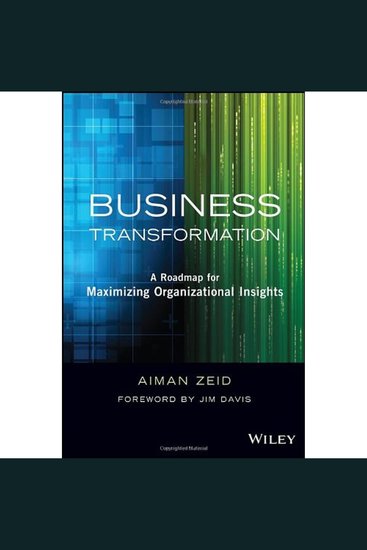
  • Business Transformation - A Roadmap for Maximizing Organizational Insights - cover

    Business Transformation - A...

    Jim Davis, Aiman Zeid

    • 0
    • 0
    • 0
    All companies use information to set strategies and accomplish  business objectives. But how many CEOs and CIOs would say they are  satisfied that their companies get maximum value from information?  Not many. How many have a systematic plan for evolving their  information capabilities to the next level? Fewer still.  SAS has developed an Information Evolution Model (IEM) to aid  companies in assessing how they use information to drive business.  The model outlines how information is managed and utilized as a  corporate asset and enables organizations to objectively evaluate  their use of information and accurately lay out a roadmap for  improvements that optimize business returns. This book shows how  the IEM can be used together with analytics.  The book  provides the necessary information that managers need to introduce  and promote the use of analytics and insight across the  organization and how to identify the starting point and develop a  roadmap. Examples of global companies that have successfully been  through this process are provided as well as best practices.
    Zum Buch
  • Becoming AI Native - Charting the Next AI Frontier - cover

    Becoming AI Native - Charting...

    Paul Lee, David Goh, Mark...

    • 0
    • 0
    • 0
    This engaging guide is designed to demystify artificial intelligence (AI) in the business world, no advanced math degrees or robotic companions are necessary. It tackles everything from traditional AI to the exciting realm of Generative AI, clearly distinguishing between what is genuinely beneficial and what is merely hype, all while demonstrating how to leverage AI to address real-world business challenges. 
    The first half of the book serves as an essential playbook for businesses eager to understand AI's potential. It cuts through the jargon, illuminating what AI can achieve and showcasing how organizations are already harnessing it to save time, enhance efficiency, and secure a competitive advantage. 
    The second half introduces the concept of the "AI Native"―a future where AI is seamlessly integrated into business operations and daily life. This transformation opens thrilling opportunities, including new markets and creative work methods. It also prompts critical questions, like what happens when AI falters? The book carefully balances optimism with caution, offering insights that inspire thoughtful reflection. 
    Whether you're leading a team, launching a startup, or gearing up for a technology-driven career, this book equips listeners to make informed decisions about AI. It is an essential resource for executives, entrepreneurs, and graduate students alike, stripping away the buzzwords to deliver actionable insights.
    Zum Buch