Join us on a literary world trip!
Add this book to bookshelf
Grey
Write a new comment Default profile 50px
Grey
Subscribe to read the full book or read the first pages for free!
All characters reduced
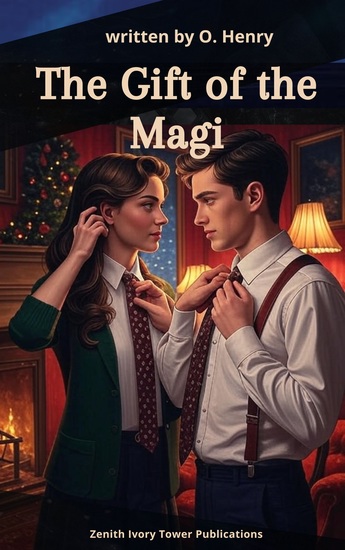
The Gift of the Magi - O Henry's Timeless Christmas Story of Love Sacrifice and Unexpected Joy - cover

The Gift of the Magi - O Henry's Timeless Christmas Story of Love Sacrifice and Unexpected Joy

O. O.Henry, Zenith Ivory Tower Publications

Publisher: Zenith Ivory Tower Publications

  • 0
  • 0
  • 0

Summary

🎁 Love is the greatest gift of all—even when you have nothing left to give.

In The Gift of the Magi, O. Henry tells one of the most beloved and enduring Christmas stories ever written. Set on a snowy Christmas Eve, this short tale follows a young, impoverished couple—Jim and Della—as they each make a secret sacrifice to bring joy to the other. Their gifts may not be expensive, but their love makes them priceless.

💔 A story of selflessness, irony, and the true spirit of giving.
With his signature wit and a twist ending that has touched generations, O. Henry reminds us that real wealth lies not in possessions, but in the heart. This unforgettable story captures the very soul of Christmas and resonates with anyone who has ever given deeply for someone they love.

🌟 Perfect for the holidays—or any season where love takes center stage.
The Gift of the Magi is a moving reminder that sometimes the greatest treasures come wrapped in sacrifice, humility, and human kindness.

🌟 What Readers and Critics Say:
"A holiday story that never grows old. Short, sweet, and stunning." — The New York Times

"O. Henry at his finest—brilliant in brevity and rich in heart." — The Washington Post

"I cry every single time I read it." — Amazon Reviewer

🎯 Why You'll Love This Book:
A perfect holiday read or stocking stuffer

A touching romantic short story about selfless love

Ideal for readers of all ages—from teens to adults

Features one of the most iconic twist endings in literature

🛒 Click Buy Now to Feel the Magic of Selfless Love This Holiday Season.
Whether it's your first time or your fiftieth, this story will move you.
👉 Click Buy Now to read The Gift of the Magi by O. Henry—a holiday classic that never stops giving.
Available since: 07/18/2025.
Print length: 22 pages.

Other books that might interest you

  • Post-Traumatic Thriving - The Art Science & Stories of Resilience - cover

    Post-Traumatic Thriving - The...

    PhD Randall Bell

    • 0
    • 0
    • 0
    Turn Trauma into Your Fuel to Thrive 
    Trauma doesn’t discriminate. It can happen to anyone, anytime. And in all likelihood, COVID-19 has traumatized each and every one of us to some degree. Everybody hits a low point once in a while, and ultimately, the quality of our lives depends on our ability to process heartbreaks and catastrophes successfully. So how do we do that? In Post-Traumatic Thriving: The Art, Science & Stories of Resilience, world-renowned expert on disasters and trauma Dr. Randall Bell interweaves science and academic research with stories of people who have not just survived but have used their trauma as their fuel to thrive. Dr. Bell sits down with survivors of the Holocaust; murder-victim’s families; crime victims; suicide survivors; and those who’ve experienced homelessness, disasters, addictions, depression, death, divorce, disabilities, defeats and disease to explore the rare mindset of the post-traumatic thriver.
    Show book
  • Battle of Fornovo The: The History of the Italian Wars’ First Major Battle - cover

    Battle of Fornovo The: The...

    Editors Charles River

    • 0
    • 0
    • 0
    In 1494, there were five sovereign regional powers in Italy: Milan, Venice, Florence, the Papal States and Naples. In 1536, only one remained: Venice. These decades of conflict precipitated great anxiety among Western thinkers, and Italians responded to the fragmentation, forevermore, of Latin Christendom, the end of self-governance for Italians, and the beginning of the early modern era in a myriad of ways. They were always heavily influenced by the lived experience of warfare between large Christian armies on the peninsula. 
    The diplomatic and military history of this 30-year period was a complex situation that one eminent Renaissance historian, Lauro Martines, has described as "best told by a computer, so many and tangled are the treatises, negotiations and battles." At the same time, the fighting went in tandem with the Renaissance and was influenced by it. Most historians credit the city-state of Florence as the place that started and developed the Italian Renaissance, a process carried out through the patronage and commission of artists during the late 12th century. If Florence is receiving its due credit, much of it belongs to the Medicis, the family dynasty of Florence that ruled at the height of the Renaissance. The dynasty held such influence that some of its family members even became Pope. 
    Meanwhile, plans for a French invasion were years in the making, and France’s young King Charles VIII, heavily influenced by chivalric tales and his men of finance, had begun his preparations for conquering Naples as a base from which to launch a crusade in 1491. Two key events were the catalysts for these plans. The first was the arrival of Cardinal Giuliano della Rovere at Avignon in May 1494.
    Show book
  • The Iconoclastic Imagination - Image Catastrophe and Economy in America from the Kennedy Assassination to September 11 - cover

    The Iconoclastic Imagination -...

    Ned O'Gorman

    • 0
    • 0
    • 0
    Bloody, fiery spectacles—the Challenger disaster, 9/11, JFK’s assassination—have given us moments of catastrophe that make it easy to answer the “where were you when” question and shape our ways of seeing what came before and after. Why are these spectacles so packed with meaning? In The Iconoclastic Imagination, Ned O’Gorman approaches each of these moments as an image of icon-destruction that give us distinct ways to imagine social existence in American life. He argues that the Cold War gave rise to crises in political, aesthetic, and political-aesthetic representations. Locating all of these crises within a “neoliberal imaginary,” O’Gorman explains that since the Kennedy assassination, the most powerful way to see “America” has been in the destruction of representative American symbols or icons. This, in turn, has profound implications for a neoliberal economy, social philosophy, and public policy. Richly interwoven with philosophical, theological, and rhetorical traditions, the book offers a new foundation for a complex and innovative approach to studying Cold War America, political theory, and visual culture.
    Show book
  • World War I: The Global Conflict That Changed the World - cover

    World War I: The Global Conflict...

    Sachin Naha

    • 0
    • 0
    • 0
    “Step back in time and experience the dramatic story of World War I, a global conflict that forever changed the course of history. In this audiobook, we journey through the events that led to the war, from the assassination of Archduke Franz Ferdinand in Sarajevo to the signing of the Treaty of Versailles. Along the way, we’ll uncover the hardships of trench warfare, the deadly new weapons like tanks and poison gas, and the political shifts that followed in the wake of this monumental war. 
    Through powerful battles, shifting alliances, and the rise and fall of empires, you’ll hear the untold stories of soldiers, leaders, and ordinary people whose lives were irrevocably altered. Whether you're a history enthusiast or just someone seeking to understand the roots of modern geopolitics, this is your guide to the conflict that shaped the 20th century. 
    Join us as we dive deep into the world of World War I, a story of courage, tragedy, and a world on the brink of transformation.”
    Show book
  • Secrets of a Suitcase - The Countess the Nazis and Middle Europe's Lost Nobility - cover

    Secrets of a Suitcase - The...

    Pauline Terreehorst

    • 0
    • 0
    • 0
    When Pauline Terreehorst bid for a vintage Gucci suitcase at Sotheby's Amsterdam, she had no idea what was inside. The case turned out to be full of fine dresses, furs, and lace, with boxes of postcard albums showing grand castles and churches in Austria, France, England, and Scotland. The curious correspondence revolved around Austrian philanthropist Countess Margarethe Szapary, and her daughter. 


    These unexpected family treasures are a gateway to a lost world: social, cultural, and political life as the Szaparys knew it vanished in twentieth-century Europe's great upheavals. Borders were redrawn, old cities received new names, communities changed loyalties—and Central Europe's cosmopolitan, royalist aristocrats had to decide whether to become Germans under Nazi rule. 


    What did Margarethe choose, when her new neighbor Hermann Goring came knocking with a troubling request? What were the consequences for her and her children? And how did the family's suitcase cross war-torn Europe to end up in Terreehorst's hands decades later?
    Show book
  • Compassionate Listening - The Empathetic Ear: Truly Hearing and Understanding Others - cover

    Compassionate Listening - The...

    Esther Jameson

    • 0
    • 0
    • 0
    Compassionate listening is an art that involves fully engaging with another person’s words, emotions, and underlying experiences. At its core, it goes beyond simply hearing someone speak; it is a deep, intentional act of understanding. It is about listening with the heart as much as with the ears, which requires a unique combination of patience, presence, and empathy. 
    To practice compassionate listening, the first step is to give the speaker our undivided attention. In today’s world, where distractions are constant, the act of truly focusing on the speaker can be revolutionary. This means setting aside your phone, shutting off mental distractions, and focusing solely on the other person. It may sound simple, but it is often a challenge, especially when our minds are preoccupied with our own thoughts, tasks, or judgments. 
    Equally important is the ability to listen with empathy. This involves not only understanding the words being spoken but also feeling and acknowledging the emotions behind them. Empathetic listening allows us to connect with others on a deeper level. It creates a sense of trust and comfort for the speaker, as they feel understood and valued. When we truly listen, we show others that their thoughts and feelings matter, fostering an environment where open communication can flourish.
    Show book