Rejoignez-nous pour un voyage dans le monde des livres!
Ajouter ce livre à l'électronique
Grey
Ecrivez un nouveau commentaire Default profile 50px
Grey
Abonnez-vous pour lire le livre complet ou lisez les premières pages gratuitement!
All characters reduced
Olivia in India - cover

Olivia in India

O. Douglas

Maison d'édition: e-artnow

  • 0
  • 0
  • 0

Synopsis

"Olivia in India" by O. Douglas Olivia in India follows the adventures of the titular character as she navigates the cities and countryside of India in the early 1900s. The entire book is written as a diary, where Olivia recounts the various events of the days and weeks. Her account is generally happy and reflective, although descriptions of the adversities native to travel prior to electricity or aircraft are eye-opening, as are the dialogues Olivia has with various people she encounters along her way. Colonialism, other cultures, and exotic landscapes are explored through the eyes of this brave and adventurous child.
Disponible depuis: 23/11/2023.
Longueur d'impression: 207 pages.

D'autres livres qui pourraient vous intéresser

  • Hypnosis and Mind Reading - How to Hypnotize Anyone Analyze People Through Body Language and Use NLP to Reprogram Your Subconscious - cover

    Hypnosis and Mind Reading - How...

    Vincent Decker

    • 0
    • 0
    • 0
    They think you're just listening. But you're already inside their mind. 
    What if every conversation gave you an advantage? 
    What if you could spot lies, insecurities, and desires—before a single word is said? 
    What if you could plant ideas so smoothly that people think they came up with them? 
    Inside, you’ll discover the real mechanics of hypnosis, mind reading, and subtle psychological influence. Nothing mystical. No need for special powers. Just proven techniques grounded in human behavior. 
    Whether you want to reprogram your own habits, influence others, or instantly read a room, this isn’t theory. It’s application. And it works. 
    Here’s what you’ll get: 
    •	How to hypnotize anyone without swinging a watch or snapping fingers 
    •	Why most people are immune to influence—and how to bypass their mental filters 
    •	How to use self-hypnosis to kill anxiety, break bad habits, and boost focus 
    •	The fastest way to read someone’s emotional state without them saying a word 
    •	Micro-signals in facial expressions that reveal what people really feel 
    •	Techniques for speed reading people in seconds (yes, really) 
    •	How to influence behavior subtly using NLP without sounding weird or salesy 
    •	How to decode body language in high-stakes moments (interviews, dates, deals) 
    •	The truth about manipulation—how to spot it, use it, and protect yourself from it 
    •	Simple mental switches to gain instant confidence and authority in any roomIf you've ever wanted to have the upper hand in a conversation, this is how it starts. If you've ever wanted to know what they’re not saying, this is where you learn how. You don’t need to control anyone—you just need to understand how people work.
    Voir livre
  • The Problems with Philosophy - cover

    The Problems with Philosophy

    Bertrand Russell

    • 0
    • 0
    • 0
    The Problems of Philosophy is a 1912 book by Bertrand Russell, in which the author attempts to create a brief and accessible guide to the problems of philosophy. Focusing on problems he believes will provoke positive and constructive discussion, Russell concentrates on knowledge rather than metaphysics: If it is uncertain that external objects exist, how can we then have knowledge of them but by probability. There is no reason to doubt the existence of external objects simply because of sense data.
    Voir livre
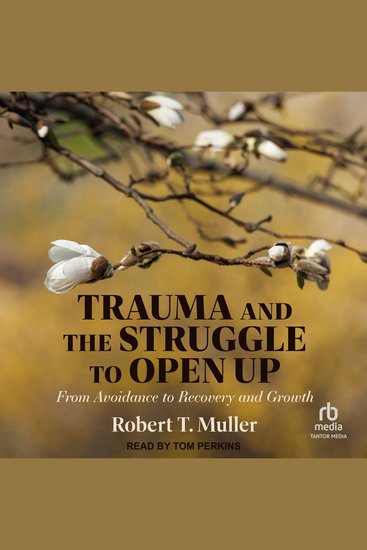
  • Trauma and the Struggle to Open Up - From Avoidance to Recovery and Growth - cover

    Trauma and the Struggle to Open...

    Robert T. Muller

    • 0
    • 0
    • 0
    How to navigate the therapeutic relationship with trauma survivors, to help bring recovery and growth. 


    In therapy, we see how relationships are central to many traumatic experiences, but relationships are also critical to trauma recovery. Grounded firmly in attachment and trauma theory, this book shows how to use the psychotherapy relationship, to help clients find self-understanding and healing from trauma. 


    Offering candid, personal guidance, using rich case examples, Dr. Robert T. Muller provides the steps needed to build and maintain a strong therapist-client relationship—one that helps bring recovery and growth. With a host of practical tips and protocols, this book gives therapists a roadmap to effective trauma treatment.
    Voir livre
  • Unite or Divide - Navigating the Crossroads of Our Society - cover

    Unite or Divide - Navigating the...

    Kempton Olney

    • 0
    • 0
    • 0
    Unite or Divide: Navigating the Crossroads of Our Society is a timely guide exploring the path from division to unity in our fractured world. This book offers insightful analysis and transformative solutions to societal fractures, blending historical context with contemporary examples and forward-thinking strategies. It traces the roots of division through history, addressing challenges like political polarization, economic inequality, and identity politics. 
     
    Rather than just diagnosing issues, it presents a vision for navigating out of division. Each chapter examines topics like technology's role in social connections, the dangers of misinformation, and the need for empathy, empowering readers with strategies to foster social cohesion—from grassroots efforts to policy-making. 
     
    The book features compelling case studies, personal transformation stories, and global perspectives, urging readers to reflect on shared humanity and community-based peacemaking. With a passionate call to action, "Unite or Divide" inspires readers with stories of change and guides them with practical steps to bridge divides. It's for anyone who believes in a better world and is ready to make it a reality. Join the movement towards unity and experience the power of transformation. Are you ready to journey towards a united society?
    Voir livre
  • Musings of a Chinese Mystic - cover

    Musings of a Chinese Mystic

    Chuang Tzu

    • 0
    • 0
    • 0
    "Musings of a Chinese Mystic" is a classic selection from the philosophical writings of Chuang Tzu, a disciple of the great Taoist philosopher Lao Tzu. An important figure in Chinese philosophy, Chuang Tzu helped to bring prominence to the philosophy of Taoism in ancient China. Drawn from the translations of Professor H. A. Giles with an introduction by Lionel Giles, "Musings of a Chinese Mystic" is an excellent introduction to the important Taoist philosophical writings of Chuang Tzu.
    Voir livre
  • Victory for the Axis - How World War II Might Have Been Won - cover

    Victory for the Axis - How World...

    Marcus Draysun

    • 0
    • 0
    • 0
    World War II was a conflict shaped by countless strategic decisions, moments of chance, and pivotal battles. While the Axis powers achieved stunning victories in the early years, several key turning points ultimately led to their downfall. But what if just a few of these moments had played out differently? Could the Axis have secured victory? 
    One of the most significant turning points was the Battle of Britain. After the fall of France in 1940, Germany stood at the doorstep of the United Kingdom, preparing for a possible invasion. The Luftwaffe launched a fierce aerial assault, aiming to cripple British defenses and force a surrender. However, the Royal Air Force, supported by radar technology and an unyielding civilian spirit, held firm. If the Luftwaffe had adjusted its strategy—focusing more on airfields instead of shifting to city bombings—the RAF might have been overwhelmed. A weakened Britain could have been forced to negotiate peace, removing a major Allied power from the war. 
    Another crucial moment came with Operation Barbarossa, Germany’s invasion of the Soviet Union in 1941. Hitler’s decision to open an Eastern Front spread Axis forces thin and underestimated Soviet resilience. If the invasion had started earlier in the year, avoiding the brutal Russian winter, German forces might have reached Moscow before Soviet reinforcements stabilized the front. Additionally, had Germany prioritized capturing Soviet oil fields in the Caucasus over direct assaults on major cities, the Wehrmacht could have sustained its war machine much longer. A Soviet collapse would have left Germany dominant in Europe, free to shift its focus elsewhere.
    Voir livre