Begleiten Sie uns auf eine literarische Weltreise!
Buch zum Bücherregal hinzufügen
Grey
Einen neuen Kommentar schreiben Default profile 50px
Grey
Jetzt das ganze Buch im Abo oder die ersten Seiten gratis lesen!
All characters reduced
Missionary Impact - cover

Missionary Impact

Noah Martin

Übersetzer A AI

Verlag: Publifye

  • 0
  • 0
  • 0

Beschreibung

Missionary Impact explores the profound and multifaceted influence of 19th and 20th-century missions in Africa, examining their impact on education, healthcare, and religious conversion. Missionaries introduced Western medical practices, contributing to improved public health, while also inadvertently suppressing traditional healing methods. Mission schools became centers for disseminating knowledge, but also fostered cultural assimilation, producing a generation of educated Africans who later spearheaded independence movements. 

 
The book analyzes how these missions, operating within the context of colonialism, left a complex legacy that extends beyond religious conversion, altering social structures and political trajectories. It begins by establishing the historical context, then delves into education and healthcare, before scrutinizing religious conversion and its consequences. The book navigates the dynamics of religious conversion, analyzing the adoption of Christianity and the resulting tensions with indigenous belief systems.

 
Ultimately, the book argues that missionary activities, though often driven by good intentions, had contradictory and far-reaching effects, giving rise to African nationalism and reshaping cultural identities. By drawing on archival research and ethnographic studies, Missionary Impact offers a nuanced perspective, making it valuable for anyone seeking a deeper understanding of African history and the legacies of colonialism.
Verfügbar seit: 19.03.2025.
Drucklänge: 58 Seiten.

Weitere Bücher, die Sie mögen werden

  • Psychology of Stress - cover

    Psychology of Stress

    Introbooks Team

    • 0
    • 0
    • 0
    “An adult biting nail in front a crowd can be much more than just bad habit. It can be chronic stress…..” 
    Humans will think as long as they have a functioning brain. And that is good; adults need to think for better living, better performance and overall better quality of life. But what if over thinking starts to affect mental balance? What if individuals forget to have fun due to the constant fear of the future? What if life becomes a burden for a man or woman due to over analyzing every situation? This is stress. Thinking is acceptable and good, but stress is not. Stress makes life miserable. Stress kills the joy of life.  Stress is the main reason why some adults cannot deal it anymore and kill themselves.  
    Stress can happen due to many reasons. Stress can happen because of an incurable illness; stress can happen due to the weak financial situation, a broken relationship can also cause stress. Whatever the reason is living with stress is not good. Stress can cause depression. And depression may force a healthy person to attempt suicide.  
    No one can be happy all the time; there will be problems. But adults must learn to deal with problems without bringing stress to their lives.
    Zum Buch
  • Homegrown - Engaged Cultural Criticism - cover

    Homegrown - Engaged Cultural...

    Bell Hooks, Amalia Mesa-Bains

    • 0
    • 0
    • 0
    In Homegrown, cultural critics Bell Hooks and Amalia Mesa-Bains reflect on the innate solidarity between Black and Latino culture. Riffing on everything from home and family to multiculturalism and the mass media, Hooks and Mesa-Bains invite listeners to re-examine and confront the polarizing mainstream discourse about Black-Latino relationships that is too often negative in its emphasis on political splits between people of color. A work of activism through dialogue, Homegrown is a declaration of solidarity that rings true even ten years after its first publication. 
     
    This new edition includes a new afterword, in which Mesa-Bains reflects on the changes, conflicts, and criticisms of the last decade.
    Zum Buch
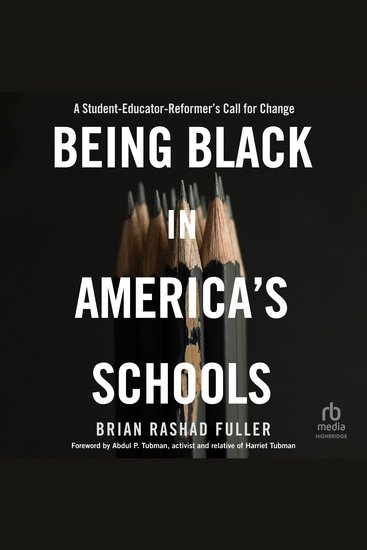
  • Being Black in America's Schools - A Student-Educator-Reformer's Call for Change - cover

    Being Black in America's Schools...

    Brian Rashad Fuller

    • 0
    • 0
    • 0
    In a polarizing and racially divided America, what do children of color learn about themselves before they even go to school? How do they see themselves and is that image only exacerbated by spending twelve years in a public education system that perpetuates negative stereotypes? Brian Rashad Fuller personally knows that the impact of low expectations can be devastating. He aims to make a difference in this humanizing and very personal portrayal of what it means to be Black in America's schools. 


    As a Black man who has spent his life as a student and an educator, Brian shares his own story of navigating the world, overcoming his family struggles, and eventually entering an educational system that he believes is inherently racist, damaging, and disserving. He exposes the challenges Black students face and offers a firsthand account of the emotional and psychological impact made by teachers, administrators, policies, practices, lessons, and student interactions. Most Americans are looking for answers on how to improve our education system—as illustrated by the critical race theory debate—but have not fully understood the lived Black experience, until now. With powerful insight into a thoroughly American institution, Brian offers present-day solutions, and liberating hope, for a centuries-long issue, as well as a galvanizing and radical step forward.
    Zum Buch
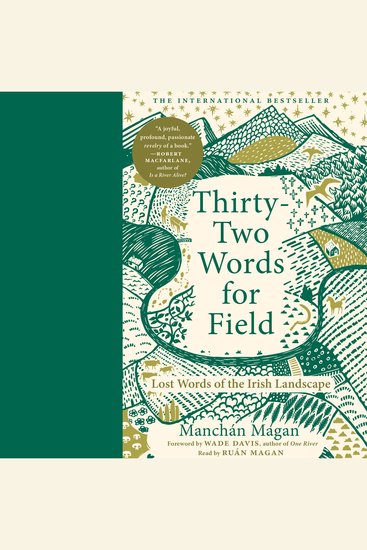
  • Thirty-Two Words for Field - Lost Words of the Irish Landscape - cover

    Thirty-Two Words for Field -...

    Manchán Magan

    • 0
    • 0
    • 0
    The Irish language has thirty-two words for field. Among them are: Geamhar – a field of corn-grass • Tuar – a field for cattle at night • Reidhlean – a field for games or dancing • Cathairin – a field with a fairy-dwelling in it. 
     
    The richness of the Irish language is closely tied to the natural landscape and offers a more magical way of seeing the world.  
     
    Most people associate Britain and Ireland with the English language, a vast, sprawling linguistic tree with roots in Latin, French, and German. But the inhabitants of these islands originally spoke another tongue. Look closely enough and English contains traces of the Celtic soil from which it sprung, found in words like bog, loch, cairn, and crag. Today, this heritage can be found nowhere more powerfully than in modern-day Gaelic.  
     
    In Thirty-Two Words for Field, Manchán explores how Gaelic, a three-thousand-year-old lexicon, has imbued the natural world with meaning and magic, evoking a time-honored way of life, from its thirty-two separate words for a field to terms like bróis (whiskey for a horseman at a wedding), iarmhaireacht (the loneliness you feel when you are the only person awake at dawn), and bladhmann (steam rising from a fermented haystack or idle boasting).  
     
    Manchán urges readers to consider the sublime beauty and profound oddness of this ancient tongue that has been spoken in close connection to the land for thousands of years. Told through stories collected from his own life and travels, Thirty-Two Words for Field is an enthralling celebration of Irish words and a testament to the indelible relationship between landscape, culture, and language.
    Zum Buch
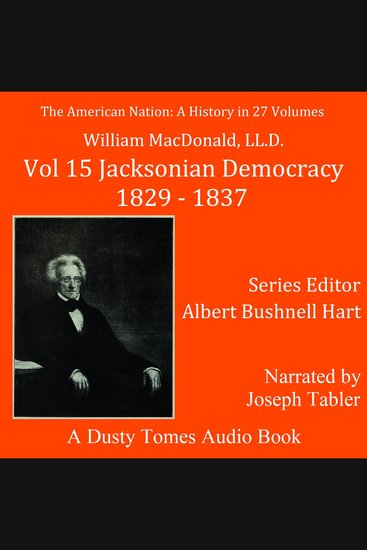
  • American Nation The: A History Vol 15 - Jacksonian Democracy 1829–1837 - cover

    American Nation The: A History...

    William MacDonald

    • 0
    • 0
    • 0
    A Dusty Tomes Audio BookIn Cooperation with Spoken Realms 
    Jacksonian Democracy 1829–1837 by William MacDonald, LLD. Professor of History in Brown University. Published in 1906 by Harper and Brothers. 
    Narrated by Joseph Tabler. This book is in the public domain. It is read ‘as written.' 
    Volume 15 of 27 in The American Nation: A History From Original Sources by Associated Scholars published by Harper Brothers (1904–1918). Edited by Albert Bushnell Hart, Professor of History at Harvard University. 
    In the Editor’s Introduction to the Series: That a new history of the United States is needed, extending from the discovery down to the present time hardly needs a statement. No such comprehensive work by a competent writer is now in existence. Individual writers have treated only limited chronological fields. Meantime there is a rapid increase of published sources and serviceable monographs based on material hitherto unused. On the one side, there is a necessity for an intelligent summarizing of the present knowledge of American history by trained specialists; on the other hand, there is a need for a complete work, written in an untechnical style, which shall serve for the instruction and the entertainment of the general reader. 
    From the Editor’s Introduction to Volume Fifteen: Hardly any year in American history so distinctly marks the transition from one era to another as 1829. The character of Andrew Jackson is so distinct and so aggressive that few writers upon the period can resist the temptation to group the events of his administration around his personality. This temptation Professor MacDonald has resisted. His conception of the period is that it witnessed the fruition of national policies, nearly all of which would have come up and would have divided the nation had there been no Andrew Jackson. At the same time, he shows how that dominant personality determined when and how most of the great questions should arise; and how Jackson hammered out a series of political principles that became the foundation of a new democratic party. 
    From the Author’s Preface: The present narrative has been kept, for the most part, strictly within the limits of the eight years of Jackson’s administration. It has not, however, been possible in all cases to avoid summarizing the early course of movements having important development within this period, though I have tried to avoid undue overlapping. The subject of slavery is, by the plan of the series, excluded altogether. As I am not writing a life of Jackson, but an account of his time, many personal details have also been omitted. 
    The volume is, in part, the outcome of special studies, of which the fruit has been presented in lectures given in the ordinary course of instruction at Bowdoin College and Brown University, and to summer classes at Harvard, Cornell, and the University of Chicago.  
    Editor’s IntroductionAuthor’s PrefaceI. The United States in the Thirties (1829–1837)II. Early Public Life of Jackson (1767–1823)III. Election of 1828 (1824–1829)IV. The Beginning of Personal Politics (1829–1837)V. Tariff and Nullification (1816–1829)VI. The Great Debate on the Constitution (1829–1830)VII. The Bank of the United States (1823–1832)VIII. Internal Improvements (1796–1837)IX. Nullification in South Carolina (1829–1833)X. Indian Affairs (1825–1837)XI. Election of 1832 (1830–1833)XII. Foreign Affairs under Jackson (1829–1837)XIII. Removal of the Deposits (1832–1837)XIV. Changes and Reforms (1829–1837)XV. The States in Jackson’s Time (1829–1837)XVI. Public Lands and the Specie Circular (1829–1837)XVII. The Election of 1836 (1836–1837)XVIII. The Personality of Jackson 
    Dusty Tomes Audio Books are public domain books retrieved from the ravages of time. Available for the first time in this format for your pleasure and consideration. 
    Narrator’s Note: I read only as written. These old books were once solid sellers for bookmen of their time. The
    Zum Buch
  • Fancies versus Fads - cover

    Fancies versus Fads

    G K Chesterton

    • 0
    • 0
    • 0
    The last volume of Chesterton's collected essays, Gathered from the London Mercury, the New Witness, and the Illustrated London News, it is the only volume from after WWI, and is most serious, philosophical, and socially direct collection. 
    "The problem is not so much Prohibition with a large P as prohibition with a small one. I mean, I am interested not so much in liquor as in liberty. I want to know on what principle the prohibitionists are proceeding in this case, and how they think it applies to any other case. And I cannot for the life of me make out. They…do not attack liquor; they do quite simply attack liberty. I mean that they are satisfied with saying about this liberty what can obviously be said about any liberty – that it can be, and is, abominably abused. If that had been a final objection to any form of freedom, there never would have been any form of freedom." 
    "So long as we combine ceaseless and often reckless scientific speculation with rapid and often random social reform, the result must inevitably be not anarchy but ever-increasing tyranny. There must be a ceaseless and almost mechanical multiplication of things forbidden. The resolution to cure all the ills that flesh is heir to, combined with the guesswork about all possible ills that flesh and nerve and brain-cell may be heir to – these two things conducted simultaneously must inevitably spread a sort of panic of prohibition. Scientific imagination and social reform between them will quite logically and almost legitimately have made us slaves."
    Zum Buch