Rejoignez-nous pour un voyage dans le monde des livres!
Ajouter ce livre à l'électronique
Grey
Ecrivez un nouveau commentaire Default profile 50px
Grey
Abonnez-vous pour lire le livre complet ou lisez les premières pages gratuitement!
All characters reduced
Seventies Wisdom Shines - cover

Seventies Wisdom Shines

Noah Davis

Traducteur A AI

Maison d'édition: Publifye

  • 0
  • 0
  • 0

Synopsis

Seventies Wisdom Shines explores the surprisingly relevant lessons from the 1970s, offering a unique path to personal growth and social well-being. Instead of fleeting trends, the book suggests rediscovering the decade's emphasis on mindful living, authentic self-expression, and community engagement can address fundamental human needs often overlooked in today's fast-paced world. For example, while the '70s are often remembered for social experimentation, the focus on individuality encouraged people to embrace their true selves, a concept still valuable today. By examining the socio-cultural backdrop of this era, the book highlights how these principles can be adapted to navigate modern complexities.

 
The book argues that revisiting the values of the 1970s provides a practical roadmap for a more meaningful life. It progresses by first introducing concepts like mindfulness and community, then developing these ideas through focused chapters exploring specific aspects. Drawing upon cognitive psychology, historical context, and personal narratives, Seventies Wisdom Shines provides practical strategies for integrating these principles into daily life, offering an alternative to disillusionment, and fostering a greater sense of purpose.
Disponible depuis: 27/02/2025.
Longueur d'impression: 84 pages.
D'autres livres qui pourraient vous intéresser

  • Woodrow Wilson - A Life from Beginning to End - cover

    Woodrow Wilson - A Life from...

    Hourly History

    • 0
    • 0
    • 0
    Before Woodrow Wilson was president of the United States, he was the president of Princeton University and the only occupant of the White House to hold a PhD. But before he became a university professor, he was a twelve-year old boy who didn’t know how to read. The reformer who challenged the corrupt party bosses to fight for legislation that gave ordinary Americans a seat at the table was also the president who provided us with one of our greatest Oval Office mysteries: when he had a massive stroke during his second term, and was out of communication with Congress, was the First Lady covertly running the country for him? There are many layers to Thomas Woodrow Wilson, the Southern-born son of a Confederate family whose willingness to tilt at legislative windmills provided the country with the Federal Reserve, the Federal Trade Commission, the first Jewish Supreme Court justice, and the seeds of what would later become, after his dream of a League of Nations was crushed, the United Nations. Read on to find out about this man who is regarded as one of the nation’s top ten presidents, and delve deeper into the mystery of Woodrow Wilson.
    Voir livre
  • Procrastination - What It Is Why It's a Problem and What You Can Do About It - cover

    Procrastination - What It Is Why...

    Fuschia M. Sirois

    • 0
    • 0
    • 0
    Why do we procrastinate? How can we stop wasting time, and finish our work? 


    Drawing on the latest theory and research, this book explains why people procrastinate, and provides practical, evidence-based strategies to help you stop delaying, complete your tasks, and fulfill your potential. At the heart of procrastination are your emotions and ability to regulate your mood. In this book you will learn how to dial down negative emotions, and replace old habits with new ones that can help you stay on track with your tasks and goals. You will also learn how to treat your procrastination with compassion, rather than harsh judgments or complicated analyses of your motivation. 


    Exercises in the book help you recognize why a task might be triggering negative feelings, plus how to be more self-compassionate, and how to build meaning into the everyday tasks that help you reach your goals. This book is ideal for anyone who struggles with procrastination, or knows someone who does, and who is looking for evidence-based insights and strategies for dealing with procrastination.
    Voir livre
  • We Philologists - cover

    We Philologists

    Friedrich Nietzsche

    • 0
    • 0
    • 0
    Nietzsche argues that philology is not just an academic discipline, but a way of life that requires a deep appreciation for language and culture. He emphasizes the importance of understanding the historical context of texts, and the need to read them in their original language to fully appreciate their meaning and beauty. "We Philologists" is a passionate and insightful reflection on the value and meaning of philology, and a call to approach the study of language and literature with greater creativity and sensitivity. Read in English, unabridged.
    Voir livre
  • You Made it Up Now Stop Believing It: The Powerful Body Memory Process for Childhood Vow Discovery and Release - cover

    You Made it Up Now Stop...

    Kathi Sohn

    • 0
    • 0
    • 0
    Unlock Your Authentic Potential with "You Made it Up, Now Stop Believing It: The Powerful Body Memory Process for Childhood Vow Discovery and Release" by Kathi Sohn. 
    Discover the life-changing process to reclaim your power and reshape your reality. In this groundbreaking audiobook, Kathi Sohn, renowned author and narrator, unveils the transformative journey to break free from the limiting beliefs forged in childhood. 
    Unveil the secrets of your subconscious and liberate yourself from the shackles of childhood vows. Explore real-life narratives of individuals who have shattered these self-imposed barriers, witnessing remarkable transformations in health, relationships, finances, and self-expression. 
    Inside, you'll learn:How childhood vows continue to influence your adult lifeThe underlying origins of these deeply ingrained beliefsProven techniques to identify and release these vows, paving the way for profound positive change 
    Don't let outdated beliefs hold you back any longer. It's time to rewrite your story and embrace the limitless possibilities that await. Experience the freedom to live authentically, as you embark on a journey of self-discovery and empowerment. 
    Elevate your life today with "You Made it Up, Now Stop Believing It" – your guide to unlocking the extraordinary within. 
    #BreakFreeFromVows 
    #ChildhoodBeliefs 
    #EmpowerYourself 
    #LifeTransformation 
    #SelfDiscoveryJourney 
    #LimitlessPotential 
    #MindsetShift 
    #PersonalGrowth 
    #EmbraceAuthenticity 
    #PositiveChange 
    #UnlockYourPower 
    #InnerFreedom 
    #LiveYourTruth 
    #ReleaseThePast 
    #Mindfulness 
    #SelfEmpowerment 
    #NewBeginnings 
    #SelfAwareness 
    #HealingJourney 
    #OwnYourStory
    Voir livre
  • Can Scientists Succeed Where Politicians Fail? - Johns Hopkins Wavelengths - cover

    Can Scientists Succeed Where...

    Peter Agre, MB BChir Seema Yasmin

    • 0
    • 0
    • 0
    How can science prevail when policies fall short? 


    Sometimes in secret, sometimes as official ambassadors for their governments, scientists trade their white coats for blazers, stepping out of the lab and directly into sensitive, often life-threatening global crises. Think of the Paris Climate Agreement or the Iran Nuclear Deal, the Manhattan Project, and the Antarctic Treaty of 1959. Scientists have played a pivotal role in many of the greatest episodes in political history. 


    But what prompts their involvement in international affairs, and what are some of the impacts of their efforts? Can Scientists Succeed Where Politicians Fail? recounts Nobel laureate Dr. Peter Agre's career as a physician-scientist who went from studying malaria and other diseases to meeting with Fidel Castro in Cuba, discoursing with North Korean officials, and traveling into the Islamic Republic of Iran. 


    The book explores Agre's story alongside those of volcanologists in North Korea, epidemiologists in Latin America, and other scientists who have and are working alongside politicians, from African tribal chiefs to communist leaders, to tackle natural disasters and infectious threats in new ways.
    Voir livre
  • Operation Typhoon: The History of the Fight for Moscow between the Nazis and Soviets - cover

    Operation Typhoon: The History...

    Phaistos Publishers

    • 0
    • 0
    • 0
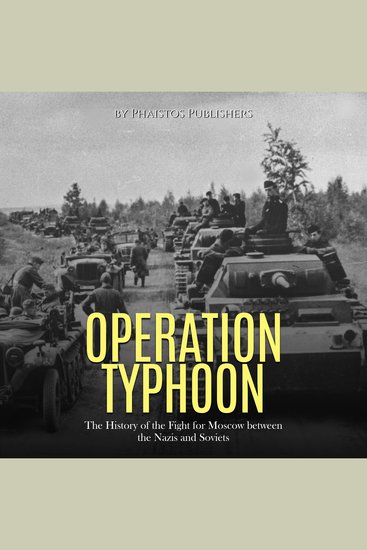
    After the Fall of France and the unsatisfactory Battle of Britain came to a close, Hitler turned to the east and issued Führer Directive 21, his secret order for the invasion of the Soviet Union, on 18 December 1940. Prior to this the Molotov-Ribbentrop Pact, a non-aggression agreement, had enabled the two countries to divide the spoils after the invasion of Poland that had triggered the Second World War. Hitler, however, had always regarded this agreement as nothing more than a temporary tactical maneuver. In the early part of the Second World War, the arrangement had suited the two nations, with the Soviet Union preoccupied with its own issues while Hitler continued his aggression in Western Europe, exporting manufactured goods to the Soviet Union in return for grain and oil. But they were never easy bedfellows since their ideological differences were diametrically opposed. 
    For his part, Stalin seems uncharacteristically trusting of Hitler despite Soviet intelligence reports and London warning him of Germany’s intentions. Operation Barbarossa caught him unprepared. Over three and a half million troops - eighty% of the German Army, attacked along a front almost 3,000 km, supported by 2,700 aircraft, the largest invasion force ever seen. Soviet forces were hastily dispatched to the frontier in huge numbers, but the Germans pushed through quickly and decisively, and within three weeks of the launch of Operation Barbarossa, Hitler’s initial objectives had been achieved. While a legend exists today that Hitler's strategic fecklessness destroyed Germany's chances, despite the wise objections of the Wehrmacht general staff (OKW), the actual situation in 1941 resembled the precise reverse of this familiar historical trope. It seems the Fuhrer retained his full strategic acumen in 1941, until he ill-advisedly adopted the suggestions of the OKW and diverted forces in a winter campaign to seize the Soviet capital, leading to the Battle of Moscow .
    Voir livre