Begleiten Sie uns auf eine literarische Weltreise!
Buch zum Bücherregal hinzufügen
Grey
Einen neuen Kommentar schreiben Default profile 50px
Grey
Jetzt das ganze Buch im Abo oder die ersten Seiten gratis lesen!
All characters reduced
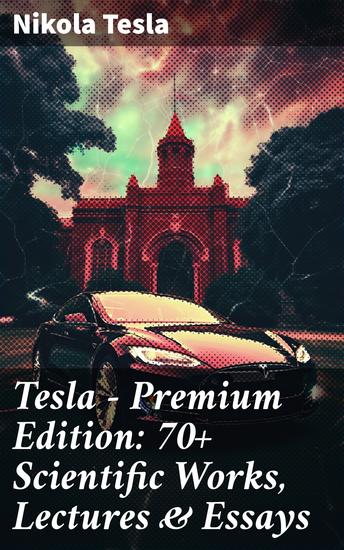
Tesla - Premium Edition: 70+ Scientific Works Lectures & Essays - Revolutionizing Science and Technology Through Genius Innovations - cover

Tesla - Premium Edition: 70+ Scientific Works Lectures & Essays - Revolutionizing Science and Technology Through Genius Innovations

Nikola Tesla

Verlag: Good Press

  • 0
  • 0
  • 0

Beschreibung

In "Tesla - Premium Edition: 70+ Scientific Works, Lectures & Essays," readers are invited to delve into the expansive intellectual landscape crafted by one of history'Äôs most visionary inventors. This anthology not only showcases Tesla'Äôs groundbreaking scientific theories and innovative designs but also offers a unique glimpse into the mind of a man who sought to revolutionize the world through electricity and magnetism. It combines a rigorous academic approach with a narrative style that is both accessible and enlightening, fitting seamlessly within the context of late 19th and early 20th-century scientific discourse, characterized by profound technological transformation and a burgeoning fascination with electricity. Nikola Tesla'Äôs genius was propelled by a combination of extraordinary intellect, tireless curiosity, and personal experiences, including his immigrant past and encounters with other prominent scientists of his time. His travels and observations of the rapidly evolving technological environments allowed him to articulate not only his inventions but also philosophical reflections on humanity's relationship with science. This collection serves as the culmination of his explorations into the unseen forces that govern the universe, shaped by an insatiable quest for knowledge. For anyone captivated by the intersection of science, innovation, and history, this book is a must-read. It presents a compelling synthesis of Tesla'Äôs ideas that remain profoundly relevant in today'Äôs age of technological advancement. Engaging yet informative, this anthology is essential for scholars, students, and enthusiasts seeking a deeper appreciation of Tesla's contributions to science and society.
Verfügbar seit: 14.12.2023.
Drucklänge: 1008 Seiten.
Weitere Bücher, die Sie mögen werden

  • Layer Hen Guide 101 - For all your laying hen needs - cover

    Layer Hen Guide 101 - For all...

    Duane Hershberger

    • 0
    • 0
    • 0
    This is a complete guide for your Layer Hen flock. Weather you are a beginner and need expert advice or have a commercial flock. The information in this book (Layer Hen Guide 101) is a must have for anyone looking to produce top quality eggs
    Zum Buch
  • Big Data Analytics for Beginners - A Comprehensive Guide to Harnessing Data Insights - cover

    Big Data Analytics for Beginners...

    Chuck Sherman

    • 0
    • 0
    • 0
    In our increasingly data-driven world, understanding the fundamentals of big data analytics is essential for both professionals and beginners. "Big Data Analytics for Beginners" is your comprehensive guide to unravel the mysteries of data analysis and tap into the transformative power of big data. 
    This book takes you on a journey through the fascinating realm of data analytics, catering to readers with little to no prior experience in the field. Whether you're an aspiring data scientist, business professional, student, or simply curious about the world of data, this book provides a solid foundation for your data analytics journey. 
    "Big Data Analytics for Beginners" is your roadmap to mastering the world of data analytics. With its clear explanations, practical examples, and valuable insights, this book empowers you to leverage data for informed decision-making, problem-solving, and innovation. Take your first steps into the world of big data analytics and unlock the potential of data in today's data-rich environment. 
     
    Zum Buch
  • Right to Die? - Euthanasia Assisted Suicide and End-of-Life Care - cover

    Right to Die? - Euthanasia...

    John Wyatt

    • 0
    • 0
    • 0
    The case for assisted suicide can seem so compelling. Surely it can't be wrong to help desperate people to kill themselves? Don't we have a right to take our own lives in certain circumstances? 
    There are no trite or easy answers. John Wyatt helps us to navigate the arguments with hearts and heads engaged, and above all with our Bibles open. There are practical and compassionate alternatives to assisted suicide, and as many who have gone before us have found, the end of our lives on this earth may turn out to be a strange and wonderful opportunity for growth and internal healing.
    Zum Buch
  • Plasma Physics - Exploring the Fourth State of Matter - cover

    Plasma Physics - Exploring the...

    Mark Hedges

    • 0
    • 0
    • 0
    Plasma, often referred to as the fourth state of matter, is a unique and dynamic state in which gas is ionized, allowing free electrons and ions to coexist. Unlike solids, liquids, and gases, plasma exhibits collective behavior due to long-range electromagnetic interactions among its charged particles. It is the most abundant form of matter in the universe, making up stars, the interstellar medium, and even artificial applications on Earth. 
    The concept of plasma dates back to the late 19th and early 20th centuries when scientists first began studying ionized gases. The term "plasma" was coined in 1928 by Irving Langmuir while researching electrical discharges in gases. Since then, plasma physics has evolved into a vast field, influencing multiple scientific and technological disciplines, including astrophysics, nuclear fusion, space exploration, and industrial applications. 
    One of the defining characteristics of plasma is its ability to conduct electricity and respond to magnetic fields. Unlike neutral gases, where collisions dominate particle interactions, plasmas are governed by electromagnetic forces, leading to complex behaviors such as waves, instabilities, and turbulence. This property allows plasmas to sustain structures like magnetospheres around planets and controlled fusion reactors designed for energy production.
    Zum Buch
  • Molds Mushrooms and Medicines - Our Lifelong Relationship with Fungi - cover

    Molds Mushrooms and Medicines -...

    Nicholas P. Money

    • 0
    • 0
    • 0
    From beneficial yeasts that aid digestion to toxic molds that cause disease, we are constantly navigating a world filled with fungi. Molds, Mushrooms, and Medicines explores the amazing ways fungi interact with our bodies, showing how our health and well-being depend on an immense ecosystem of yeasts and molds inside and all around us. 


    Nicholas Money takes listeners on a guided tour of a marvelous unseen realm, describing how our immune systems are engaged in continuous conversation with the teeming mycobiome inside the body, and how we can fall prey to serious and even life-threatening infections when this peaceful coexistence is disturbed. He also sheds light on our complicated relationship with fungi outside the body, from wild mushrooms and cultivated molds that have been staples of the human diet for millennia to the controversial experimentation with magic mushrooms in the treatment of depression. 


    Drawing on the latest advances in mycology, Molds, Mushrooms, and Medicines reveals what scientists are learning about the importance of fungi to our lives, from their vital role in supporting the ecosystems on which we depend to their emerging uses in lifesaving medicine.
    Zum Buch
  • Stars in the Dark - The Relationship between Galaxies and Dark Matter - cover

    Stars in the Dark - The...

    Dirk Fallon

    • 0
    • 0
    • 0
    For centuries, humans have gazed into the night sky, believing that what they saw—stars, planets, glowing nebulae—was all there was. But as our tools for exploring the universe improved, scientists began to notice something strange. The visible matter in galaxies simply wasn’t enough to explain how those galaxies moved and behaved. Something unseen, something invisible, seemed to be exerting a powerful influence on everything. 
    In the 1930s, astronomer Fritz Zwicky was studying a group of galaxies known as the Coma Cluster. When he measured how fast the galaxies within the cluster were moving, he realized they were traveling far too quickly to be held together by the visible matter alone. According to the laws of gravity, the cluster should have torn itself apart. Zwicky proposed that some kind of “missing mass” must be present, something that added gravitational force without emitting light. He called it “dark matter.” At the time, his idea was mostly ignored. 
    Decades later, in the 1970s, American astronomer Vera Rubin provided even more compelling evidence. She was studying the rotation of spiral galaxies, expecting that stars farther from the center would orbit more slowly, just as planets farther from the sun move more slowly in our solar system. But that wasn’t what she found. The outer stars were moving just as fast as those closer in, a finding that didn’t make sense if only visible matter was involved. Her work suggested that some unseen material—something with mass—was surrounding the galaxies in large halos, exerting gravitational pull and affecting their motion. This was dark matter at work.
    Zum Buch