Rejoignez-nous pour un voyage dans le monde des livres!
Ajouter ce livre à l'électronique
Grey
Ecrivez un nouveau commentaire Default profile 50px
Grey
Abonnez-vous pour lire le livre complet ou lisez les premières pages gratuitement!
All characters reduced
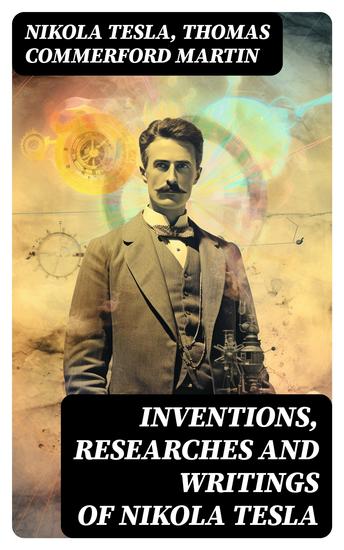
Inventions Researches and Writings of Nikola Tesla - Enriched edition Including Tesla's Autobiography - cover

Inventions Researches and Writings of Nikola Tesla - Enriched edition Including Tesla's Autobiography

Nikola Tesla, Thomas Commerford Martin

Maison d'édition: DigiCat

  • 0
  • 0
  • 0

Synopsis

In 'Inventions, Researches and Writings of Nikola Tesla,' the collection unlocks a treasure trove of technological marvels and visionary ideas that define the confluence of science and innovation during the late 19th and early 20th centuries. Featuring a diverse range of styles from detailed technical discourse to speculative reflections, this anthology captures the pioneering spirit of its era. The compilation is not merely a celebration of Tesla's groundbreaking work but also a dialogue between numerical data, inventive genius, and theoretical foresight, crystallized through select standout excerpts that offer insight into his revolutionary contributions. The anthology is expertly curated by Thomas Commerford Martin, whose editorial vision contextualizes Nikola Tesla's writings, bridging historical insights with modern relevance. Martin, a prominent electrical engineer and writer, ensures a compilation that not only aligns with but also enhances understanding of the American and European scientific milieus. The varied voices within the collection, though singularly authored by Tesla, represent a kaleidoscope of industrial progress and cultural influences, emphasizing the anthology's alignment with the broader tapestry of industrial and technological advancements. Readers are invited into a richly layered universe of thought and innovation, exploring Tesla's work through myriad perspectives. This anthology offers an unparalleled educational journey, encouraging audiences to engage with Tesla's prolific discoveries and the trail of influence they continue to ignite today. Its breadth of insights fosters a lively intellectual dialogue, providing a valuable resource for those interested in the origins and evolution of modern technology.

In this enriched edition, we have carefully created added value for your reading experience:
- A comprehensive Introduction outlines these selected works' unifying features, themes, or stylistic evolutions.
- A Historical Context section situates the works in their broader era—social currents, cultural trends, and key events that underpin their creation.
- A concise Synopsis (Selection) offers an accessible overview of the included texts, helping readers navigate plotlines and main ideas without revealing critical twists.
- A unified Analysis examines recurring motifs and stylistic hallmarks across the collection, tying the stories together while spotlighting the different work's strengths.
- Reflection questions inspire deeper contemplation of the author's overarching message, inviting readers to draw connections among different texts and relate them to modern contexts.
- Lastly, our hand‐picked Memorable Quotes distill pivotal lines and turning points, serving as touchstones for the collection's central themes.
Disponible depuis: 15/11/2023.
Longueur d'impression: 509 pages.
D'autres livres qui pourraient vous intéresser

  • Evolution Is Wrong - A Radical Approach to the Origin and Transformation of Life - cover

    Evolution Is Wrong - A Radical...

    Erich von Däniken

    • 0
    • 0
    • 0
    A Fascinating Exploration on Why the Darwinists’ Theory No Longer Explains EverythingThere was once a set of ideas called the theory of evolution, conceived by clever people and confirmed by countless scientists. Then people discovered the electron microscope. This made it possible to make the molecules within the cell visible, and suddenly questions about evolution arose that were not possible before. Which force actually bundles the atoms in the right order? What moves the molecular chains into the correct position? How did the first living unit within the cell actually come about? How does inheritance work, how does information pass on to the next generation? Did humans descend only and exclusively from primates—as Charles Darwin and countless other great minds assumed—or did additional “engines” intervene in evolution? Today it is clear: countless questions can no longer be answered with the previous theory of evolution. There is a form of life called “Blob” (Physarum polycephalum). The “thing” has neither eyes nor ears, neither a mouth nor a nose or even a brain. Nevertheless, it takes in food, overcomes obstacles by the shortest route and exchanges information with other “blobs.” The “blob” contradicts any evolutionary thought that one develops from the other. Or the “gastric-brooding frogs” (Rheobatrachus) found in Australia. They hatch their young in the stomach. Impossible in a slow, evolutionary process. Everywhere there are characteristics of animals that do not want to fit into the theory of evolution anywhere. And man? Are we really the most adapted life-form on this planet? Today, more and more scientists who contradict the previous theory of evolution speak out. The theory fits the changes within the species, but it can no longer be reconciled with the inner workings of the cell. Some other influence that has so far escaped us is affecting evolution. It is called “Intelligent Design.” Intelligent planning is suspected behind this. Anyone or anything—a spirit of the universe? Aliens?—could be behind this planning. Erich von Däniken uses countless examples to demonstrate the impossibility of the previous evolutionary idea. He quotes scientists who argue against the previous teaching, but also those who defend it. Unfortunately, established science still refuses to look at discrepancies and holes in the theory of evolution, even though it is quite obvious that there is more going on with regard to the development of all species, as well as human culture, than could be explained by the theory of evolution alone.
    Voir livre
  • Where Did the Universe Come From? And Other Cosmic Questions - Our Universe from Quantum to the Cosmos - cover

    Where Did the Universe Come...

    Geraint F. Lewis, Chris Ferrie

    • 0
    • 0
    • 0
    In this thought-provoking exploration, physicists Chris Ferrie and Geraint F. Lewis delve into the fundamental questions that have puzzled humanity for centuries. With clarity and precision, Ferrie and Lewis navigate the realms of quantum physics, relativity, and cosmology, providing accessible explanations that engage both novices and enthusiasts. 
     
    Featuring a harmonious blend of scientific rigor and captivating storytelling, Where Did the Universe Come From? bridges the gap between complex concepts and everyday understanding. 
     
    Listeners will: explore the origin of the universe and the fundamental forces that govern it; dive into the mind-boggling realm of quantum mechanics; uncover the mysteries of black holes, dark matter, and the enigmatic nature of the cosmos; and enjoy an engaging narrative that seamlessly integrates complex scientific concepts with accessible explanations. 
     
    Whether you're an astrophysics enthusiast, a science student, or simply someone with a profound interest in the wonders of the universe, this comprehensive guide offers a rich tapestry of knowledge about the captivating wonders that surround us all.
    Voir livre
  • The Architecture of Discipline - Building Integrity in the Intelligent Cloud - cover

    The Architecture of Discipline -...

    Lori Higham

    • 0
    • 0
    • 0
    In the era of the intelligent cloud, architecture must do more than enable systems; it must verify them. The Architecture of Discipline defines how modern enterprises design environments capable of demonstrating their own integrity—continuously and at scale. Drawing on extensive leadership experience in cloud security, Zero Trust, governance, and AI oversight, Lori Higham redefines architecture as a discipline of structure and accountability, where evidence emerges as the natural outcome of design rather than the afterthought of audit. 
    This work moves fluidly between theory and reflection, rhetoric and practice. It invites the reader to question assumptions about control, trust, and automation while offering concrete mechanisms for building systems that remain accurate, accountable, and adaptive as they evolve. Here, architecture becomes both a technical craft and a philosophical inquiry: a dialogue between what is built and what can be proven. 
    Across chapters on governance, Zero Trust, responsible AI, and assurance, The Architecture of Discipline demonstrates how design becomes verification: how standards translate into automation, ethics into operational boundary, and continuity into measurable assurance. Each section balances rigorous conceptual framing with tangible architectural patterns, reinforcing that discipline in design is both method and mindset. 
    More than a manual, this is a conversation with the reader—a call to architects, engineers, and decision-makers to examine not only what they build, but how they sustain fidelity between design and outcome. In intelligent environments, integrity is not assumed; it is demonstrated through evidence. The measure of architecture is its capacity to sustain integrity through change—to analyze, constrain, and reveal the systems it governs faster than risk can erode them.
    Voir livre
  • Omnivore’s Dilemma The: Book Summary & Analysis - cover

    Omnivore’s Dilemma The: Book...

    Briefly Summaries

    • 0
    • 0
    • 0
    This is a concise summary and analysis of The Omnivore’s Dilemma, by Michael Pollan. It is not the original book and is not affiliated with or endorsed by Michael Pollan. Ideal for those seeking a quick and insightful overview.
     
    In this eye-opening exploration of the modern food system, the author investigates where our food comes from and how our choices impact our health, the environment, and society. Following four different food chains—industrial, organic, alternative, and foraged—this book examines the hidden costs of what we eat, from factory farms to sustainable agriculture. Blending investigative journalism with engaging storytelling, it challenges readers to rethink their relationship with food and make more informed dietary decisions.
    Voir livre
  • Urban Governance and Renewal - Policy Power and Change (3 in 1) - cover

    Urban Governance and Renewal -...

    Lyric Vale

    • 0
    • 0
    • 0
    In the complex architecture of city-making, governance represents the invisible framework that shapes urban development, mediates competing interests, and determines whose voices influence the evolution of metropolitan spaces. Beyond physical infrastructure and economic dynamics, the political dimensions of urban environments—the policies, power structures, and institutional arrangements that guide development decisions—profoundly shape the trajectory of cities and the lived experiences of their inhabitants. This comprehensive exploration delves into the intricate domains of Urban Policy and Governance, The Politics of Urban Development, and Urban Renewal, examining how formal and informal power systems determine which neighborhoods flourish, which communities face displacement, and how the benefits and burdens of urban change are distributed. 
    The narrative of urban governance is fundamentally a story of contested visions, where multiple stakeholders—from elected officials and corporate interests to community organizations and marginalized populations—engage in complex negotiations over the future of shared urban spaces. By examining the historical evolution, contemporary challenges, and emerging paradigms of urban governance, this book illuminates how policy frameworks, political processes, and renewal strategies reflect deeper power dynamics and ideological perspectives about what cities should be and whom they should serve. Readers will journey through diverse urban contexts—from the boardrooms where development decisions are made to the grassroots movements that challenge established power structures—discovering how governance approaches have evolved from top-down interventions to more collaborative, participatory models that recognize the plurality of urban stakeholders.
    Voir livre
  • Creating a Wildlife Habitat - Gardens for Birds and Butterflies - cover

    Creating a Wildlife Habitat -...

    Gertrude Harris

    • 0
    • 0
    • 0
    Creating a wildlife habitat garden is a rewarding way to connect with nature and contribute to the well-being of local ecosystems. Whether you live in a city, suburb, or rural area, designing a garden that supports birds, butterflies, and other beneficial creatures can bring a sense of peace and harmony to your space. The importance of wildlife habitat gardens has grown over the years as the natural world faces unprecedented challenges, such as habitat loss, climate change, and pollution. By planting with purpose, you can play an essential role in reversing these trends and create a sanctuary that supports biodiversity. 
    The primary focus of this book is on two of the most beloved and visible wildlife groups—birds and butterflies. These creatures not only provide beauty and joy to our gardens but also contribute significantly to the health of our environments. Birds are critical pollinators, seed dispersers, and pest controllers, while butterflies are essential for pollination, helping to fertilize plants as they move from flower to flower. Both species are also vital indicators of ecosystem health, and their presence can signal a thriving environment. 
    Designing a garden that attracts and supports birds and butterflies requires more than simply placing a birdbath or planting a few flowers. It involves understanding their needs and the role plants play in supporting these creatures through every stage of their life cycle. From providing the right types of plants to offering shelter, food, and water, every element of your garden will need to be carefully considered to create a balanced, thriving habitat.
    Voir livre