Rejoignez-nous pour un voyage dans le monde des livres!
Ajouter ce livre à l'électronique
Grey
Ecrivez un nouveau commentaire Default profile 50px
Grey
Abonnez-vous pour lire le livre complet ou lisez les premières pages gratuitement!
All characters reduced
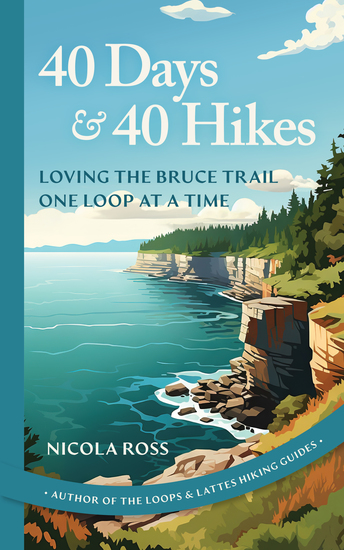
40 Days & 40 Hikes - Loving the Bruce Trail One Loop at a Time - cover

40 Days & 40 Hikes - Loving the Bruce Trail One Loop at a Time

Nicola Ross

Maison d'édition: ECW Press

  • 0
  • 0
  • 0

Synopsis

Travel the Bruce Trail in day hikes with Loops & Lattes author Nicola Ross 
		 
Best known for her detailed Loops & Lattes hiking guides, Nicola Ross has inspired tens of thousands of people to lace up their boots and explore Ontario’s trails. In 40 Days & 40 Hikes, this adventurer, author, and environmentalist sets herself a new challenge: to hike the Bruce Trail from Niagara to Tobermory in her own creative way. In 40 cleverly crafted day-loops, Ross covers over 900 kilometers mostly following Canada’s longest marked trail, taking you with her on an insightful journey to the Niagara Escarpment’s remarkable sights.
		 
As Ross walks, she reveals stories of the trail’s flora and fauna, geology and history. The Bruce Trail becomes the central character as she ponders her role in protecting the fragile corner of the planet that, she contends, is entwined in her DNA. Despite long days on the trail, encounters with bears, ticks, and a deadly derecho, her passion for her beloved Niagara Escarpment mounts as she explores Ontario’s “ribbon of wilderness.”
		 
Perfect for hikers, non-hikers, and anyone who loves an adventure, 40 Days & 40 Hikes is both a captivating travelogue and a useful companion for those who Ross will undoubtedly inspire to follow in her footsteps.
Disponible depuis: 09/04/2024.
Longueur d'impression: 384 pages.

D'autres livres qui pourraient vous intéresser

  • Journey Through the Ancient Trade Routes: A New World History - Embark on Epic Adventures: Discover Ancient Trade Routes with Our Engaging World History Audiobook! - cover

    Journey Through the Ancient...

    Ethan Blackwood

    • 0
    • 0
    • 0
    Journey Through the Ancient Trade Routes: A New World History 
    ⭐⭐ Simplified Audio Guide ⭐⭐ 
    Are you ready to expand your knowledge of history, culture, and adventure through ancient trade routes? 
    Seeking a comprehensive guide that delves into the world of ancient commerce and civilizations? 
    Your search ends here! 
    This guide serves as your definitive companion for deepening your understanding, enhancing your skills, and engaging in interactive learning. With this, you're geared for success. 
    Updated with the latest insights and discoveries in the field. 
    Key features of this enriched guide: 
    - Profound insights about ancient trade routes and their significance 
    - Detailed explanation of the history, culture, and adventure through ancient trade 
    - Effective strategies for exploring and understanding ancient commerce and its influence on civilizations 
    Our guide distinguishes itself through comprehensive coverage, essential for mastering the subject. Concepts aren't merely skimmed; they are delved into with precision. 
    Please note that this guide is an independent resource for your benefit. 
    Designed with a clear structure and easy-to-understand language, our journey through ancient trade routes ensures smooth transitions between topics. Say goodbye to dense jargon and welcome clear, precise, and technically accurate content. 
    So, why wait? Click the BUY NOW button, secure your guide, and begin your journey through the ancient trade routes today!
    Voir livre
  • Asuka Period - Buddhism Reform and the Birth of Japanese Civilization - cover

    Asuka Period - Buddhism Reform...

    Rolf Hedger

    • 0
    • 0
    • 0
    The Asuka Period (538–710) marks a pivotal era in Japan’s history, serving as the transitional phase between the ancient Kofun Period and the Nara Period. This era is often considered the birthplace of Japanese civilization, a time when the political, religious, and cultural foundations of the nation began to take shape. It was during this period that Japan first came into direct contact with continental Asia, particularly through the introduction of Buddhism, the establishment of a centralized government, and the adoption of Chinese-style political and legal systems. 
    The early years of the Asuka Period were dominated by the Soga clan, who played a crucial role in the political and religious developments of the time. Their influence can be seen in their advocacy for the adoption of Buddhism, which arrived in Japan from Korea around the mid-sixth century. Buddhism’s introduction, however, was met with resistance from the powerful native Shinto religious leaders and aristocracy, creating a conflict that would shape the religious landscape of Japan for centuries to come. 
    Despite early opposition, Buddhism gradually took hold in Japan. The Soga clan, with the support of the royal family, used Buddhism as a tool to consolidate power and gain legitimacy. By the late 6th century, the religion had become deeply integrated into the fabric of Japanese society, influencing not only spiritual practices but also politics, art, and culture.
    Voir livre
  • Steps To Hire Exceptional Hospitality Property Staff-2023 - Hotels-Resorts-Inns-Bed and Breakfasts-Vacation Homes - cover

    Steps To Hire Exceptional...

    Gerry MacPherson

    • 0
    • 0
    • 0
    Won’t it be wonderful to be able to find and retain awesome & devoted employees for your hotel, resort, inn, bed and breakfast or vacation home? 
    Your employees are the backbone of your business and by knowing how to hire, train and support your staff you’ll create an environment that will garner loyalty and impress your guests. Finding and retaining the right employees for your hospitality property is imperative. 
    If you or your staff are not properly trained, overworked and stressed, it does not take long for your services to slide and a negative mindset to develop. 
    These 9 tutorials will help streamline your employee development, hiring and training process.The Right MindsetHow to Hire WinnersCan’t Afford Employee Training Programs – Think AgainHow to Train for Success Effective Communication Will Improve Your PropertyEnhance Your Customer ServiceHow to Handle Customer ComplaintsHow to UpsellHow to Fire an Employee 
    You can view this section as an individual course or watch it as part of the “Your Guide to Owning & Operating a Hospitality Property – Successfully” course. 
    If you want to hire and keep the right employees, then don’t hesitate. 
    Sign up now!
    Voir livre
  • Mughal Empire - The Taj Mahal Legacy - cover

    Mughal Empire - The Taj Mahal...

    Rolf Hedger

    • 0
    • 0
    • 0
    The Mughal Empire emerged as one of the most powerful and influential dynasties in Indian history, leaving a lasting impact on culture, architecture, and governance. Its foundation was laid by Babur, a descendant of both Timur and Genghis Khan, who established Mughal rule in the early 16th century. Babur's military prowess and strategic vision enabled him to defeat the Delhi Sultanate in the First Battle of Panipat in 1526. This victory marked the beginning of Mughal dominance in the Indian subcontinent. However, Babur’s reign was short-lived, and it was his grandson, Akbar, who truly solidified the empire’s foundation. 
    Akbar ascended the throne at a young age and quickly proved himself to be an exceptional leader. His reign, which lasted from 1556 to 1605, was marked by territorial expansion, administrative reforms, and a commitment to cultural and religious harmony. Unlike previous rulers, Akbar recognized the diversity of India and sought to integrate different communities into his empire. He abolished the jizya tax on non-Muslims, promoted interfaith dialogue, and appointed talented individuals from various backgrounds to key positions in his administration. His policy of religious tolerance and inclusive governance earned him the loyalty of many, contributing to the stability and prosperity of the empire. 
    One of Akbar’s most remarkable achievements was the establishment of an efficient administrative system. He divided his empire into provinces, each governed by appointed officials who reported directly to the central authority. This system ensured effective governance and facilitated tax collection, trade, and law enforcement. Additionally, Akbar introduced a standardized revenue system that helped regulate the economy and promote agricultural growth. His emphasis on merit-based appointments created a well-organized bureaucracy that endured long after his reign.
    Voir livre
  • All Strangers Are Kin - Adventures in Arabic and the Arab World - cover

    All Strangers Are Kin -...

    Zora O'Neill

    • 0
    • 0
    • 0
    *Winner of the Lowell Thomas Award for Best Travel Book*  
    An American woman determined to learn the Arabic language travels to the Middle East to pursue her dream in this “witty memoir” (Us Weekly).  
    Join Zora O’Neill for a grand tour through the Middle East, to laugh with her in Egypt, delight in the stories she passes on from the Gulf region, and find yourself transformed by her experiences in Lebanon and Morocco. She’s packed her dictionaries, her unsinkable sense of humor, and her talent for making fast friends of strangers. From quiet, bougainvillea-lined streets to the lively buzz of crowded medinas, from families’ homes to local hot spots, she brings a part of the world that is often flattened by news headlines into real and colorful relief.    
    A natural storyteller with an eye for the deeply absurd and the deeply human, O’Neill explores the indelible links between culture and communication. A powerful testament to the dynamism of language, All Strangers Are Kin reminds us that learning another tongue leaves you rich with so much more than words. 
    “Zora O’Neill is a wonderful writer, a hakawati who can spin a tale with the best of them.” —Rabih Alameddine, author of The Hakawati and An Unnecessary Woman 
    “Wry, witty, and charmingly erudite, this lovely book goes through the looking glass of the Arabic language and emerges with a radiant image of the Arab world.” —Diana Abu-Jaber, author of Life Without a Recipe, Crescent, The Language of Baklava, and others
    Voir livre
  • Himalaya - Exploring the Roof of the World - cover

    Himalaya - Exploring the Roof of...

    John Keay

    • 0
    • 0
    • 0
    Himalaya is one of the world's most extraordinary geophysical, historical, environmental and social regions.  
     
    Historian John Keay introduces us to the myriad mysteries of this vast, confounding and utterly fascinating corner of the planet, and makes the case that it is one of our most essential – and endangered – wonders. 
     
    More rugged and elevated than any other zone on earth, it embraces all of Tibet, six of the world's eight major mountain ranges and nearly all its highest peaks. It contains around 50,000 glaciers and the most extensive permafrost outside the polar regions. Over an area nearly as big as Europe, the population is scattered, often nomadic and always sparse. Many languages are spoken, some are written and few are related. 
     
    Religious and political affiliations are equally diverse. Borders are disputed, while jealous neighbours shy away from a common strategy for protecting an environment in which desert meets rainforest and temperatures can fluctuate between 30 and -30°C in the course of a single day. 
     
    For centuries, Himalaya has captivated an illustrious succession of admirers, from explorers, surveyors and sportsmen, to botanists and zoologists, ethnologists and geologists, missionaries and mountaineers.
    Voir livre