Begleiten Sie uns auf eine literarische Weltreise!
Buch zum Bücherregal hinzufügen
Grey
Einen neuen Kommentar schreiben Default profile 50px
Grey
Jetzt das ganze Buch im Abo oder die ersten Seiten gratis lesen!
All characters reduced
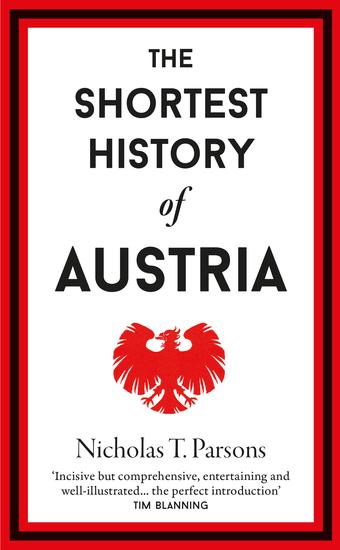
The Shortest History of Austria - cover

The Shortest History of Austria

Nicholas T Parsons

Verlag: Old Street Publishing

  • 0
  • 0
  • 0

Beschreibung

'Incisive but comprehensive, entertaining and well-illustrated, this is the perfect introduction to what was once a huge empire and is now a small but (undeservedly) very lucky country' TIM BLANNING

Austria is a small country with a glorious history but a troubled past. It sits at the crossroads of central Europe: the furthest the Ottomans reached in the seventeenth century, a back-channel between east and west during the Cold War, and today a member of the European Union with its neutrality challenged by the Russian invasion of Ukraine.

In The Shortest History of Austria, Nicholas T. Parsons expertly tells the story of Austria from its origins at the outer reaches of the Roman Empire to its dominance of central Europe under the Habsburgs, and from the rebuilding of the republic after the devastation of World War II to the political tensions of today.

As he ranges from the Romans to the Reformation, from the assassination of Archduke Franz Ferdinand to the Anschluss, and from Mozart to Gustav Klimt to Harry Lime, Parsons reveals the drama of Austria's history – and the crucial role the country has played in the story of Europe.
Verfügbar seit: 20.05.2025.
Drucklänge: 256 Seiten.

Weitere Bücher, die Sie mögen werden

  • The Ancient Wisdom Collection - Meditations the Art of War The Book of Five Rings Tao Te Ching & Many More Classic Works - cover

    The Ancient Wisdom Collection -...

    Sun Tzu, Marcus Aurelius,...

    • 0
    • 0
    • 0
    What if you could draw from a vast reservoir of ancient wisdom to excel in leadership, strategy, and personal growth? 
    This unparalleled anthology unites the most time-tested works on strategy, warfare, self-mastery, and the pursuit of power. Adapted for modern readers, each text provides unique perspectives—ranging from the peaceful introspection of Tao Te Ching to the calculated tactics of The Art of War. Together, they form a guidebook for overcoming challenges and fostering success in any arena. 
    What You’ll Discover in This Comprehensive Collection: 
    - The Art of War – Sun Tzu – A timeless masterpiece on strategic warfare and leadership. 
    - Meditations – Marcus Aurelius – Stoic reflections on discipline, resilience, and self-mastery. 
    - The Book of Five Rings – Miyamoto Musashi – Samurai wisdom on combat, strategy, and personal growth. 
    - Tao Te Ching – Laozi – A foundational text on balance, leadership, and the power of non-action. 
    - The Kybalion – Hermetic Philosophy – Esoteric teachings on universal laws and mental discipline. 
    - Arthashastra – Kautilya – An ancient Indian treatise on statecraft, economics, and military strategy. 
    - The Maxims of War – Napoleon Bonaparte – Insights from one of - history’s greatest military commanders. 
    - Instructions to His Generals – Frederick the Great – Tactical guidance from the Prussian king and military strategist. 
    - The Commentaries of Julius Caesar – Firsthand accounts of war, leadership, and conquest. 
    - History of the Peloponnesian War – Thucydides – A historical analysis of power, politics, and military conflict. 
    Imagine having an entire library of proven wisdom at your fingertips, offering guidance on how to lead, strategize, and live with purpose. This collection is a timeless companion for those seeking mastery in life’s battles—both internal and external. 
    Claim the power of the ages. Get your copy now and embark on an extraordinary journey through the best of ancient strategic thought.
    Zum Buch
  • A Conspiratorial Life - Robert Welch the John Birch Society and the Revolution of American Conservatism - cover

    A Conspiratorial Life - Robert...

    Edward H. Miller

    • 0
    • 0
    • 0
    The first full-scale biography of Robert Welch, who founded the John Birch Society and planted some of modern conservatism’s most insidious seeds. 
      
    Though you may not know his name, Robert Welch (1899-1985)—founder of the John Birch Society—is easily one of the most significant architects of our current political moment. In A Conspiratorial Life, the first full-scale biography of Welch, Edward H. Miller delves deep into the life of an overlooked figure whose ideas nevertheless reshaped the American right. 
     
    A child prodigy who entered college at age 12, Welch became an unlikely candy magnate, founding the company that created Sugar Daddies, Junior Mints, and other famed confections. In 1958, he funneled his wealth into establishing the organization that would define his legacy and change the face of American politics: the John Birch Society. Though the group’s paranoiac right-wing nativism was dismissed by conservative thinkers like William F. Buckley, its ideas gradually moved from the far-right fringe into the mainstream. By exploring the development of Welch’s political worldview, A Conspiratorial Life shows how the John Birch Society’s rabid libertarianism—and its highly effective grassroots networking—became a profound, yet often ignored or derided influence on the modern Republican Party. Miller convincingly connects the accusatory conservatism of the midcentury John Birch Society to the inflammatory rhetoric of the Tea Party, the Trump administration, Q, and more. As this book makes clear, whether or not you know his name or what he accomplished, it’s hard to deny that we’re living in Robert Welch’s America.
    Zum Buch
  • Murderous Minds - Exploring the Criminal Psychopathic Brain: Neurological Imaging and the Manifestation of Evil - cover

    Murderous Minds - Exploring the...

    PhD Dean A. Haycock

    • 0
    • 0
    • 0
    How many times have you seen a murder on the news or on a TV show like CSI: Crime Scene Investigation, and said to yourself, "How could someone do something like that?" Today, neuroscientists are imaging, mapping, testing, and dissecting the source of the worst behavior imaginable in the brains of the people who lack a conscience: psychopaths. Neuroscientist Dean Haycock examines the behavior of real life psychopaths and discusses how their actions can be explained in scientific terms, from research that literally looks inside their brains to understanding how psychopaths, without empathy but very goal-oriented, think and act the way they do. Some don't commit crimes at all, but rather make use of their skills in the boardroom. But what does this mean for lawyers, judges, psychiatrists, victims, and listeners—for anyone who has ever wondered how some people can be so bad. Could your nine-year-old be a psychopath? What about your co-worker? The ability to recognize psychopaths using the scientific method has vast implications for society, and yet is still loaded with consequences. 


    Contains mature themes.
    Zum Buch
  • The Don't Sweat Guide To Your Job Search - Finding a Career You Really Love - cover

    The Don't Sweat Guide To Your...

    Don't Sweat Press, Richard Carlson

    • 0
    • 0
    • 0
    In these troubled economic times, looking for a new job, or searching for that very first job opportunity, can be extremely stressful. There's more competition out there, and fewer jobs to compete for. 
     
    However, this time does not have to be as worrisome as it might seem. The Don't Sweat Guide to Your Job Search helps you to be more relaxed and peaceful as you hunt for the right occupation, and everyone knows that people are at their best in interviews when they're calm and relaxed. In essays such as: 
     
    -- Beware of Time Frames 
    -- Be Your Own Matchmaker 
    -- Cast Your Net Wide 
    -- What You Bring to the Table 
    -- It's Not a One-Way Street 
    -- The Theory of Relativity, Job Style 
     
    And many more. The editors of Don't Sweat Press reveal the best ways to search for a job without getting needlessly stressed out.
    Zum Buch
  • Utahisms - Unique Expressions Inventions Place Names & More - cover

    Utahisms - Unique Expressions...

    David Ellingson Eddington

    • 0
    • 0
    • 0
    Utahisms: Unique Expressions, Inventions, Place Names and more ranges from the characteristic to the bizarreThe Beehive State's iconic vistas are singular and distinctive. So too are its colloquialisms, peculiar place names and landmark firsts. Confusion from local dialect ultimately thwarted a would be robber in Salt Lake City. The proper pronunciation of Tooele might surprise visitors, while residents still debate its origins. And, phrases once thought to be solely Utahn often prove otherwise. The world's first department store was born out of xenophobia and religious persecution in 1869. Martha Hughes Cannon followed through on Brigham Young's encouraging women to become physicians. She later became the first female state senator in the United States, defeating her own husband.Examining everything from phonetics to history, BYU Linguistics Professor David Eddington reveals the roots of what is truly, uniquely Utah.
    Zum Buch
  • Dark Psychology - Dealing with Difficult People Abuse Liars and Manipulators - cover

    Dark Psychology - Dealing with...

    Wesley Felt

    • 0
    • 0
    • 0
    In today’s world, our perception fundamentally shapes our reality. This explains why two people can have entirely different interpretations of the same event. The meaning we assign to events stems from our beliefs and emotions. So, can altering our perception actually change our world? If so, how can this be achieved? And if it's possible, how can we mold our reality to create a better one? 
      
    What we see defines what we believe, and what we believe dictates what we consider true. Our sense of truth then becomes our reality. Thus, our perception molds our reality. Although we share the same world, we each focus on our own perceived truths. Even though everyone has eyes, each person views the world in a unique way. It’s easy to find what we’re looking for, but harder to notice what we’re not searching for. For example, one person might see a glass as half-full while another sees it as half-empty. 
      
    “A pessimist sees the trouble in every opportunity; an optimist sees the chance in every trouble.” 
      
    Perception Is Relative 
      
    There are numerous examples of how perception influences our reality. When we buy a new white car, we suddenly notice that color and model everywhere. If we like or dislike a song, it seems to play frequently. When someone points out a particular mannerism or nervous tic in another person, it seems to become more noticeable afterward.
    Zum Buch