Begleiten Sie uns auf eine literarische Weltreise!
Buch zum Bücherregal hinzufügen
Grey
Einen neuen Kommentar schreiben Default profile 50px
Grey
Jetzt das ganze Buch im Abo oder die ersten Seiten gratis lesen!
All characters reduced
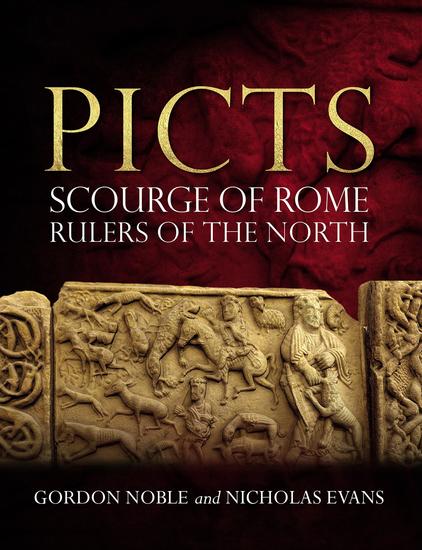
Picts - Scourge of Rome Rulers of the North - cover

Picts - Scourge of Rome Rulers of the North

Nicholas Evans, Gordon Noble

Verlag: Birlinn

  • 0
  • 0
  • 0

Beschreibung

Shortlisted for the EAA Book Prize and the Current Archaeology Book of the Year Award
The Picts have fascinated for centuries. They emerged c. ad 300 to defy the might of the Roman empire only to disappear at the end of the first millennium ad, yet they left major legacies. They laid the foundations for the medieval Scottish kingdom and their captivating carved stones are some of the most eye-catching yet enigmatic monuments in Europe. Until recently the Picts have been difficult to trace due to limited archaeological investigation and documentary sources, but innovative new research has produced critical new insights into the culture of a highly sophisticated society which defied the might of the Roman Empire and forged a powerful realm dominating much of northern Britain.
This is the first dedicated book on the Picts that covers in detail both their archaeology and their history. It examines their kingdoms, culture, beliefs and everyday lives from their origins to their end, not only incorporating current thinking on the subject, but also offering innovative perspectives that transform our understanding of the early history of Scotland.
Verfügbar seit: 03.11.2022.
Drucklänge: 336 Seiten.


Weitere Bücher, die Sie mögen werden

  • Psychology of Peoples - Its influence on their evolution - cover

    Psychology of Peoples - Its...

    Gustave Le Bon

    • 0
    • 0
    • 0
    After receiving a doctorate in medicine, Le Bon travelled in Europe, North Africa, and Asia and wrote several books on anthropology and archaeology. His interests later shifted to natural science and social psychology. Gustave Le Bon is best known for his seminal work „Crowd Psychology“ where he describes the psychological effects in various group settings. In „Psychology of Peoples“ written in 1894 he utilizes his anthropological knowledge and cross-references it with social psychology. He developed a view that history is the product of racial or national character, with emotion, not intelligence, being the dominant force in social evolution. He attributed true progress to the work of an intellectual elite. As a product of its time and conditions, the content of this book is partly highly controversial and should be seen as an intellectual challenge. Some arguments should be outright rejected, cause they haven’t stood the test of time. To his credit, already back in 1894 Le Bon foresaw the dangers of the application of socialism, well before the Russian Revolution and Mao’s takeover of China. 
    Zum Buch
  • Palace of Deception - Museum Men and the Rise of Scientific Racism - cover

    Palace of Deception - Museum Men...

    Darrin Lunde

    • 0
    • 0
    • 0
    From 1908 to 1933, the American Museum of Natural History launched more scientific field expeditions than at any other time in its existence. Sponsoring lavish trips to Africa and Central Asia, the museum filled its halls with artifacts and an aura of adventure, supported by some of New York City's most prominent men. All the while, the museum's then president, Henry Fairfield Osborn, attempted to use his adventurers' expeditions to fulfill a personal agenda: to propagate his belief in racial hierarchy. 
     
    Palace of Deception uncovers the complicated legacy of three iconic figures of the American Museum: the preeminent explorer Roy Chapman Andrews; Carl Akeley, the pioneering taxidermist; and Osborn, the museum's president. Darrin Lunde tells the story of the American's Museum foundational years. Lunde also shows how the achievements of the museum's adventurers were used to introduce residents of New York to a version of the natural world endorsed by the museum's leader. 
     
    Palace of Deception recreates some of the most celebrated, globe-trotting journeys from natural history's heyday. It also traces the larger, racially infused milieu that underwrote the golden age of exploration, uncovering the simmering anxieties about race behind the era's greatest adventures. It is a legacy that still haunts natural history institutions today.
    Zum Buch
  • Aesthetics - The Philosophy of Beauty Perception and Art - cover

    Aesthetics - The Philosophy of...

    Hector Davidson

    • 0
    • 0
    • 0
    Aesthetics is a branch of philosophy that explores the nature of beauty, art, and taste, and the creation and appreciation of beauty. It examines what makes something aesthetically pleasing or beautiful, and the principles underlying the judgments and experiences related to these concepts. 
    Aesthetics addresses a wide range of questions: What is beauty? Can aesthetic value be objectively determined, or is it entirely subjective? What role do cultural and historical contexts play in shaping our perceptions of beauty and art? How do sensory experiences and emotions influence our aesthetic judgments? 
    The field of aesthetics is deeply interdisciplinary, intersecting with art criticism, cultural studies, psychology, and even neuroscience, to understand how humans perceive and respond to aesthetic experiences. Aesthetic theory often involves the analysis of artworks, literature, music, and natural beauty, seeking to uncover the principles and criteria that govern aesthetic appreciation and creation.
    Zum Buch
  • Start of the Crusades The: The Origins of the World’s Most Famous Religious Wars - cover

    Start of the Crusades The: The...

    Charles River Editors

    • 0
    • 0
    • 0
    Though it went largely unremarked in the Islamic world at the time, the First Crusade has since become a contentious symbol of European imperialism in the Middle East. Debate over whether the Crusades can truly be perceived as an early example of European colonialism continues in medieval historiography, though the evidence for this is thin. The territory taken by the Franks from the Turks had previously belonged to Eastern Christians and had only recently been seized by the Turks themselves. The Crusader States were relatively small and weak, and they were reconquered centuries before modern European colonialism began. The Crusaders themselves saw it as a holy war of reclamation of previously lost (albeit almost-mythical) territory. To them, the Muslims were the first aggressors, and they were somewhat bolstered in this view by the support that they largely held from local Christians.   
    	The Crusader States were relatively small and weak, and while they tried to be a bulwark of Christianity in the Holy Land, the Crusader States were reconquered centuries before modern European colonialism began. Nonetheless, the Crusades and the Crusader States galvanized the Christians of Western Europe to expand their world. While it remains unclear how much that world expanded in practical terms such as trade, or how it affected later attitudes during the expansion to the New World and other regions, it definitely engaged the European mind in both positive and negative ways. As such, the crusades soon achieved near-mythic status in the European literature and remain among the most important events of the Middle Ages.  
    At the same time, the Crusader States were not one homogenized region but actually several distinct territories that had their own unique histories and interests. In fact, many of them were founded a century apart.
    Zum Buch
  • Little Women Podcast: Love And Spiritual Transformation In Little Women - cover

    Little Women Podcast: Love And...

    Niina Niskanen

    • 0
    • 0
    • 0
    In her novels, Louisa May Alcott emphasises characters' spiritual transformation when they fall in love with one another. This happens to Laurie when he falls for Amy and to Jo when she falls for Friedrich. How did Louisa May Alcott and other transcendentalists view love? They saw love as something sacred, based on the idea that you build something bigger with your significant other. 
    Dive into the heart of Louisa May Alcott's "Little Women", where love is more than romance—it’s a journey of spiritual transformation. In this unique podcast episode, explore how Alcott portrays love as a profound force, one that shapes and elevates her characters’ lives. This transformative love touches Laurie as he falls for Amy, and Jo as she opens her heart to Friedrich, revealing Alcott’s deeper vision of love’s sacred essence.🌌 Key ThemesLove as Sacred: Discover how Alcott and transcendentalist thinkers saw love as a partnership in building something meaningful and larger than oneself.Character Growth: Follow Laurie and Jo’s transformations, showing how falling in love impacts their spirituality and personal growth.Transcendentalist Influence: Uncover the ways Alcott and her contemporaries believed love could transcend individual desires and unite two souls in a shared purpose.🎧 Why Listen? 
    If you've ever wondered how love can be both soulful and transformative, this episode offers fresh insights into how a classic novel redefines romantic relationships. Perfect for fans of literary analysis, Alcott's works, and anyone curious about the intersection of love, spirituality, and self-discovery. 
    This episode invites listeners to journey beyond the surface of romance and explore how love can lead to profound spiritual awakening.
    Zum Buch
  • Sins Of Love - cover

    Sins Of Love

    Fay Leta Crawford

    • 0
    • 0
    • 0
    Sins of Love is a collection of poems written solely by myself. Sins of Love is my interpretation of love and heartbreak in correlation with the stages of death and dying. I have taken my experiences and the experiences of others and categorized them into five stages. This book is a walk through the side of love most people don’t want to talk about. This conversation is necessary in order to heal, grow and find the love meant for you. 
    Follow me as we trail through my denial, my anger, my bargaining, my depression and my acceptance in my Sins of Love. 
    Special thanks to my amazing Producer & Engineer Extraordinaire, Kenechi Ubani 
    Special thanks to my Cover Art Designer, Emmanuel Baligad
    Zum Buch