Begleiten Sie uns auf eine literarische Weltreise!
Buch zum Bücherregal hinzufügen
Grey
Einen neuen Kommentar schreiben Default profile 50px
Grey
Jetzt das ganze Buch im Abo oder die ersten Seiten gratis lesen!
All characters reduced
The Prince - Must Read Classics - cover

The Prince - Must Read Classics

Niccolo Machiavelli

Übersetzer W. K. Marriott

Verlag: DigiCat

  • 0
  • 0
  • 0

Beschreibung

Niccolò Machiavelli's 'The Prince' stands as a seminal work in political philosophy, exploring the complexities of power, governance, and human nature. Written in the early 16th century, this treatise adopts a pragmatic and often ruthless approach to statecraft, challenging the moralistic views of its time. Machiavelli's literary style is characterized by directness and clarity, employing historical examples to illustrate his arguments. The work delves into the balances of virtue and vice, the efficacy of deception, and the role of fortune, positioning itself firmly within the context of Renaissance humanism and the tumultuous political landscape of Italy. Machiavelli, born in Florence in 1469, was a diplomat and political thinker deeply influenced by the instability of Italian city-states during his life. His experiences, including imprisonment and exile, fostered a disillusionment with idealistic political theories, prompting him to advocate for realpolitik. 'The Prince' reflects his desire to provide pragmatic advice to rulers, drawn from both classical and contemporary sources, as a means of achieving stability and strength in governance. Recommended for students of political science, history, and philosophy, 'The Prince' invites readers to confront the uncomfortable truths of power dynamics. Its enduring relevance and provocative insights encourage critical reflection on leadership and ethics, making it essential reading for anyone grappling with the complexities of authority and morality in modern contexts.
Verfügbar seit: 17.05.2022.
Drucklänge: 108 Seiten.


Weitere Bücher, die Sie mögen werden

  • A Life in the American Century - cover

    A Life in the American Century

    Jr. Joseph S. Nye

    • 0
    • 0
    • 0
    For the past eight decades, we have lived in "the American Century"—a period during which the US has enjoyed unrivaled power—be it political, economic, or military—on the global stage. Born on the cusp of this new era, Joseph S. Nye Jr. has spent a lifetime illuminating our understanding of the changing contours of America power and world affairs. His many books on the nature of power and political leadership have rightly earned him his reputation as one of the most influential international relations scholars in the world today. 


    In this deeply personal book, Joseph Nye shares his own journey living through the American century. From his early years growing up on a farm in rural New Jersey to his time in the State Department, Pentagon, and Intelligence Community during the Carter and Clinton administrations where he witnessed American power up close, shaping policy on key issues such as nuclear proliferation and East Asian security.  After 9/11 drew the US into wars in Iraq and Afghanistan, Nye remained an astute observer and critic of the Bush, Obama, and Trump presidencies. Today American primacy may be changing, but he concludes with a faint ray of guarded optimism about the future of his country in a richer but riskier world.
    Zum Buch
  • Fear Tactics - Using Fear to Control or Manipulate Others - cover

    Fear Tactics - Using Fear to...

    Cito Harder

    • 0
    • 0
    • 0
    Fear is one of the most primal human emotions, deeply embedded in the survival instincts of individuals and societies. Throughout history, it has been harnessed as a tool of control, allowing those in positions of power to manipulate others for personal, political, or financial gain. Fear tactics involve the deliberate use of intimidation, threats, and uncertainty to shape perceptions, influence decisions, and suppress opposition. Whether used in personal relationships, corporate environments, or large-scale governance, these tactics exploit an individual’s natural aversion to danger and discomfort.  
    At its core, a fear tactic works by triggering the instinctive fight-or-flight response. When people perceive a threat—whether real or fabricated—they become more susceptible to external influence. Logical reasoning often takes a backseat to emotional reactions, making individuals more likely to comply with demands, accept misleading information, or make decisions that they otherwise would not consider. Fear-based influence operates on the principle that an individual will do whatever is necessary to avoid the perceived threat, even if it means relinquishing personal freedoms, adopting extreme beliefs, or placing trust in an unworthy authority.
    Zum Buch
  • Rare Earth Elements & Critical Minerals: Science Supply Chains & Statecraft - What They Do Why They Matter & What The Future Holds… - cover

    Rare Earth Elements & Critical...

    Dr. Nick Coman, I. A.I.

    • 0
    • 0
    • 0
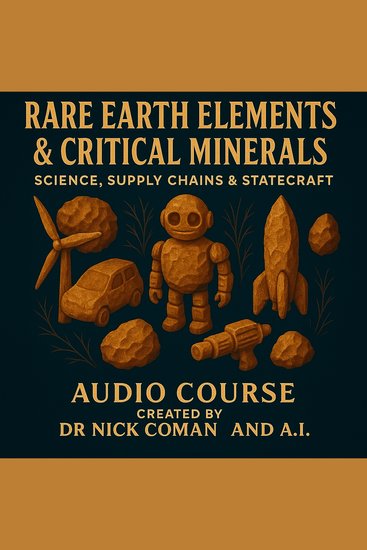
    A 36‑lecture audio course on the materials that run the modern world—from ore bodies and brines to magnets, batteries, chips, and reactors. Each lecture focuses on one element or mineral, tracing its journey from deposit geology through beneficiation and refining to the devices it powers. 
    We make the flowsheet legible: comminution and flotation; roasting, high‑pressure acid leaching, solvent extraction, and ion exchange; separation to oxides and metals; alloying and specialty powders. See how neodymium‑iron‑boron magnets are born, why lithium hexafluorophosphate matters in electrolytes, where gallium nitride wins in power, how graphite anodes evolve with silicon, and how the uranium fuel cycle and vanadium flow batteries actually work. 
    Markets and politics are treated as engineering constraints. Learn to spot yield killers, read offtake agreements, and separate strategic scarcity from narrative. Test real substitutions—ferrites in small motors, sodium‑ion for short‑range storage, gallium nitride versus silicon carbide—and where performance cliffs block redesign. We map chokepoints beyond the mine: separation capacity, reagents, waste handling, water and energy intensity, and manufacturer qualification cycles. Then we follow the consequences—export controls and quotas, permitting and community consent, tariffs and friend‑shoring, standards and labeling rules. 
    Rigorous, narrative‑driven, and built for the intellectually ambitious, this course is an operator’s guide to the science, supply chains, and statecraft of a materials‑constrained century.
    Zum Buch
  • Irish Unity - Time to Prepare - cover

    Irish Unity - Time to Prepare

    Ben Collins

    • 0
    • 0
    • 0
    Growing up during The Troubles, I was determined that I was not going to be forced into Irish unity by terrorist violence or the threat of it. At the time, there was no space to think about a different future. But since then, we have had peace, however imperfect it may be, and we now have the opportunity to freely decide our fate.
    Why will everyone living on the island of Ireland benefit from Irish unity?
    How will the referendum be won?
    Do we need to start preparing now?
    What will happen when Ireland is reunified?
    Disillusioned with the state of pro-union politics in Britain and Northern Ireland, scarred by what he and many others see as a detrimental vote for Brexit and determined to heal the wounds inflicted by partition, Ben Collins sets out a multitude of political, social and economic benefits of removing the border on the island of Ireland, once and for all.
    Written from the viewpoint of an East Belfast-born former UUP campaigner, Irish Unity: Time to Prepare addresses the concerns of unionists in Northern Ireland and sceptics in the Republic and urges everyone on the island of Ireland to escape the crumbling United Kingdom so that we can build a peaceful and prosperous future together, for ourselves and our children.
    Zum Buch
  • Addiction Becomes Normal - On the Late-Modern American Subject - cover

    Addiction Becomes Normal - On...

    Jaeyoon Park

    • 0
    • 0
    • 0
    Addiction is now seen as an ordinary feature of human nature, an idea that introduces new doubts about the meaning of our desires. 
      
    Over the last forty years, a variety of developments in American science, politics, and culture have reimagined addiction in their own ways, but they share an important understanding: increasingly, addiction is described as normal, the natural result of a body that has been exposed to potent stimuli. This shift in thinking suggests that addiction is a condition latent in all of us, a common response to a society rich in thrills. 
      
    In Addiction Becomes Normal, Jaeyoon Park provides a history and critical analysis of the normalization of addiction in late-modern American society. By exploring addiction science, diagnostic manuals, judicial reform, and public health policy, he shows how seeing addiction as normal has flourished in recent decades and is supported throughout cultural life in the United States by the language of wellness, psychotherapy, and more. Building on Michel Foucault’s depiction of the human figure, Park argues that this shift reflects the emergence of a new American subject, one formed by the accretion of experiences. This view of the human subject challenges the idea that our compulsions reflect our characters, wills, or spirits. For if addiction is an extreme but ordinary attachment, and if compulsive consumption resembles healthy behavior, then desire is no longer an expression of the soul so much as the pursuit of a past reward. A perceptive work of recent history and political theory, Addiction Becomes Normal raises new questions about what it means to be human in America today.
    Zum Buch
  • The Petroleum Papers - Inside the Far-Right Conspiracy to Cover Up Climate Change - cover

    The Petroleum Papers - Inside...

    Geoff Dembicki

    • 0
    • 0
    • 0
    Burning fossil fuels will cause catastrophic global warming: this is what top American oil executives were told by scientists in 1959. But they ignored that warning. Instead, they developed one of the biggest, most polluting oil sources in the world—the oil sands in Alberta, Canada. As investigative journalist Geoff Dembicki reveals in this explosive book, the decades-long conspiracy to keep the oil sands flowing into the US would turn out to be one of the biggest reasons for the world's failure to stop the climate crisis. 


    In The Petroleum Papers, Dembicki draws from confidential oil industry documents to uncover for the first time how companies like Exxon, Koch Industries, and Shell built a global right-wing echo chamber to protect oil sands profits—a misinformation campaign that continues to this day. He also tells the high-stakes stories of people fighting back: a Seattle lawyer who brought down Big Tobacco and is now going after Big Oil, a Filipina activist whose family drowned in a climate disaster, and a former Exxon engineer pushed out for asking hard questions. 


    With experts now warning we have less than a decade to get global emissions under control, The Petroleum Papers provides a step-by-step account of how we got to this precipice—and the politicians and companies who deserve our blame.
    Zum Buch