Rejoignez-nous pour un voyage dans le monde des livres!
Ajouter ce livre à l'électronique
Grey
Ecrivez un nouveau commentaire Default profile 50px
Grey
Abonnez-vous pour lire le livre complet ou lisez les premières pages gratuitement!
All characters reduced
Machiavelli: The Prince - Navigating the Machiavellian World: Unveiling Power Dynamics and Leadership Principles in Renaissance Political Philosophy - cover

Machiavelli: The Prince - Navigating the Machiavellian World: Unveiling Power Dynamics and Leadership Principles in Renaissance Political Philosophy

Niccolò Machiavelli

Traducteur W. K. Marriott

Maison d'édition: Good Press

  • 0
  • 0
  • 0

Synopsis

In "The Prince," Niccolò Machiavelli delves into the complex dynamics of power and leadership during the tumultuous Renaissance period. With a pragmatic and often starkly realistic approach, Machiavelli articulates strategies for rulers to maintain control and safeguard their states. His work blends political theory with anecdotal evidence, drawing on historical examples and classical philosophy to present a guide that eschews moral righteousness in favor of effectiveness and stability. The literary style is clear, concise, and often provocative, marking a departure from the idealistic views of governance prevalent in previous writings, thereby situating Machiavelli as a pivotal figure in the foundation of modern political thought. Machiavelli, a diplomat and political theorist from Florence, wrote "The Prince" following a period of political upheaval that left a profound impact on him. His background in the intricacies of Florentine politics, coupled with his experiences of exile and observation of the Italian city-states, led him to formulate a realistic narrative of power and its often ruthless pursuits. This contextual backdrop informs the unflinching advice he gives to rulers, seeking not to promote virtue, but to navigate the complexities of human nature and societal structures. Readers looking to grasp the intricacies of political strategy and the often uncomfortable truths of leadership will find "The Prince" essential. Machiavelli's insights remain extraordinary not only for their historical significance but for their enduring relevance in contemporary political discourse. This short yet profound treatise is recommended for anyone seeking to understand the darker yet essential facets of governance and the nature of power.
Disponible depuis: 01/12/2023.
Longueur d'impression: 108 pages.


D'autres livres qui pourraient vous intéresser

  • China's World View - Demystifying China to Prevent Global Conflict - cover

    China's World View -...

    David Daokui Li

    • 0
    • 0
    • 0
    Writing in response to the growing anti-Chinese sentiment and alarmed by the threat of war, Dr. David Daokui Li pulls from his wealth of firsthand experience to demystify contemporary Chinese society and advocate for understanding between China and the West. In this urgently needed and fascinating book, he explains the inner workings of a rising superpower to help the world understand how it works—and how to work with it. 


    In Li's hands, an economic and political system that often baffles Westerners becomes coherent, sophisticated, and logical. He begins by explaining how two thousand years of history—from Confucian philosophy and ancient imperial dynasties to Communist Party chairmen from Mao to Deng Xiaoping—profoundly influence China's leadership today. Li brings the listener into high-level meetings he attended with figures including Xi Jinping, showing China's approach to governance. 


    In demystifying contemporary Chinese society, Li helps listeners reconceptualize contemporary China and the implications of its growth. He asserts that China's rise will be beneficial for the global order, holding out the hope that with shared understanding and mutual learning the Chinese and Western systems will eventually find a way to peacefully coexist.
    Voir livre
  • Kincora: Britain's Shame - cover

    Kincora: Britain's Shame

    Chris Moore

    • 0
    • 0
    • 0
    For over four decades the story of the extraordinary evil that occurred at the Kincora Boys’ Home in East Belfast in the 1970s and the shocking attempts by MI5 to cover it up have haunted our political and social terrain for decades. Award-winning former BBC journalist Chris Moore has been working on the story since it first emerged in 1980, and has uncovered a horrific catalogue of failed opportunities to put an end to the sadistic activities of the men who were running the home, in particular those of prominent Orangeman and MI5 source William McGrath. 
     
    What has emerged over the course of Moore’s investigation, in which he has gained exclusive access to witnesses, secret documents and whistleblowers within the British intelligence services, is that not only were the boys in Kincora systematically sexually abused, but that some were forced into a countrywide paedophile ring, whose members included Lord Louis Mountbatten. Moore also exposes MI5’s attempts to cover up what actually happened and that the organisation knew as early as the 1970s that the boys in Kincora were being abused. 
     
    Kincora is a shocking exposé of how the British state failed to protect some of its most vulnerable members.
    Voir livre
  • Stakeknife's Dirty War - The Inside Story of Scappaticci the IRA's Nutting Squad and the British Spooks Who Ran the War - cover

    Stakeknife's Dirty War - The...

    Richard O'Rawe

    • 0
    • 0
    • 0
    Freddie Scappaticci was born in 1946 and raised in a deeply nationalist area of Belfast. When the Troubles broke out in 1969, he joined the Provisional IRA, where he quickly rose through the ranks, becoming commander of Belfast in 1984. 
     
    From the outside, Scappaticci appeared to be a dedicated volunteer, but inwardly, he had become disenchanted with the IRA and, in 1977, he started working for British intelligence. At the same time, he took up a leading role in a newly formed IRA Internal Security Unit (ISU), aka ‘The Nutting Squad’. He personally executed two suspected informers and condemned at least thirty-seven more to death. 
     
    Was he the serial killer that history portrays him? Undoubtedly. But it’s not that simple, because every time he passed the death penalty on an informer, he told his British intelligence handlers about the intended execution, giving them the opportunity to prevent the killing. 
     
    Did the tasking and co-ordinating group, the primary British intelligence organisation in Northern Ireland during the troubles, aid and abet the IRA in the mass-murder of British citizens? That is the question Richard O’Rawe poses in Stakeknife’s Dirty War. But O’Rawe goes further: he lays out a very compelling case that points to the TCGs running the IRA’s war from the mid-1980s to the 1994 ceasefire. Such was the British intelliegence penetration of the IRA, that Freddie Scappaticci, aka ‘Stakeknife’, was in control of all IRA operations in the Belfast Brigade area. This book will shock readers, and cause them to reevaluate everything they formerly held to be true about Stakeknife’s dirty war in Ireland.
    Voir livre
  • Why AI Undermines Democracy and What to Do About It - cover

    Why AI Undermines Democracy and...

    Mark Coeckelbergh

    • 0
    • 0
    • 0
    Across the world, AI is used as a tool for political manipulation and totalitarian repression. Stories about AI are often stories of polarization, discrimination, surveillance, and oppression. Is democracy in danger? And can we do anything about it? 


    In this compelling and balanced book, Mark Coeckelbergh reveals the key risks posed by AI for democracy. He argues that AI, as currently used and developed, undermines fundamental principles on which liberal democracies are founded, such as freedom and equality. How can we make democracy more resilient in the face of AI? And, more positively, what can AI do for democracy? Coeckelbergh advocates not only for more democratic technologies, but also for new political institutions and a renewal of education to ensure that AI promotes, rather than hinders, the common good for the twenty-first century. 


    Why AI Undermines Democracy and What to Do About It is a must-listen for anyone who is concerned about the fate of democracy.
    Voir livre
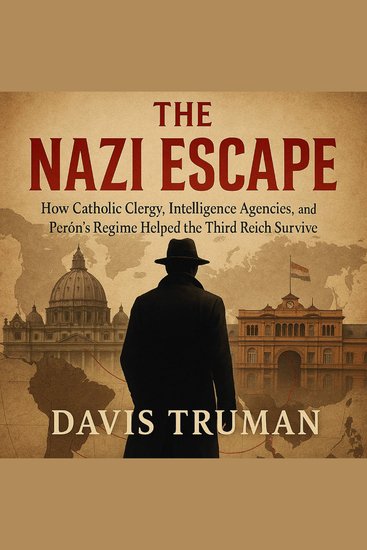
  • The Nazi Escape - How Catholic Clergy Intelligence Agencies and Perón's Regime Helped the Third Reich Survive - cover

    The Nazi Escape - How Catholic...

    Davis Truman

    • 0
    • 0
    • 0
    This audiobook is narrated by an AI Voice.   
    What if the fall of Hitler was only the beginning? 
    In The Nazi Escape, uncover the shocking, meticulously researched story of how a secretive global alliance, spanning Vatican corridors, Allied intelligence networks, and Argentina’s highest political ranks, engineered one of history’s most chilling cover-ups. With the Third Reich in ruins, elite Nazi war criminals vanished without a trace. But they didn’t disappear... they were helped. 
    This gripping exposé reveals how Catholic clergy operated covert escape routes known as “ratlines,” how Western intelligence agencies turned a blind eye, or lent a hand, and how Juan Perón’s Argentina became a haven for some of the most notorious figures of World War II. 
    From shadowy monasteries in Rome to the pampas of South America, The Nazi Escape reads like a thriller, but every word is true. Packed with declassified documents, firsthand accounts, and shocking revelations, this is the untold story the world wasn’t supposed to know.
    Voir livre
  • Lying - Communicating False Information Deliberately - cover

    Lying - Communicating False...

    Cito Harder

    • 0
    • 0
    • 0
    Lying, the deliberate act of communicating false information, has been a part of human behavior for centuries. It is a complex and multifaceted phenomenon that plays a role in many aspects of life, from personal relationships to politics, business, and beyond. While most people recognize lying as morally wrong, it remains a pervasive and unavoidable part of the human experience. This chapter will explore the nature of lying, the different types of lies, and why people engage in this behavior. 
    At its core, lying involves providing information that the speaker knows to be false, with the intent to deceive the listener. Unlike mistakes or misunderstandings, lies are intentional and often involve a conscious decision to mislead. Lying can take many forms, ranging from small, seemingly harmless "white lies" to more harmful and deliberate fabrications designed to achieve personal gain or avoid consequences. While some lies may appear trivial, others can have significant consequences, leading to broken trust, damaged relationships, or even harm to others. 
    The act of lying is not limited to individuals but can also be embedded in larger societal and cultural practices. From politicians who manipulate public opinion to corporations that mislead consumers about the quality of their products, deception is often employed as a tool to achieve power, influence, or financial success. Understanding the motivations behind lying is key to understanding its prevalence and persistence in society. People lie for various reasons: to protect themselves, to avoid punishment, to gain an advantage, or to spare others' feelings. The reasons behind a lie often depend on the context and the perceived consequences of telling the truth.
    Voir livre