Rejoignez-nous pour un voyage dans le monde des livres!
Ajouter ce livre à l'électronique
Grey
Ecrivez un nouveau commentaire Default profile 50px
Grey
Abonnez-vous pour lire le livre complet ou lisez les premières pages gratuitement!
All characters reduced
Discourses on Livy - cover

Discourses on Livy

Niccolo Machiavelli

Traducteur Ninian Hill Thomson

Maison d'édition: DigiCat

  • 0
  • 0
  • 0

Synopsis

In "Discourses on Livy," Niccolò Machiavelli embarks on a profound analysis of classical republicanism, drawing inspiration from Rome's history to articulate his vision of political governance. Employing a methodical and discursive literary style, Machiavelli juxtaposes the successes and failures of ancient Rome against contemporary Italian statecraft, emphasizing the importance of civic virtue and the role of citizen engagement in a republic. His work not only contributes to the discourse on political theory but also challenges the prevailing notions of despotism and tyranny, thus marking an essential pivot between medieval scholasticism and modern political thought. Machiavelli, a seasoned diplomat and political theorist of Renaissance Florence, wrote this treatise following his experiences with the tumultuous political landscape of Italy. His exposure to varying forms of governance and his extensive study of classical texts profoundly influenced his thought process, leading him to critique the inadequacies of his time while advocating for a balanced government with mixed institutions. "Discourses on Livy" is an indispensable read for those interested in political philosophy, historical analysis, and the intricate dynamics of power. It invites readers to examine the foundations of republicanism and consider the implications of Machiavelli's insights for modern governance, making it a vital addition to any scholar's library.
Disponible depuis: 14/12/2023.
Longueur d'impression: 495 pages.

D'autres livres qui pourraient vous intéresser

  • Albert Einstein’s "Why Socialism?" - The Enduring Relevance of His Classic Essay - cover

    Albert Einstein’s "Why...

    Albert Einstein

    • 0
    • 0
    • 0
    A contemporary look at Albert Einstein's classic call for socialism 


    First published more than seventy-five years ago in the inaugural issue of Monthly Review: An Independent Socialist Magazine, Albert Einstein's "Why Socialism?" is an unheralded classic. Written during the McCarthyite witch-hunt in the United States, it constituted an act of defiance, making a case for socialism unrivaled in its time or ours. Yet, its very existence has been an embarrassment to an establishment which has continually sought to downplay the significance of his iconoclastic essay, together with Einstein's socialism itself. 


    This volume includes Einstein's essay along with a detailed commentary on his essay by Monthly Review editor, John Bellamy Foster. Foster's introduction tells the story of Einstein's life-long commitment to socialism and the events leading to the publication of "Why Socialism?" and contextualizes the importance of his essay as we enter a time of planetary crisis and new threats of world war. Over the three-quarters of century since its publication, "Why Socialism?" is one of those rare statements whose power has only grown, reaching untold numbers of readers over the years. It is of crucial importance that―for the sake of the future of humanity―Einstein's message continues to proliferate.
    Voir livre
  • The Anarchist Movement - A historical Overview of Anarchist Theory and Practice - cover

    The Anarchist Movement - A...

    Arlo Holders

    • 0
    • 0
    • 0
    Anarchism, as both a philosophy and a political movement, seeks to abolish hierarchical structures of power, particularly the state, and promote a society based on voluntary cooperation, mutual aid, and self-governance. The term “anarchy” is often misunderstood and associated with chaos or disorder, but in the context of anarchism, it refers to the absence of coercive authority, not lawlessness. Anarchism challenges the legitimacy of centralized governments, institutions, and systems that perpetuate inequality and domination, advocating instead for decentralized, egalitarian forms of social organization. 
    The roots of anarchism can be traced back to the philosophical and political developments of the 17th and 18th centuries, particularly in the Enlightenment. Thinkers such as William Godwin and Jean-Jacques Rousseau laid the groundwork for anarchist thought by critiquing the rise of centralized authority and envisioning societies based on the autonomy of individuals and communities. However, it was in the 19th century that anarchism began to take shape as a distinct political ideology, largely influenced by the writings and activism of figures like Pierre-Joseph Proudhon, Mikhail Bakunin, and Peter Kropotkin. 
    Central to anarchist theory is the belief in individual freedom and autonomy. Anarchists argue that all individuals should have the right to govern their own lives without interference from external authorities, whether those authorities are political, economic, or social. Anarchism posits that society can function without the need for a state, which is often seen as a coercive and oppressive institution. Instead, anarchists advocate for decentralized forms of governance, such as direct democracy, mutual aid, and voluntary association, where decisions are made collectively by communities rather than imposed by a centralized authority.
    Voir livre
  • The Search for Reagan - The Appealing Intellectual Conservatism of Ronald Reagan - cover

    The Search for Reagan - The...

    Craig Shirley

    • 0
    • 0
    • 0
    Never before has anyone explored the mind, soul, and heart of Ronald Reagan. The Search for Reagan explores the challenges and controversies in Reagan's life and how he successfully dealt with each, depicting a man who was never as conservative as some conservatives wanted him to be, but rather as conservative as he was comfortable being—a man who wanted to win on his own terms and integrity. 


    Ronald Reagan was a singularly unique man and conservative who championed a wildly successful revolution—leading to more freedom and less government for the American people and to the fall of communism, while boosting American morale. He was the first president in many years who believed optimism from the Oval Office had a direct bearing on the affairs of the nation. As a consequence, he left office more popular than when he entered, with a whopping 73 percent approval. He understood that American conservatism was based upon the individual and not the group. In his presidency, he solved the mystery of high inflation that had bedeviled his predecessor, high interest rates, and high gas prices. He created over twenty million new jobs, and the number of American millionaires grew from 4,414 to 34,944. He is considered by most historians to be one of our four greatest presidents, along with George Washington, Abraham Lincoln, and Franklin Roosevelt.
    Voir livre
  • Voices for the Future - 20 Years of the Trilogue Salzburg - cover

    Voices for the Future - 20 Years...

    Wolfgang Schüssel, Liz Mohn

    • 0
    • 0
    • 0
    How can culture, politics and business work together to meet the challenges of the future? Will united Europe fall victim to individual national interests? Is the economy the silver bullet when it comes to solving global challenges? Can policy makers still lead in an age of fake news and escalating expectations? What kind of support is needed – and from which culture – to shape a sustainable society?
    The book Voices for the Future documents the lively exchange between international thought leaders from the cultural, economic and political spheres on solutions to current and coming problems. Since 2002, they have been gathering at the Trilogue Salzburg to take a shared look at what the future holds. Where has the Trilogue been farsighted in terms of the issues that now dominate the policy agenda and our everyday lives? What must (still) happen if we are to respond effectively to future challenges? Voices for the Future essays answers to these questions, addressing the topics of Europe, the labor market, leadership, education and values.
    Voir livre
  • Social Democracy 101: Jack London at Yale - The Roots of Socialism in the United States - cover

    Social Democracy 101: Jack...

    Shane Irvine, Alexander Irvine,...

    • 0
    • 0
    • 0
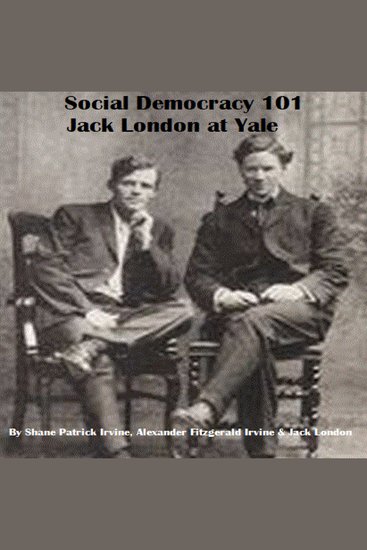
    In 1906, my great-grandfather Dr. Alexander Fitzgerald Irvine was the secretary of the Socialist Party of Connecticut and a fellow at Yale University where he taught studies in divinity. He sought to shed some light on the subject of social protection. He had first-hand experience as a reverend in the New Haven religious community. He became very aware of parishioner stealing and other forms of skulduggery used to acquire the most prosperous benefactors. He despised the practice of selectively seeking profitable parishioners while ignoring the plight of the downtrodden. He felt that this practice was in conflict with Jesus’ teachings. He thereafter invited Jack London to speak at Yale on the subject of socialism. This book is derivative of my great-grandfather's book, Jack London at Yale. 
    My great-grandfather further believed that, due to this hypocrisy involving the church’s duty to the poor, the government needed to take an active role in offering a hand up to those in need. He strongly advocated that it should not be assumed that the church and pity be the sole final resources for those in need, and the government needed to take an active role in providing social networks. 
    Health, education, and welfare are major barriers to entrepreneurial opportunity. Without forms of social democracy such as universal healthcare and education, the potential for mass enterprise is squandered. People are precluded by these basic economic barriers from reaching their potential. It is these issues that have continued to plague workers worldwide, and people of all persuasions and walks of life are affected by this ongoing class struggle. We need individualism and a free market society, and we also need it to be tamed with a fairness that, along with prosperity, provides protections for the vulnerable and opportunity for all. Health, education, and welfare are just as important as a strong military. All of them are forms of social democracy. 
    Voir livre
  • Kingdom and Country - Following Jesus in the Land that You Love - cover

    Kingdom and Country - Following...

    Angie Ward

    • 0
    • 0
    • 0
    We love God. We love our country. What does it look like to love each properly and well?National tensions are at a record high. People on all points in the political spectrum care deeply about their country, although they differ wildly in their opinions about what it looks like to serve that country well. As Christians, we love God and seek to follow him. At the same time, nothing shapes us and tugs at our loyalties quite like the place we live. And of course we are regularly encouraged to pledge our allegiance to our country―or particular understandings of it. Who wins when the priorities of God and our country clash?In Kingdom and Country, a collection of leading Christian thinkers and practitioners take a holistic approach to considering the questions of patriotism, nationalism, and where our ultimate loyalties must like. Contributors include Alejandro Mandes, Juliet Liu, Ryan Tafilowski, Derek Vreeland, Rod Wilson, Michelle Reyes, Amanda Smith, Karen Wilk, Sean Palmer, and Tina BoeschKingdom and Country is the second in a series of Kingdom Conversations, books that bring together trusted Christian voices to address some of the most urgent and perplexing challenges of our time in timeless and redemptive ways.
    Voir livre