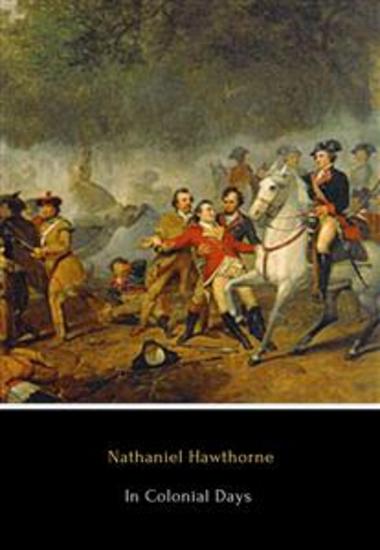
In Colonial Days
Nathaniel Hawthorne
Maison d'édition: Carousel Books
Synopsis
Four tales take place in the colonial Province House, Massachusetts, where Britain's last governors and governesses exchange tales as the Empire crumbles.
Maison d'édition: Carousel Books
Four tales take place in the colonial Province House, Massachusetts, where Britain's last governors and governesses exchange tales as the Empire crumbles.
Sometimes a wife or husband can tell a story that shocks their partner, or just amuse them with fantasies. For romance, couples that have a happy marriage have an advantage as shared memories, experiences, and secrets set the stage for more fun. Discover what an adventurous couple can do in this new short story collection, A Barrel Full of Short Stories. Twenty-six short stories offer snapshots of life as it is, and life as it can be. Old photographs and memorabilia collected over centuries hide observations and secrets. Can we reveal them? That’s what we will try to find out. James and Linda Tucker take on a challenge to find inspiration at Cracker Barrel restaurants across the country. Their later-in-life romance stories of unfold from their imagination inspired by the collections displayed and from the people they see come and go. Find out what prostitutes, preachers, and everyday people have to say about life as it is, and what it can be for you in this collection of short stories and personal essays A Barrel Full of Short Stories: Twenty-six Short Stories: Snapshots of Life as It Is, and Life as It Can BeVoir livre
Russia 1833 When a Royal Princess moves into the country house next-door to sixteen year old Vladímir Petróvitch’s parents, Vladímir is sent into the mysterious world of first love, where he must keep his passion burning and not fall too deep into despair as he is pitted against other suitors in-order to win the princess’s hand. Though it’s not all as it seems… Through the chase for the princess’s love Vladímir learns of a scandal that will fall deep into the heart of his family and show him how brutal love can be.Voir livre
A Psychological Thriller Short Story After almost twenty years, Mary Ellen’s return to her hometown is like entering a surreal and haunting nightmare. She had thought she left this all behind for good. The reason for her return? Her father’s funeral. But this trip back is more than just grieving and receiving condolences - it’s a reckoning with the ghosts of a past she worked hard to forget. Merrily, her sister, known for her wild nature, seems even crazier than Mary Ellen remembers. If not more. Her quirks have grown more pronounced, giving Mary Ellen a glimpse into a mind seemingly on the verge of unravelling.As Mary Ellen navigates the familiar yet alien corridors of our childhood home, she realizes that Merrily’s oddities might be the key to the very secrets she escaped all those years ago.Voir livre
Leo Tolstoy was born in 1828 in the Russian province of Tula to a wealthy noble family. As a child, he had private tutors but he showed little interest in any formal education. When he went to the University of Kazan in 1843 to study oriental languages and law, he left without completing his courses. Life now was relaxed and idle but with some writing also taking place. Gambling debts forced an abrupt change of path and he joined the army to fight in the Crimean War. He was commended for his bravery and promoted but was appalled at the brutality and loss of life. He recorded these and other earlier experiences in his diaries which formed the basis of several of his works. In 1852 ‘Childhood’ was published to immediate success and was followed by ‘Boyhood’ and ‘Youth’. His experience in the army and the horrors he witnessed resulted in ‘The Cossacks’ in 1862 and the trilogy ‘Sevastopol Tales’. After the war he travelled around Europe, visiting London and Paris and meeting such luminaries as Victor Hugo and Charles Darwin. It was now that Tolstoy began his masterpiece, ‘War and Peace’. Published in 1869 it was an epic work that changed literature. He quickly followed this with ‘Anna Karenina’. These successes made Tolstoy rich and helped him accomplish many of his dreams but also brought problems as he grappled with his faith and the lot of the oppressed poor. These revolutionary views became so popular that the authorities now kept him under surveillance. He led a life of asceticism and vegetarianism and put his socialist ideals into practice by establishing numerous schools for the poor and food programmes. He also believed in giving away his wealth, which caused much discord with his wife. His writing continued to bring forth classics such as ‘The Death of Ivan Ilyich’ and many brilliant and incisive short stories such as ‘How Much Land Does A Man Need’. In 1901 Tolstoy was excommunicated from the Church and controversially deselected for the Nobel Prize for Literature. Whilst undertaking a pilgrimage by train in October 1910 with his daughter Aleksandra he caught pneumonia in the nearby town of Astapovo. Leo Tolstoy died on November 9th, 1910, he was 82. In this much acclaimed short story Tolstoy’s characters are engulfed by a huge snowstorm which descends upon them and puts the successful conclusion of their journey into perilous doubt.Voir livre
In 1851 Leo Tolstoy enlisted in the Russian army and was sent to the Caucasus to help defeat the Chechens. During this war a great Avar chieftain, Hadji Murád, broke with the Chechen leader Shamil and fled to the Russians for safety. Months later, while attempting to rescue his family from Shamil's prison, Hadji Murád was pursued by those he had betrayed and, after fighting the most heroic battle of his life, was killed. Tolstoy, witness to many of the events leading to Hadji Murád's death, set down this story with painstaking accuracy to preserve for future generations the horror, nobility, and destruction inherent in war.Voir livre
Hanns Heinz Ewers was born on 3rd November 1871 in Düsseldorf, Germany. His first published poem was at 17 on the death, after a reign of only 99 days, of the German Emperor Frederick III. A stint in the German military was cut short after only 44 days because of his myopia. Writing was to be the way forward for him with a book of satiric verse published in 1901. At the same time he co-founded a literary vaudeville troupe that toured central and eastern Europe before censors and expenses forced its closure. An inveterate traveller he was in South America when the Great War enveloped Europe and he relocated to New York. From here his story darkens. Although by now a successful and admired author he was arrested in the U S in 1918 as a German Agent on the pretext of his travels and a falsified Swiss passport. Interned, he was released in 1921 and returned to Germany. He claimed only to be raising money for the German Red Cross. His literary fame is decidedly easier to clarify. His novels beginning with ‘The Sorcerer’s Apprentice’ in 1910 are dark, they bristle with evil intent and are littered with characters who have a dubious moral compass and yet, along with his short stories, are brazen, brilliant feats of literary narrative. He also wrote and published plays, fairy tales, opera librettos, critical essays and lectured for many years on ‘The Religion of Satan’ and was one of the first to write scripts for the cinema, which he considered a legitimate art form. As the Weimar republic began its chaotic death throes Ewers became attracted to the rising Nazi Party. At first he was warmly received despite disagreeing with its anti-semitism (his most famed literary character had a Jewish mistress) and he was even commissioned by Hitler to write a biography of the Nazi martyr Horst Wessel. This together with his own homosexuality culminated with his works being banned in 1934 and his assets and property seized. It took him many years to have the ban lifted. This association rightfully clouds his personal reputation but has meant his literary contributions are also overlooked and neglected. Hanns Heinz Ewers died of tuberculosis on 12th June 1943 in his Berlin apartment.Voir livre