Rejoignez-nous pour un voyage dans le monde des livres!
Ajouter ce livre à l'électronique
Grey
Ecrivez un nouveau commentaire Default profile 50px
Grey
Abonnez-vous pour lire le livre complet ou lisez les premières pages gratuitement!
All characters reduced
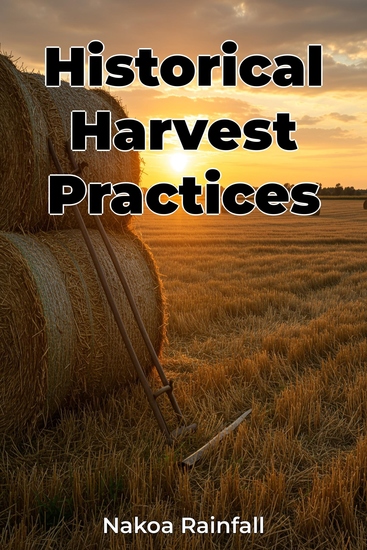
Historical Harvest Practices - cover

Historical Harvest Practices

Nakoa Rainfall

Traducteur A AI

Maison d'édition: Publifye

  • 0
  • 0
  • 0

Synopsis

Historical Harvest Practices explores the diverse methods societies have used throughout history to gather food, highlighting the intricate connections between harvesting techniques, social structures, and environmental factors. It examines how communities, from ancient civilizations to more recent societies, have adapted their agricultural practices to ensure food security, revealing that harvesting is not merely a technical activity but is deeply embedded within a society's cultural and economic fabric.

 
Readers will discover how some early societies developed sophisticated irrigation systems to maximize crop yields, while others relied on communal labor practices to manage the harvest, illustrating the diverse ways cultures have approached food production.

 
The book progresses from introducing key concepts and methodologies to exploring specific case studies across different regions and eras, analyzing the tools, techniques, and social organizations employed in harvesting.

 
By integrating insights from archaeology, history, and anthropology, Historical Harvest Practices offers a comprehensive understanding of how past approaches to harvesting can inform contemporary debates about sustainable agriculture, food security, and the future of food production. Understanding the evolution of these practices provides critical insights into agricultural innovation and human adaptation to environmental changes.
Disponible depuis: 21/02/2025.
Longueur d'impression: 62 pages.

D'autres livres qui pourraient vous intéresser

  • Germany Between the World Wars: The History and Legacy of the Weimar Republic and Nazi Germany in the Interwar Period - cover

    Germany Between the World Wars:...

    Editors Charles River

    • 0
    • 0
    • 0
    The Weimar Republic has become a byword for a failed, tragic, political experiment. The official period of its existence, 1919-1933, marked the inter-war years in Germany and their related uncertainty, chaos and the state’s ultimate collapse. Historians have found the roots of Nazism embedded in the Weimar years and that in the final analysis, Weimar politicians voluntarily handed over power to the man who wrought destruction on an epic scale, Adolf Hitler. Yet the Weimar era encapsulated a number of trends and fissures within German society, as well as the international community. The Weimar Republic was a prisoner of events and in the long run had little power to shape them. Historians are fond of interpreting the past as a tension between human agency, that is to say decision-making, and structural developments that evade individual choices. Both these interpretations are crucial when examining the tumultuous years of Germany’s Weimar Republic. 
    The early 1930s were a tumultuous period for German politics, even in comparison to the ongoing transition to the modern era that caused various forms of chaos throughout the rest of the world. In the United States, reliance on the outdated gold standard and an absurdly parsimonious monetary policy helped bring about the Great Depression. Meanwhile, the Empire of Japan began its ultimately fatal adventurism with the invasion of Manchuria, alienating the rest of the world with the atrocities it committed.  
    It was in Germany, however, that the strongest seeds of future tragedy were sown. The struggling Weimar Republic had become a breeding ground for extremist politics, including two opposed and powerful authoritarian entities: the right-wing National Socialists and the left-wing KPD Communist Party. As the 1930s dawned, these two totalitarian groups held one another in a temporary stalemate, enabling the fragile ghost of democracy to continue a largely illusory survival for a few more years.
    Voir livre
  • Empty Cages - Facing the Challenge of Animal Rights - cover

    Empty Cages - Facing the...

    Tom Regan

    • 0
    • 0
    • 0
    Described by Jeffrey Masson as "the single best introduction to animal rights ever written, Tom Regan's EMPTY CAGES stands as an essential guide to the ongoing animal rights debate. In a style at once simple and elegant, Regan dispels the negative image of animal rights advocates as portrayed by the mass media, unmasks the fraudulent rhetoric of "humane treatment" favored by animal exploiters in both familiar and less well-documented contexts, and explains why existing laws function to legitimize institutional cruelty. In so doing, Regan invites readers to join the struggle for animal rights—one person at a time, one step at a time. Written by the leading philosophical spokesperson for animal rights, Tom Regan's shocking exposé of animal abuse makes an essential and lasting contribution to how animal rights is viewed in the United States and around the world. 
    "Tom Regan delivers a searing indictment of the way we treat animals in the world we have made for ourselves, and presents a trenchant case that animals have or should have rights in the same way that human beings have."—J. M. Coetzee, winner of the 2003 Nobel Prize for Literature 
    "Every so often a book is written that is destined to change the way people think. Tom Regan has written just such a book. EMPTY CAGES is compelling because it is logical, rational, and written in an elegantly simple style. Please buy this book, read it, and tell your friends about it. Everyone needs a copy on their bookshelf."—Jane Goodall 
    "Tom Regan's EMPTY CAGES is a powerful call for justice on one of the most urgent issues human society faces. Calmly, lucidly, he asks readers to confront the miserable conditions we have inflicted on animals, leaving us with three choices: find a flaw in the argument, work for change, or throw the book away and try to forget it. The indelible force of Regan's argument makes the third course very difficult."—Martha C. Nussbaum, University of Chicago
    Voir livre
  • Urban Policy and Governance - Challenges and Solutions - cover

    Urban Policy and Governance -...

    Lyric Vale

    • 0
    • 0
    • 0
    Urban policy and governance are central to shaping the future of cities worldwide. As urban areas continue to expand, the challenges faced by city leaders, policymakers, and residents grow ever more complex. Urban policy refers to the strategies, frameworks, and regulations that guide the development and management of cities. It encompasses everything from housing and infrastructure to social equity, environmental sustainability, and economic growth. Governance, on the other hand, focuses on the decision-making processes, institutions, and actors responsible for implementing these policies. Effective urban governance ensures that cities function smoothly and equitably while addressing the diverse needs of their populations. 
    The rapid pace of urbanization has been a defining feature of the 21st century, with over half of the world's population now living in cities. This urban shift presents numerous challenges, including overcrowding, resource scarcity, environmental degradation, and social inequality. However, it also creates opportunities for innovation and progress. A well-crafted urban policy can harness the potential of urbanization to improve quality of life, create economic opportunities, and foster sustainability. 
    Urban governance is shaped by various factors, including political, economic, and social dynamics. At its core, it involves coordinating efforts among multiple stakeholders, such as local governments, private sector entities, civil society groups, and international organizations. The collaboration between these actors is crucial to addressing the complex and interconnected issues that cities face. Effective governance must be inclusive, transparent, and accountable to ensure that all voices, particularly those of marginalized communities, are heard and considered in decision-making processes.
    Voir livre
  • Celia A Slave - cover

    Celia A Slave

    Melton A. McLaurin, Jennifer L....

    • 0
    • 0
    • 0
    Celia was only fourteen years old when she was acquired by John Newsom, an aging widower and one of the most prosperous and respected citizens of Callaway County, Missouri. The pattern of sexual abuse that would mark their entire relationship began almost immediately. After purchasing Celia in a neighboring county, Newsom raped her on the journey back to his farm. He then established her in a small cabin near his house and visited her regularly. Over the next five years, Celia bore Newsom two children; meanwhile, she became involved with a slave named George and resolved at his insistence to end the relationship with her master. When Newsom refused, Celia one night struck him fatally with a club and disposed of his body in her fireplace. 


    Her act quickly discovered, Celia was brought to trial. She received a surprisingly vigorous defense from her court-appointed attorneys. Nevertheless, the court upheld the tenets of a white social order that wielded almost total control over the lives of slaves. Celia was found guilty and hanged. 


    Melton A. McLaurin uses Celia's story to reveal the tensions that strained the fabric of antebellum southern society. Celia's case demonstrates how one master's abuse of power over a single slave forced whites to make moral decisions about the nature of slavery.
    Voir livre
  • After Savagery - Gaza Genocide and the Illusion of Western Civilization - cover

    After Savagery - Gaza Genocide...

    Hamid Dabashi

    • 0
    • 0
    • 0
    Written during a genocide, After Savagery reveals the ethical bankruptcy of "Western philosophy" and how it undergirds the erasure of the colonized. 
    The death toll in Gaza continues to rise―a cold, lifeless number representing entire communities crushed under the weight of settler colonialism.What remains of the theories we use to understand our world? With lyrical and lucid fury, Hamid Dabashi exposes the racist roots of Western philosophy, demanding that listeners overcome its pernicious phantom of relevance. Rather than perceiving "the West" as giving carte blanche to Israel, Dabashi insists that Israel must be understood as its quintessence.If Israel is the West and the West is Israel, then Palestine is the world and the world is Palestine. Holding to glimmers from revolutionary works of literature and film, Dabashi argues, in grief and love, that the wretched of the earth need poetry after barbarism—and that Palestine is the site of a liberated imagination.
    Voir livre
  • Unwrapping Myself - A Holiday Journey of Coming Home to Wonder and the Inner Child - cover

    Unwrapping Myself - A Holiday...

    Ho Thao My

    • 0
    • 0
    • 0
    This audiobook is narrated by an AI Voice.   
    This audiobook is narrated by an AI Voice. 
    “Unwrapping Myself: A Holiday Journey of Coming Home to Wonder and the Inner Child” is a gentle, soul-warming guide for anyone who has ever felt lost, exhausted, or emotionally distant during the holidays. While the world celebrates, many of us quietly carry old hurts, unmet needs, and memories we can’t quite name. This book invites you into an emotional homecoming—a soft return to the part of you that has always been longing to be seen, held, and loved. 
    Through tender storytelling, reflective holiday moments, and guided inner work, this book helps you reconnect with your Inner Child, heal emotional patterns rooted in childhood, and rediscover the magic, creativity, and wonder you once felt so naturally. Instead of forcing joy or perfection, you will learn the deeper art of self-compassion, presence, and seasonal self-care allowing the holidays to become a sanctuary instead of a performance. 
    Whether you are facing loneliness, family tension, nostalgia, or simply the heaviness that December tends to bring, this book offers gentle emotional support and meaningful reflection, making it a powerful companion through Christmas, the New Year season, and beyond. 
    What You’ll Discover Inside: 
    - How holiday memories from the past quietly shape your emotional patterns today 
    - Practices for nurturing, listening to, and reconnecting with your Inner Child 
    - Guided reflections for releasing perfectionism, shame, and emotional pressure 
    - Rituals, journal prompts, and grounding exercises for heartfelt holiday self-care 
    - How to welcome the New Year not with forceful resolutions, but with authentic renewal 
    Perfect as a Christmas Gift for yourself or someone you love. 
    A gentle guide for those who desire a New Year, New Me rooted not in pressure, but in healing, softness, presence, and inner wholeness. 
    If you’re ready to return to your heart, your memories, and your quiet magic, this book is your invitation.
    Voir livre