Join us on a literary world trip!
Add this book to bookshelf
Grey
Write a new comment Default profile 50px
Grey
Subscribe to read the full book or read the first pages for free!
All characters reduced
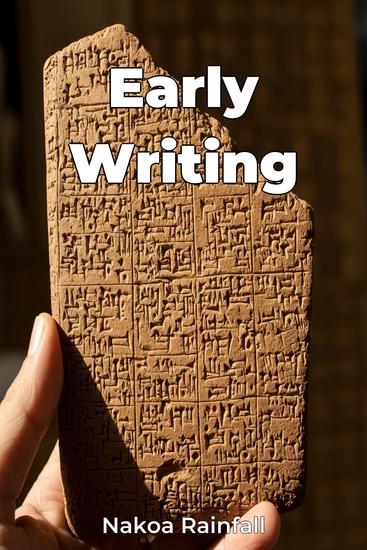
Early Writing - cover

Early Writing

Nakoa Rainfall

Translator A AI

Publisher: Publifye

  • 0
  • 0
  • 0

Summary

"Early Writing" explores the captivating origins and evolution of writing, a cornerstone of human civilization. Delving into ancient history, the book reveals how early societies transitioned from spoken language to lasting written records. It highlights that writing wasn't a singular invention but a gradual development driven by practical needs, such as managing agricultural surpluses.

 
The book journeys through Mesopotamia, examining the genesis of cuneiform from Sumerian pictographs to a more abstract script. It then investigates Egyptian hieroglyphs, a complex system of ideograms and phonograms used in religious and monumental contexts. "Early Writing" further explores the emergence of early alphabets in the Levant and their transformative impact on literacy and communication.

 
Each chapter builds upon the last, tracing the chronological development and providing a comparative perspective. Supported by archaeological evidence and deciphered inscriptions, the book presents a balanced account of these early writing systems. It connects to fields like archaeology and linguistics, providing broader insights into ancient civilizations. The book argues that understanding these systems allows us to appreciate the diverse ways early civilizations organized their societies and transmitted information.
Available since: 03/29/2025.
Print length: 55 pages.

Other books that might interest you

  • The Confirmation Bias - How Seeking Information That Confirms Your Beliefs Skews Reality - cover

    The Confirmation Bias - How...

    William Rands

    • 0
    • 0
    • 0
    Confirmation bias is a cognitive phenomenon that plays a significant role in shaping our beliefs and perceptions. It refers to the tendency of individuals to search for, interpret, and remember information in a way that confirms their preexisting beliefs or theories, while disregarding or minimizing evidence that contradicts those beliefs. This bias is not limited to any particular field or context and can influence people in a variety of ways, from politics and religion to personal relationships and health decisions. 
    At its core, confirmation bias serves to protect the individual from cognitive dissonance, which is the uncomfortable tension that arises when a person holds conflicting beliefs or encounters information that challenges their worldview. By favoring information that aligns with their existing views, individuals reduce the mental discomfort of having to reconcile opposing ideas. While this process may offer short-term comfort, it can lead to long-term distortions in thinking, preventing growth and the development of more accurate or well-rounded perspectives. 
    This cognitive bias operates at both conscious and unconscious levels. On a conscious level, people may deliberately seek out information that supports their views, whether it be through selective reading, watching certain news outlets, or engaging in discussions with like-minded individuals. However, confirmation bias also operates unconsciously, influencing the way information is processed, remembered, and recalled. For example, individuals may be more likely to remember information that supports their beliefs and forget or dismiss data that contradicts them, even if they are unaware of this selective memory process.
    Show book
  • Language Courses for Beginners Learn Japanese (Unabridged) - cover

    Language Courses for Beginners...

    NeoAudio

    • 0
    • 0
    • 0
    Learn Japanese - The course contains 50 practical lessons, including dialogue to listen to and exercises to repeat. These topics are covered, along with others:
    - Greeting and understanding
    - Asking for directions
    - Shopping
    - Airports and customs
    - At the hotel
    - At restaurants
    - Paying a bill
    - Taking a taxi, car, train, or bus
    - Doctor, pharmacy, police
    - Phone calls
    - Asking questions
    - Numbers and colours
    - Personal pronouns and verbs
    - Giving the time, weather, body parts
    - Meals, eating and drinking
    - School and university
    - Family and hobbies
    You should listen to the course more than once in order to remember what you have learned.
    Show book
  • Screenwriting - The Craft and The Career - cover

    Screenwriting - The Craft and...

    Philip Shelley

    • 0
    • 0
    • 0
    This authoritative, practical guide lays out everything you need to be a successful screenwriter for film and television.
    Written by one of the UK's leading script editors, consultants and producers with over thirty years' experience – including founding and running Channel 4's acclaimed 4Screenwriting course – it provides essential tips and insider advice on:
    
    - Generating compelling story ideas – and finding your own voice as a writer
    - Understanding the fundamental principles and elements of good storytelling for the screen – and how to apply them in your script
    - Creating engaging characters – and why they need to drive your story
    - Crafting distinctive and memorable dialogue – and how less can be more
    - Presenting your script on the page effectively – with tips on both formatting and language
    - Building and sustaining your career – including how to break into the industry and successfully promote yourself and your work
    - Collaborating with key people – including producers, agents and script editors
    There are detailed analyses of scenes from a wide range of screen dramas, hands-on exercises to help you put it all into practice, and case studies of key contemporary writers such as Russell T Davies, Sally Wainwright, Jimmy McGovern, Abi Morgan, James Graham and Jed Mercurio.
    Ideal for all aspiring and emerging screenwriters, this inspiring book will equip you with the tools you need to write the scripts that only you can write, and turn your talent and passion into a professional career.
    'Inspiring and insightful. Very few people know as much about screenwriting as Philip Shelley' David Nicholls (One Day, Starter for 10)
    'A practical and empowering cut-to-the-chase overview from someone who's given countless British screenwriters (including me!) their break' Chris Chibnall (Broadchurch, Doctor Who)
    'Philip Shelley's knowledge and guidance is unparalleled: this book is wise, practical, and brilliantly helpful' Charlie Covell (The End of the F***ing World, Kaos)
    'A brilliant, highly informative guide… I wish it had been published when I was starting out' Anna Symon (The Essex Serpent, Joan)
    Show book
  • How to Write Fiction: 7 Easy Steps to Master Fiction Writing Novel Writing Writing a Book & Short Story Writing - cover

    How to Write Fiction: 7 Easy...

    Jaiden Pemton

    • 0
    • 0
    • 0
    Are you ready to dive into the world of fiction writing, but don't know where to start? 
    Do you feel unclear about how to distinguish and use the elements of fiction writing? 
    Are you still on the search to unlock your personal writing voice, and write in a style that keeps your readers engaged? 
      
    How to Write Fiction is the guide you need! We will teach you how to write fiction in 7 easy steps. This guide is designed to provide you with all the tools you need in a concise, easy to understand format that will answer all your burning questions and get you on your way to successful fiction writing. 
      
    In order to have success in the fiction world, you must write in a way that keeps your audience engaged and helps them to establish a deeper connection to your works. 
      
    YOU’LL LEARN:The logistics of each element of fiction writing (character development, plot development, setting, point of view, theme, style, and voice)Common fiction writing mistakes to avoidWriting exercises to help you get started and keep you on trackTop tips to developing a writing style and voice that sets your work apartExclusive secrets every fiction writer needs to knowAnd so much more!  
      
    Whether you're just starting out on the journey of fiction writing and need to develop a clearer understanding of the elements or have been at it for a while and are looking for fresh perspectives and tips for further develop your style, this guide is the companion you need. Let’s get started!
    Show book
  • Ancestral Puebloans - The Cliff Dwellers of Mesa Verde and the Architects of the Southwest - cover

    Ancestral Puebloans - The Cliff...

    Rolf Hedger

    • 0
    • 0
    • 0
    The Ancestral Puebloans, once known as the Anasazi, were among the earliest inhabitants of the American Southwest, establishing complex societies that thrived in the arid landscapes of present-day Colorado, New Mexico, Arizona, and Utah. Their origins trace back thousands of years to nomadic hunter-gatherers who gradually transitioned into settled agricultural communities. Archaeological evidence suggests that the ancestors of the Pueblo people descended from early groups who migrated into the region over 10,000 years ago, following game and adapting to the changing environment. 
    As these early populations settled, they developed strategies to cope with the harsh desert conditions. By around 2000 BCE, they had begun cultivating maize, a crop introduced from Mesoamerica, which allowed for more stable food sources and led to the formation of permanent villages. The adoption of agriculture marked a significant shift in their way of life, as they built storage pits for surplus grain and started domesticating turkeys for additional sustenance. Over time, these settlements expanded, and small familial clusters evolved into larger communities. 
    The Basketmaker period, beginning around 1200 BCE, represents a crucial stage in Ancestral Puebloan development. During this era, people lived in semi-subterranean pit houses, circular structures dug into the earth and covered with wooden frames and mud plaster. These early homes provided insulation against the region’s extreme temperatures. The Basketmakers were also known for their exceptional weaving and basketry skills, crafting intricate containers and sandals from yucca fibers and other natural materials. Pottery, which became a defining feature of Puebloan culture, gradually emerged during the later stages of this period, allowing for improved food storage and cooking techniques.
    Show book
  • Money Muscles in HUMAN BODY - cover

    Money Muscles in HUMAN BODY

    Faisal AlNashmi

    • 0
    • 0
    • 0
    This book talks about how humans should focus on developing, furnishing, and polishing their money muscles. This book argues that if a person can identify their money muscle and put it to good use, the chances of them being rich are 100 percent. The book then gives different tips to find, develop and guard the money muscle to become rich. You can use this book as a guide for your career. If you are interested in wealth creation and generation, this book can be a helpful guide
    Show book