Begleiten Sie uns auf eine literarische Weltreise!
Buch zum Bücherregal hinzufügen
Grey
Einen neuen Kommentar schreiben Default profile 50px
Grey
Jetzt das ganze Buch im Abo oder die ersten Seiten gratis lesen!
All characters reduced
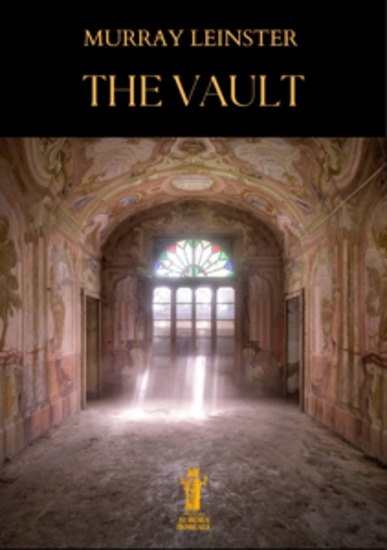
The Vault - cover

The Vault

Murray Leinster

Verlag: Edizioni Aurora Boreale

  • 0
  • 0
  • 0

Beschreibung

Murray Leinster was a pen name of William Fitzgerald Jenkins (1896-1975), an American writer of genre fiction, particularly of science fiction. He wrote and published more than 1,500 short stories and articles, 14 movie scripts, and hundreds of radio scripts and television plays.The Vault, the Leinster’s story which we propose to our readers today, was published in August 1922 on the Black Mask magazine.
Verfügbar seit: 18.02.2025.

Weitere Bücher, die Sie mögen werden

  • The Skeleton's Key - cover

    The Skeleton's Key

    Kevin D. Bullock, M.L. Bullock

    • 0
    • 0
    • 0
    As an archaeological team cares for the Indian Shell Mounds on Dauphin Island, they discover a strange metal key—in a skeleton's hand! Questions loom about the key's origin and what mysteries it might unlock. Could it be an artifact left behind by Spanish explorers, the first people besides the First Nation People to reside on the island? Or is the skeleton one of the unfortunate Casket Girls who died when the island was called Massacre Island? 


    After a few days of study, the key demonstrates strange characteristics and one archaeologist, in particular, is concerned that the activity surrounding the key could be paranormal. 


    Midas and the Gulf Coast Paranormal Team accept the case and head to the island to see for themselves the key, the skeleton, and a strange box that will not unlock. 


    Are they prepared for the ghosts of Massacre Island? Will the ghosts of the First Nation's people rise up in protest?
    Zum Buch
  • Transformation - A Faustian tale set in Italy by the celebrated author of Frankenstein - cover

    Transformation - A Faustian tale...

    Mary Shelley

    • 0
    • 0
    • 0
    Mary Wollstonecraft Godwin was born on the 30th August 1797 in Somers Town, London. 
     
    Her mother, the famous feminist philosopher, educator, and writer Mary Wollstonecraft died when Mary was only 11 days old and she was raised by her father, the philosopher, novelist, journalist, and perpetually in debt, William Godwin. 
     
    Though Mary received little formal education her father taught her a broad range of subjects and added to her bright and curious personality she easily absorbed a good and broad education. 
     
    In July 1814, after conducting a secret affair with the poet Percy Bysshe Shelley, who had earlier promised to pay off yet another round of her father’s business debts, the pair eloped to France.  Within two months, penniless and pregnant they returned to England. 
     
    Her husbands’ affairs caused her frequent heartbreak but despite all the travails, including the loss of her own child, Shelley’s recent inheritance gave them the opportunity to journey again to Europe. 
     
    It was here that ‘Frankenstein’ was born and established Mary’s own name in literature. 
     
    Her life hereafter was plagued with loss; the death of two further children and then her husband in a boating accident.  Her writing continued through novels, travel pieces and biographies.  Her short stories, some based in Europe, tackle difficult situations and genres as well the obstacles that women were burdened with in society.  Her editorship of her late husband’s poetry was also widely praised.   
     
    Mary’s radical politics continued to guide her journey throughout her life but, by 1840, illness had begun to haunt her years, depriving her of energy and vigour.  
     
    Mary Shelley died on the 1st February 1851, at Chester Square, London of a suspected brain tumour.  She was 53.
    Zum Buch
  • The Devil's Trill - A Nocturne Symphony Novel - cover

    The Devil's Trill - A Nocturne...

    Lyra R. Saenz

    • 0
    • 0
    • 0
    I saw my death coming. 
    It was staring me in the face through the eyes of another witch, but I was wrong. It’s an easy mistake to make, that your enemies would be the cause. Death didn’t come from the front. It didn’t even come from behind. No, my death came from the person I kept beside me for so many years. My heart-keeper, my savior, my protector, my husband, my killer… 
    Summer may have been the villain, but her story is one of survival and betrayal. Captured as a witch, she’s “recruited” to fight against the technomancers as a secret weapon. Her marriage to Donarick Thames sets in motion a vicious cycle of misfortune when her once-sweet husband starts to grow more violent, but in the meantime, she’s a badass witch who commands netherbeasts. 
    This novella contains spoilers for Sonata, book 2 of Lyra R. Saenz’s Nocturne Symphony. Readers who have not yet read Sonata are advised to pause before venturing further. 
    Additional Warnings: Mentions of rape, torture, domestic abuse, stillbirth/infanticide, and abortion.
    Zum Buch
  • Short Horror Stories Collection 3 Terrifying Tales for Sleepless Nights - A Bone-Chilling Audio Drama of Supernatural Terror and Psychological Dread - cover

    Short Horror Stories Collection...

    Stories From The Shadows

    • 0
    • 0
    • 0
    DARE TO LISTEN AFTER DARK? Press play... if you’re brave enough. “Short Horror Stories Collection. 3 Terrifying Tales for Sleepless Nights” will drag you deep into a vortex of PSYCHOLOGICAL TERROR that linger long after the final word. In “The Elysium Cut”, five filmmakers enter a cursed theater seeking inspiration—but the movie they watch begins to mirror their lives, pulling them into a gruesome spectacle where they become the cast. In “Psycho”, a seemingly ordinary motel becomes a deathtrap as Vera, the lone manager, finds herself the chosen subject of a predator’s twisted masterpiece. And in “The Rotted Garden”, Audrey inherits more than just a house—she inherits a living, breathing nightmare rooted in blood-soaked secrets. YOU WON’T JUST HEAR THESE STORIES—YOU’LL FEEL THEM crawling beneath your skin. This isn’t just horror—it’s a cinematic descent into madness. So close the curtains, turn off the lights, and get ready for 3 TERRIFYING TALES that WON’T let you sleep.
    Zum Buch
  • H P Lovecraft: Nyarlathotep - The Crawling Chaos - cover

    H P Lovecraft: Nyarlathotep -...

    H.P. Lovecraft

    • 0
    • 0
    • 0
    Who is this thing?  He or better IT, first appears in "Nyarlathotep" (1920), and is described as a "tall, swarthy man" who resembles an ancient Egyptian pharaoh.  In this story he wanders the Earth, seemingly gathering legions of followers, the narrator of the story among them, through his demonstrations of strange and seemingly magical instruments. These followers lose awareness of the world around them, and through the narrator's increasingly unreliable accounts, the reader gets an impression of the world's collapse.  This is an eerie and unsettling story.  
    Nyarlathotep differs from the other beings in a number of ways. Most of them are exiled to stars, like Yog-Sothoth and Hastur, or sleeping and dreaming like Cthulhu; Nyarlathotep, however, is active and frequently walks the Earth in the guise of a human being, usually a tall, slim, joyous man. He has "a thousand" other forms, most of these reputed to be maddeningly horrific. Most of the Outer Gods have their own cults serving them; Nyarlathotep seems to serve these cults and take care of the deities' affairs in their absence. Most of the gods use strange alien languages, but Nyarlathotep uses human languages and can be mistaken for a human being. The other Outer Gods and Great Old Ones are often described as mindless or unfathomable rather than truly malevolent, but Nyarlathotep delights in cruelty, is deceptive and manipulative, and even cultivates followers and uses propaganda to achieve his goals. 
    Nyarlathotep enacts the will of the Outer Gods, and is their messenger, heart and soul; he is also a servant of Azathoth, his father, whose wishes he immediately fulfills. Unlike the other Outer Gods, causing madness is more important and enjoyable than death and destruction to Nyarlathotep. It is suggested by some that he will destroy the human race and possibly the Earth as well.
    Zum Buch
  • The Evil Clergyman - cover

    The Evil Clergyman

    H.P. Lovecraft

    • 0
    • 0
    • 0
    "The Evil Clergyman" is an excerpt from a letter written by American horror fiction writer H. P. Lovecraft in 1933. After his death, it was published in the April 1939 issue of Weird Tales as a short story. The story was later adapted into the unreleased 1987 anthology film Pulse Pounder.The story begins in the attic of an ancient house. The narrator's companion refers to the former owner of the house and the presumably violent end that befell him. He advises the narrator not to stay after dark or touch anything, especially the small object on a table, which the companion seems to fear considerably. The narrator is then left alone in the attic; he notes the many theological and classical books, and one bookshelf in particular containing books on magic. He feels a considerable curiosity for the forbidden object on the table. The narrator finds a strange flashlight-like device in his pocket that produces a peculiar violet glow. He attempts to illuminate the object on the table with this strange light, which he describes as being composed of particles. The object makes a crackling sound like a sparking vacuum tube, and takes on a pinkish glow with a vague white shape taking form from its center. The narrator, feeling that his surroundings are taking on strange new properties, realizes that he is not alone; the sinister newcomer is described as wearing clerical garb typical of the Anglican Church. The newcomer begins throwing magical books into a fireplace.
    Zum Buch