Unisciti a noi in un viaggio nel mondo dei libri!
Aggiungi questo libro allo scaffale
Grey
Scrivi un nuovo commento Default profile 50px
Grey
Iscriviti per leggere l'intero libro o leggi le prime pagine gratuitamente!
All characters reduced
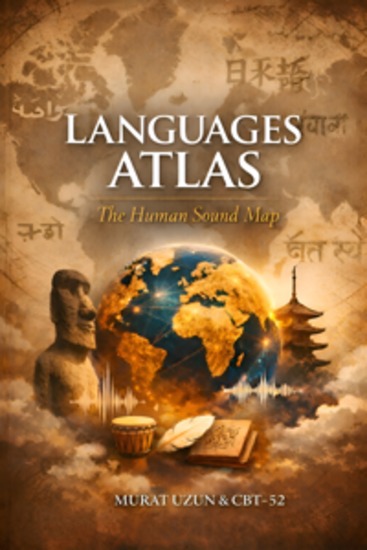
Languages Atlas - cover

Languages Atlas

Murat Uzun

Casa editrice: Murat Uzun CBT-52

  • 0
  • 0
  • 0

Sinossi

LANGUAGES ATLASHumans felt before they spoke.And some emotions were older than words.Atlas of Languages was written not to explain how languages were formed,but to show how humans expressed themselves.This book does not follow the origin of words, but the journey of meaning.It is a memory of humanity stretching from the steppes to the seas, from continent to continent.Arabic, Turkish, Chinese, Latin, Swahili, and dozens more...In these pages, languages appear not as information, but as a form of existence.None is superior.None is inferior.Because every language is humanity’s effort to be understood.This book reminds us not which language we speak,but why we speak.
Disponibile da: 18/02/2026.

Altri libri che potrebbero interessarti

  • Sprachgebrauch und Sprachidentitäten - Variationslinguistische Perspektiven - cover

    Sprachgebrauch und...

    Christa Dürscheid, Florina...

    • 0
    • 0
    • 0
    Wie formt Sprache unsere Identität? Wie inszenieren wir verschiedene Identitäten durch Sprache? Welche Normen bestimmen unseren Sprachgebrauch - und wie verändern sich diese im Lauf der Zeit, in Abhängigkeit von den beteiligten Akteur:innen? Was verraten historische Quellen über die damals Schreibenden und ihre Schreibpraktiken?
    Der Sammelband widmet sich diesen und weiteren Fragen zur Rolle von Sprache in gesellschaftlichen und technologischen Wandelprozessen. Er umfasst deutsch- und englischsprachige Beiträge, die interessante Einblicke in die Variabilität von Einzelsprachen bieten und sich in drei Teile gliedern: Sprachgebrauch und Sprachidentitäten in historischen Schriftzeugnissen (Teil I), Sprachgebrauch im Spannungsfeld von Norm, Variation und Didaktik (Teil II) und Sprachgebrauch, Sprachidentitäten und Indexikalität im Wandel (Teil III). Ergänzend dazu wird in der Einleitung erläutert, welches Konzept von Sprachidentität dem Sammelband zugrunde liegt und welche Argumente dafür sprechen, von mehreren Sprachidentitäten auszugehen.
    Mostra libro
  • Dogwhistles and Figleaves - How Manipulative Language Spreads Racism and Falsehood - cover

    Dogwhistles and Figleaves - How...

    Jennifer Mather Saul

    • 0
    • 0
    • 0
    It is widely accepted that political discourse in recent years has become more openly racist and more accepting of wildly implausible conspiracy theories. Dogwhistles and Figleaves explores ways in which such changes—both of which defied previously settled norms of political speech—have been brought about. Jennifer Saul shows that two linguistic devices, dogwhistles and figleaves, have played a crucial role. Some dogwhistles (such as "88", used by Nazis online to mean "Heil Hitler") serve to disguise messages that would otherwise be rejected as unacceptable, allowing them to be transmitted surreptitiously. Other dogwhistles (like the 1988 "Willie Horton" ad) work by influencing people in ways that they are not aware of, and which they would likely reject were they aware. Figleaves (such as "just asking questions") take messages that could easily be recognized as unacceptable, and provide just enough cover that people become more willing to accept them. Saul argues that these devices are important for the spread of racist discourse. She also shows how they contribute to the transmission of norm-violating discourse more generally, focusing on the case of wildly implausible conspiracist speech. This book is the first full-length exploration of dogwhistles and figleaves. It offers an illuminating and disturbing view of the workings of contemporary political discourse.
    Mostra libro
  • Travel words and phrases in Uzbek - cover

    Travel words and phrases in Uzbek

    J. M. Gardner

    • 0
    • 0
    • 0
    Travel words and phrases in Uzbek. 300 essential words and phrases and the 100 most common verbs. Uzbek is a Turkic language that is the first official and only declared national language of Uzbekistan. The language of Uzbeks, it is spoken by some 32 million native speakers in Uzbekistan and elsewhere in Central Asia. How to learn a language differently? Today, language learning is revolutionizing : you do not have to go to traditional language classes anymore. Our learning method : a selection of hundreds of phrases and essential words. You listen to them, you repeat them, and you speak. We rely on pronunciation, oral rehearsal, listening, combined with words, essential phrases, and a vocabulary list. 20% of the words are used 80% of the time. The end goal is to get a sufficient level in one language to be able to hold simple conversations, to be able to understand simple exchanges, deal with with everyday life and start exploring the new culture that opens up to you.
    Mostra libro
  • The Daily Pressfield - A Teaching a Day From the Author of The War of Art - cover

    The Daily Pressfield - A...

    Steven Pressfield

    • 0
    • 0
    • 0
    THE DAILY PRESSFIELD is 365 days (plus a bonus week) of motivation, inspiration, and encouragement.  
    Are you starting a new book/album/business venture? Open to page one of THE DAILY PRESSFIELD and start rolling. Each chapter begins with a picked quote from THE WAR OF ART, GATES OF FIRE, Pressfield's Writing Wednesdays blog, and other P-field sources. The second half of each chapter is Steve's commentary on that passage. THE DAILY PRESSFIELD is a year's worth of kicks-in-the-butt and pats-on-the-back, structured to counsel, support, and guide you-day-by-day-from the start of your project to its successful completion.
    Mostra libro
  • Learn Conversational Brazilian Portuguese Vol 3 - Lessons 51-70 For beginners - cover

    Learn Conversational Brazilian...

    LinguaBoost

    • 0
    • 0
    • 0
    Learn Conversational Brazilian Portuguese Vol. 3 is an audio course for beginners or for anyone who struggles with becoming fluent in Brazilian Portuguese. The focus of this course is to practice speaking conversational Portuguese from the very first lesson. 
    In these twenty lessons, you'll be introduced to a lot of useful, everyday phrases and sentence structures. You'll also be able to expand your vocabulary and talk about daily activities, shopping, education, technology and much more. 
    Based on techniques and strategies that make language learners succeed:Learn in short bursts every day 
    Each lesson takes about 10–15 minutes to complete.Learn in context 
    Isolated words or random sentences won’t get you far. By learning phrases related to a specific topic or situation, you will see much better results.Focus on high-frequency words 
    Starting with the most frequently used words will boost your comprehension and communication in your target language.Review the material 
    Repeating the phrases at certain specified intervals is a powerful technique to help your memory absorb and recall what you have learned.Listen to native speakers 
    All the phrases are translated and spoken by native speakers.
    Mostra libro
  • English Vocabulary - The Basics - cover

    English Vocabulary - The Basics

    Michael McCarthy

    • 0
    • 0
    • 0
    English Vocabulary: The Basics offers a clear, non-jargonistic introduction to English vocabulary, the way linguists classify and explain it, and the place of vocabulary in our overall picture of the language, and in society. Introducing a range of terminology for discussing vocabulary, the listener is provided with a coherent, structured description of what we know about words and their meanings. 


    Key features of this book include: 


    ● Analysis of historical roots of present-day words 


    ● Coverage of the differences between speech and writing and between formality and informality 


    ● Understanding of the social implications of choices that readers make to use standard or non-standard (e.g., regional/dialect) vocabulary 


    ● A focus on British English with reference to a wide range of varieties of English that include North American English, Irish English, Indian English, Malaysian English, Nigerian English, and Caribbean English 


    This book is an engaging and thought-provoking listen for anyone with an interest in English vocabulary.
    Mostra libro