


Rig Veda Mandal 4 - In English rhyme
Munindra Misra
Verlag: Munindra Misra
Beschreibung
The Rig Veda - Mandal 04 with 58 Shuktas in English rhyme
Verfügbar seit: 05.07.2025.
Drucklänge: 138 Seiten.

Verlag: Munindra Misra
The Rig Veda - Mandal 04 with 58 Shuktas in English rhyme
Here is a thought-provoking 51- minute audio presentation for writers, readers, students, teachers, parents...anyone who has ever wondered why a particular poem is their favorite. It includes the poem Stopping by the Woods, by Robert Frost.
Delving beneath the surface of Robert Frost's poetry, John Lehman is a nationally published writer and poet with 20 years experience as a professional speaker and 15 years as a creative director and senior copy writer for advertising agencies. He is a graduate of the Great Books program at Notre Dame University and has a master's degree in curriculum development from the University of Michigan.
John has presented seminars throughout the country. He is a book reviewer, business columnist, poet, and freelance feature writer for magazines and newspapers. His articles have appeared in The Christian Science Monitor, Popular Science, Omni, and in more than 50 other trade or consumer publications. He is also the founder of Rosebud magazine, managing partner of Zelda Wilde Publishing and the poetry editor of Wisconsin People and Ideas.
©2009 John Lehman; (P)2009 John Lehman
Zum Buch
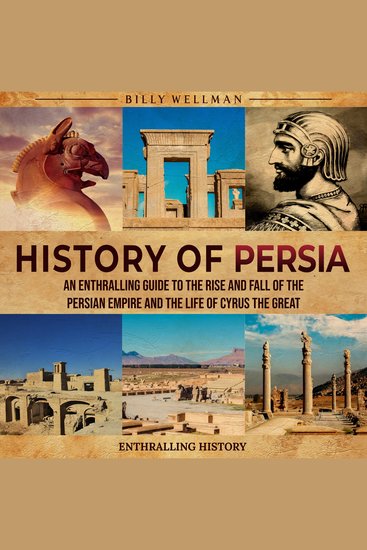
Two manuscripts in one audiobook:The Persians: An Enthralling Guide to the History of Persia and the Persian EmpireCyrus the Great: The Enthralling Life of the Father of the Persian Empire
In the first part of this audiobook, you will discover the following:How the Assyrian Empire gave rise to the Medians and then the Achaemenid dynastyThe establishment of the Persian Empire by Cyrus the Great and his many expeditions, which helped build the greatest empire of its timeThe period of Achaemenid rule over Persia, stretching from Cambyses II to Darius IIIThe Achaemenid takeover of Lydia, Egypt, the Indus Valley, Babylonia, and Asia MinorAchaemenid conflicts with Greece, which ultimately led to the empire’s downfall at the hands of Alexander the GreatThe political, cultural, religious, and social influence of the Achaemenid Empire in and around ancient Persia
In the second part of this audiobook, you will discover more about the following:The life of Cyrus the Great: both as a monarch and as a man.A dip into the milieu of cultures, influences, and worldviews of Cyrus’s timeCyrus’s multi-faceted Achaemenid EmpireMythology and religions of the eraHow Cyrus achieved harmony between conquerors and conqueredThe fall of the splendid city of BabylonA unique artifact that ties in with modern-day human rightsCyrus the Great’s legacyAnd so much more!
Scroll up and click the “add to cart” button to learn more about the History of Persia!
Zum Buch
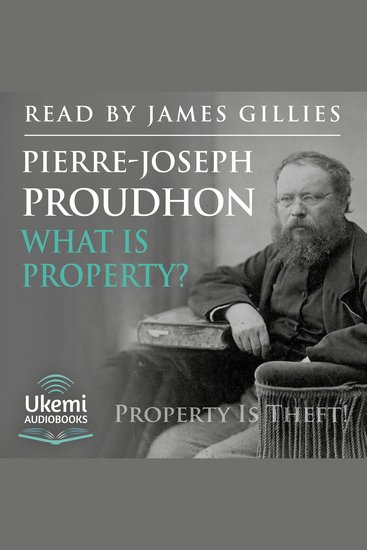
‘Property is Theft’, a phrase which has passed into common parlance, was the rallying call of Pierre-Joseph Proudhon’s political treatise What Is Property? Proudhon (1809-1865) was both admired and excoriated. A political theorist of the first order, he was vilified in his native France by the Communists and the Monarchists alike, though admired by Karl Marx as well as many in the nation’s academia and judiciary who valued the clarity of his thought and analytical method.

He criticised both Right and Left (the very definition of French political thinking), describing them as two sides of the same coin. Their solutions to society’s ills, he said, were like Thesis and Antithesis, based on a common error and both inadequate to the task of healing society. He offered, instead, a third way, which he called his Synthesis. Regarded as the founder of modern Anarchism, his aim was not to engender chaos, as the word anarchy often connotes, but to suggest a workable, political, and economic foundation for society which would promote order and equity for all under the most unfettered conditions of individual liberty.

Proudhon grew up in poverty, and was home schooled as a child, but received a bursary in his youth sufficient to allow him to attend the City College in his home town (though not sufficient, it seems, to buy him shoes). There, he discovered the library which introduced him to a world, classical and contemporary, previously denied him. Lacking wealth or contacts, he worked variously as a printer, a compositor and proof-reader by day and an essayist by night, learning Latin along the way to assist in his work. In 1830, a friend, a scholar, invited Proudhon to join him in Paris to pursue his philosophical writings full time. When a cholera outbreak forced his return home, Proudhon spent the next few years juggling his two careers. In 1839, he applied for a pension (bursary) at the Academy of Besançon which obliged him to write works on its behalf.

What Is Property?, published in France in 1840, was his first. It was so controversial that little else followed. However, it established his reputation, and he was eventually able to pursue his philosophical work full time. What Is Property? (First Memoir) attempts to uncover the roots of poverty and associated social ills and examines different attitudes to poverty and wealth from the Greeks to the present day. Proudhon quickly identifies a common thread, property, which he distinguishes from possession, and argues that only a fundamental, though gradual, abandonment of property (as an asset) and all that flows from it, can rescue society from its current conflicts. The memoir seeks to illuminate the underlying causes of war, poverty, slavery, and oppression and points the way to a solution. In effect, it is a practical manual for the survival of mankind. The Second Memoir (1841), included on this recording, is Proudhon’s response to the criticisms of the First Memoir, initially uncomprehending and then self-assured by turns. What Is Property? is Proudhon’s masterwork. It divides opinion, but no one who hears it can come away with their view of their own world unchanged.

Translation: Benjamin R. Tucker.
Zum Buch
The nature of warfare has drastically evolved over the centuries, and in the modern age, it has reached unprecedented levels of complexity, technology, and global impact. The battles fought today are not just confined to physical battlegrounds, but stretch across the cyber world, through the air with drones, and into the very fabric of political and social systems. Understanding the shocking truth about modern warfare means acknowledging how it has fundamentally changed and the far-reaching consequences it has on global security, human lives, and the future of warfare itself.

Unlike the traditional wars of the past, where armies fought on clearly defined battlefields, modern warfare is multifaceted. Conflicts today often involve a mix of conventional military forces, covert operations, cyber-attacks, and the use of advanced technologies like drones and artificial intelligence. The lines between combatants and non-combatants are increasingly blurred, and civilians are often the most affected by the consequences of war. The tools and tactics employed in modern warfare raise important questions about the ethics of conflict, the responsibility of nations, and the role of technology in shaping the future of armed engagement.

One of the most significant shifts in modern warfare is the central role technology now plays. The advancements in weapons systems, surveillance capabilities, and the rise of autonomous machinery have fundamentally altered how wars are fought. With the introduction of drones and cyber warfare, military strategies are less about physical dominance and more about information control, precision strikes, and disrupting an enemy's infrastructure without direct confrontation. This change has made warfare faster, more efficient, and, in many ways, less personal.
Zum Buch
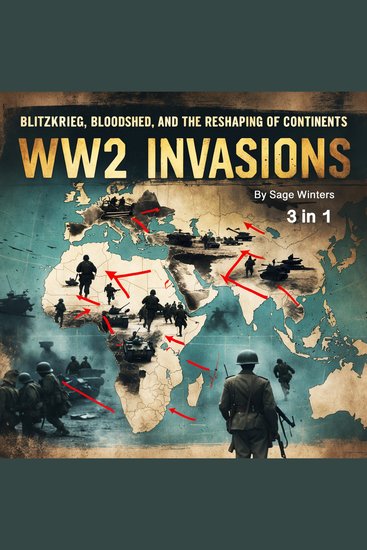
This book consists of three titles:
- Blitzkrieg: The outbreak of World War II in 1939 heralded the arrival of a new era in military strategy, characterized by speed, surprise, and relentless coordination. At the heart of this revolution was Blitzkrieg, or "lightning warfare," a doctrine developed and executed primarily by Nazi Germany. Blitzkrieg was a military strategy that sought to overcome the static, trench-based warfare that had defined World War I. The tactics were designed to strike quickly and decisively, bypassing traditional defenses and causing maximum disruption. Its goal was not just to win battles but to create a psychological shock, overwhelming the enemy with rapid, coordinated strikes before they could mount a defense.
- Operation Overlord: Operation Overlord, the Allied invasion of Normandy on June 6, 1944, stands as one of the most significant military operations in modern history. Known globally as D-Day, it marked the beginning of the end of Nazi occupation in Western Europe and paved the way for the eventual defeat of Adolf Hitler’s regime. The operation was not only a turning point in World War II but also in the broader scope of 20th-century history, reshaping the political, military, and cultural landscape of Europe.
- The Invasion of Italy: The invasion of Italy was one of the pivotal campaigns of World War II, playing a crucial role in the eventual Allied victory in Europe. Southern Europe, particularly Italy, was seen as a gateway for the Allies to weaken Nazi forces, divert their attention from the Eastern Front, and eventually push towards Germany. But the road to Italy was not a simple or straightforward one. It was a strategic decision shaped by both military considerations and political imperatives.
Zum Buch
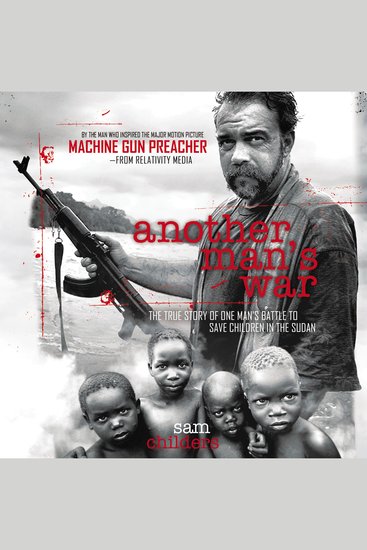
A gun-toting preacher, a rebel army led by a madman, and entire villages slaughtered just because they were in the way.
In Another Man's War, follow Sam Childer's remarkable transformation from violent thug to a man of faith, and his ongoing battle to save children in one of the world's most lawless areas.
Photos are included in the audiobook companion PDF download.
“Another Man’s War is about true terrorism . . . against more than 200,000 children in northern Uganda and Southern Sudan. Sam Childers—a fighter and a preacher (some call him a mercenary)—tirelessly leads a small militia into the jungle, daring to fight against a vicious army outnumbering him one thousand to one. One man can make a huge difference. Sam Childers certainly does.” ?Peter Fonda, actor/filmmaker, best known as star of Easy Rider
“The Reverend Sam Childers has been a very close friend to the government of South Sudan for many years and is a trusted friend.” ?President Salva Kiir Mayardit of South Sudan
“The Reverend Sam Childers is a long time devoted friend to our government and his courageous work is supported by us.” ?President Yoweri Museveni of Uganda
“Sam Childers is one of those rare men [who is] willing to do literally whatever it takes to promote the message of Jesus Christ and save children from the tyranny of evil men.” ?John Rich, lead singer and songwriter, Big & Rich
Zum Buch





