Begleiten Sie uns auf eine literarische Weltreise!
Buch zum Bücherregal hinzufügen
Grey
Einen neuen Kommentar schreiben Default profile 50px
Grey
Jetzt das ganze Buch im Abo oder die ersten Seiten gratis lesen!
All characters reduced
Mahabharat In English rhyme - cover

Mahabharat In English rhyme

Munindra Misra

Verlag: Munindra Misra

  • 0
  • 0
  • 0

Beschreibung

The Mahabharat, is an ancient tale of yore,An epic saga, forever for humanity to explore.A tapestry of life, woven with divine threads,Aranya Parva from Sections 141 to 270 treads.
 
In the forest's depths, the Pandavas did stray, Seeking refuge from anger, day by day.With Kunti's wisdom guiding them on their path, Their unity, strength shone like a beacon's aftermath.
 
In Dwaitavana's shade, darkness would descend, And danger loomed, as their courage did ascend.Arjuna's penance earned him celestial might, Indra's blessing granted, in the light of morning bright.
 
Ghatotkacha's birth got strength from Hidimba's hand, A son of the forest, with destiny to withstand.Through trials they journeyed, with valor unbound, Krishna’s wisdom guided, as their hearts did resound.
Verfügbar seit: 13.04.2025.
Drucklänge: 395 Seiten.


Weitere Bücher, die Sie mögen werden

  • Inconvenient Apocalypse An - Environmental Collapse Climate Crisis and the Fate of Humanity - cover

    Inconvenient Apocalypse An -...

    Wes Jackson, Robert Jensen

    • 0
    • 0
    • 0
    For decades, our world has understood that we are on the brink of an apocalypse—yet the only implemented solutions have been small and convenient, feel-good initiatives that avoid unpleasant truths about the root causes of our impending disaster. Wes Jackson and Robert Jensen argue that we must reconsider the origins of the consumption crisis and the challenges we face in creating a survivable future. Longstanding assumptions about economic growth and technological progress—the dream of a future of endless bounty—are no longer tenable. The climate crisis has already progressed beyond nondisruptive solutions. The end result will be apocalyptic; the only question now is how bad it will be. 


    Jackson and Jensen examine how geographic determinism shaped our past and led to today's social injustice, consumerist culture, and high-energy/high-technology dystopias. The solution requires addressing today's systemic failures and confronting human nature by recognizing the limits of our ability to predict how those failures will play out over time. Though these massive challenges can feel overwhelming, the coauthors weave a secular reading of theological concepts—the prophetic, the apocalyptic, a saving remnant, and grace—to chart a realistic path for humanity not only to survive our apocalypse but also to emerge with a renewed appreciation of the larger living world.
    Zum Buch
  • Healing What's Within - Coming Home to Yourself--and to God--When You're Wounded Weary and Wandering - cover

    Healing What's Within - Coming...

    Chuck DeGroat

    • 0
    • 0
    • 0
    We can’t always control what happens to us. But we can discover how to heal the hidden hurt it leaves behind. If you’re like many of us, you carry a weight of buried pain. Despite looking put together on the outside, you feel secretly fractured within. While you appear strong and resilient on the outside, inside a storm brews of all the ways you’ve been hurt or harmed. There’s a constant churn of unprocessed feelings of shame, anger, grief, or loneliness. And your body tells the story of its struggles in a myriad of aches and ailments. Little by little, you find yourself becoming disconnected from who you truly are. Not knowing what to do with your suffering and fearing you'll be hurt again, you’ve learned to cope, to numb and suppress the ache within. It doesn’t have to be this way. In Healing What’s Within, therapist and professor Chuck DeGroat invites you on a compassionate journey inward to return and retune to the life God created you to live. Along the way, you will discover how to:  Gently consider and confront what’s keeping you stuck and blocking the path to joy and flourishing  Better understand the relationship between your body and your emotions  Experience God as a compassionate witness to your trauma―and his unconditional kindness to wherever you find yourself  Discover real rest and renewal as you reconnect with God, others, and yourself.  It’s never too late to start healing. God’s heart is always ready to help you find your way Home.
    Zum Buch
  • Women of the American South - Strength and Survival in Troubling Times - cover

    Women of the American South -...

    Layla Gupta

    • 0
    • 0
    • 0
    The Antebellum South, the period in American history before the Civil War, was a time of immense social, economic, and political turbulence. In this era, women of the South played crucial roles, yet their lives were shaped by complex systems of power, race, and class that significantly influenced their identities and experiences. The women of the Antebellum South, particularly those in the planter class, were often seen through the lens of their domestic roles—wives, mothers, and caretakers—but their contributions went far beyond these confines. 
    For white Southern women, the plantation system defined much of their existence. These women were raised to be the wives of wealthy landowners, and their lives were deeply connected to the economic and social systems that kept the plantation economy thriving. They managed large households, oversaw domestic servants (often enslaved people), and ensured that the daily needs of the family were met. While their lives were marked by relative comfort and privilege compared to many of their Northern counterparts, this privilege came at a cost—mainly the complicity in and active support of slavery. Their social status and wealth were intertwined with the exploitation of enslaved Africans, and the power dynamics within the household mirrored the racial and gender hierarchies of the time.
    Zum Buch
  • Free Speech and Turbulent Freedom - The Dangerous Allure of Censorship in the Digital Era - cover

    Free Speech and Turbulent...

    Michael J. Glennon

    • 0
    • 0
    • 0
    A vast censorship regime has smothered America's digital marketplace of ideas, squelching free speech on vital policy issues. Its supporters regard its benefits as morally and politically beyond question. They contend it's carried out by private social media platforms, not governmental authorities. 


    In Free Speech and Turbulent Freedom, Michael J. Glennon offers a timely and incisive response. The censors are short-sighted, he argues. Quibbling over outdated distinctions misses the real threat—which is the fusion of public and private power into a modern-day cartel able to overleap longstanding constitutional safeguards. American democracy, he argues, rests on a decentralized marketplace of ideas independent of the government. In crisp, trenchant terms, Glennon shows how concrete practical concerns justify protecting admittedly harmful online speech—even speech that advocates violence or embraces hatred or apparent falsehood. 


    To safely self-correct, democracy requires open channels of political communication. Glennon calls on the courts to unblock those channels—to measure such speech against enduring First Amendment precepts rather than pliable international norms—and to protect the speech interests not merely of the government and Big Tech, but of all participants in the marketplace of ideas.
    Zum Buch
  • Turn Toward The Storm - How I Turned Trauma Into Triumph - cover

    Turn Toward The Storm - How I...

    Anonym

    • 0
    • 0
    • 0
    On the surface, Bevan Cox looked like a man who had it all: career success, physical strength, and social admiration. Inside, he was drowning in childhood trauma, betrayal, codependency, and a justice system turned against him. When the noise became impossible to silence and his final goodbye was seconds from being uploaded, a divine interruption stopped him. 
    Turn Toward the Storm is that story. 
    Told with gut-wrenching honesty and zero sugarcoating, this audiobook is a raw memoir of hitting absolute rock bottom—and choosing to rebuild anyway. Through false arrests, trauma bonds, narcissistic abuse, and suicidal ideation, Bevan doesn’t just survive—he learns to heal. What emerges is a powerful roadmap for anyone carrying invisible scars they’ve been taught to ignore. 
    Listeners walk through jail cells, therapy rooms, and courtrooms engineered for his downfall. You’ll step into the world of fitness competitions, where discipline becomes a lifeline. You’ll sit in the quiet, brutal moments where faith stops being a concept and becomes the only thing left standing. 
    Along the way, you’ll learn how to set boundaries, rewire destructive beliefs, dismantle the ego, and rebuild an identity from the ashes of who you used to be. This is not a story about perfection or performance: it’s about courage, responsibility, and the radical decision to fight for a life you no longer believe you deserve. 
    Turn Toward the Storm is for anyone who’s been told to “stay strong” while silently falling apart. It’s for those who grew up in chaos, loved the wrong people, were betrayed by systems meant to protect them, or wake up wondering why they’re still here. 
    If your pain has ever whispered that your story is over, this audiobook stands as proof that it’s not. Peace isn’t a reward for the perfect—it’s a decision made by the brave.
    Zum Buch
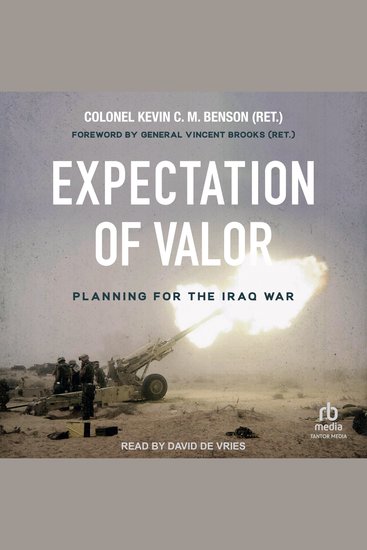
  • Expectation of Valor - Planning for the Iraq War - cover

    Expectation of Valor - Planning...

    Colonel Kevin C.M. Benson (Ret),...

    • 0
    • 0
    • 0
    Given the length of time the United States spent in Iraq, there is a perception that there was no consideration before the war of what should be done after coalition forces arrived in Baghdad and removed Saddam Hussein. However as this unofficial history reveals, there was a great deal of planning to address how to achieve the policy objectives for Iraq set by the Bush administration. Kevin Benson—director of plans for the United States Third Army, the ground forces command headquarters for GEN Franks' Central Command, at the start of the war—details the development of the invasion plan and its subsequent execution from D-Day in March 2003 until the change of command of operations in Iraq and the departure of Third Army in June 2003. 


    He addresses the persistent trope that "the Army did no planning" for "Phase IV," revealing that extensive plans were proposed, and were met with very little interest in Washington. The book covers the difficulties encountered in dealing with Secretary of Defense Donald Rumsfeld, from getting his approval on the number of forces requested to conducting the campaign to find the "smoking gun" of WMD; the instructions given to Army, Marine, and coalition forces; and the daily secure video teleconferences with Central Command and the Pentagon, and the rather remarkable conversations and guidance that came from these meetings.
    Zum Buch