Rejoignez-nous pour un voyage dans le monde des livres!
Ajouter ce livre à l'électronique
Grey
Ecrivez un nouveau commentaire Default profile 50px
Grey
Abonnez-vous pour lire le livre complet ou lisez les premières pages gratuitement!
All characters reduced
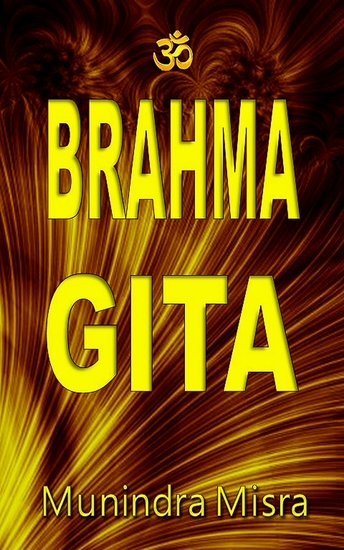
Brahma Gita - In English Rhyme - cover

Brahma Gita - In English Rhyme

Munindra Misra

Maison d'édition: Munindra Misra

  • 0
  • 0
  • 0

Synopsis

Sri Brahma Gita in English rhyme is a part of the ancient Brahma Puran (Part 1) [Chapters 35, 37 (slokas 96-97) & 38].
 
Sri Brahma Gita provides an understanding of the Supreme Atma.
 
It also provides a deep knowledge of the perishable & imperishable, the unity & diversity and the Vidya & Avidya concepts.
 
When Lord Shiv calmed down after death of Sati,
 
Daksha asked forgiveness and became devotee,
 
Paid obeisance to Shiv, eulogized him reverently,
 
This the core essence of the Brahma Gita does be.


After Daksha praises Lord Shiv, chants his glories,
 
Lord blesses him and Devas who at Yajna did be,
 
Daksha becomes recipient of Shiv’s grace finally,
 
These verses liberate all who chant it devotedly.
 
 
Disponible depuis: 17/01/2023.
Longueur d'impression: 30 pages.
D'autres livres qui pourraient vous intéresser

  • Influencing Hemingway - People and Places That Shaped His Life and Work - cover

    Influencing Hemingway - People...

    Nancy W Sindelar

    • 0
    • 0
    • 0
    Ernest Hemingway embraced adventure and courted glamorous friends while writing articles, novels, and short stories that captivated the world. Hemingway’s personal relationships and experiences influenced the content of his fiction, while the progression of places where the author chose to live and work shaped his style and rituals of writing. Whether revisiting the Italian front in A Farewell to Arms, recounting a Pamplona bull run in The Sun Also Rises, or depicting a Cuban fishing village in The Old Man and the Sea, setting played an important part in Hemingway’s fiction. The author also drew on real people—parents, friends, and fellow writers, among others—to create memorable characters in his short stories and novels.   In Influencing Hemingway: The People and Places That Shaped His Life and Work Nancy W. Sindelar introduces the reader to the individuals who played significant roles in Hemingway’s development as both a man and as an artist—as well as the environments that had a profound impact on the a
    Voir livre
  • Hamilcar Barca: The Life and Legacy of the Legendary Carthaginian General - cover

    Hamilcar Barca: The Life and...

    Editors Charles River

    • 0
    • 0
    • 0
    Carthage was one of the great ancient civilizations, and at its peak, the wealthy Carthaginian empire dominated the Mediterranean against the likes of Greece and Rome, with commercial enterprises and influence stretching from Spain to Turkey. In fact, at several points in history it had a very real chance of replacing the fledgling Roman empire or the failing Greek poleis (city-states) altogether as master of the Mediterranean. Although Carthage by far preferred to exert economic pressure and influence before resorting to direct military power (and even went so far as to rely primarily on mercenary armies paid with its vast wealth for much of its history, it nonetheless produced a number of outstanding generals, from the likes of Hanno Magnus to, of course, the great bogeyman of Roman nightmares himself: Hannibal.  
    	Certain foreign policy decisions led to continuing enmity between Carthage and the burgeoning power of Rome, and what followed was a series of wars which turned from a battle for Mediterranean hegemony into an all-out struggle for survival. Although the Romans gained the upper hand in the wake of the First Punic War, the Carthaginians brought the Romans to their knees for over a decade during the Second Punic War. Of course, they were led in Italy by the legendary Hannibal Barca, who maintained his army near Rome for nearly 15 years, but never attempted to march on Rome.  
    	One overlooked figure in the Punic Wars is Hamilcar Barca, who is now best remembered for being Hannibal’s father. However, before Hannibal marched out of Spain, it was Hamilcar who had positioned forces there, and he was already a significant historical figure in his own right. Indeed, had it not been for his death, his legacy likely would have been more important than that of his illustrious son, who is now remembered as one of history’s greatest generals. 
    Voir livre
  • The Bone Picker - Native Stories Alternate Histories - cover

    The Bone Picker - Native Stories...

    Devon A. Mihesuah

    • 0
    • 0
    • 0
    Under the shadow of gray clouds, three children venture into the woods, where they spot the corpse of an old man on a scaffold. Suddenly a wild figure emerges, with long fingernails and tangled hair. It is the Hattak fullih nipi foni, the bone picker, who comes to tear off rotting flesh with his fingernails. Only the Choctaws who adhere to the old ways will speak of him. The frightening bone picker is just one of many entities, scary and mysterious, who lurk behind every page of this spine-tingling collection of Native fiction, written by award-winning Choctaw author Devon A. Mihesuah. 


    As a Choctaw citizen, with deep ties to Indian Territory and Oklahoma, Mihesuah grew up hearing the stories of her ancestors. In the tradition of Native storytelling, she spins tales that move back and forth fluidly across time. The ancient beings, we discover, followed the tribe from their original homelands in Mississippi and are now ever-present influences on tribal consciousness. 


    While some of the horrors told here are "real life" in nature, the art of fiction that Mihesuah employs reveals surprising outcomes or alternative histories. It turns out the things that scare us the most can lead to the answers we are seeking and even ensure our very survival.
    Voir livre
  • Depression - More Than Just Sadness - cover

    Depression - More Than Just Sadness

    Owen Jones

    • 0
    • 0
    • 0
    Churchill, a renowned sufferer of depression called it ‘The Black Dog’, but it has had several names over the years, and it seems to be more common now than ever. Luckily, it can be treated fairly easily too, if the sufferer knows that he or she has a problem and also seeks help, which is far too often not the case. 
    Most people ‘snap out of it’ with a little help from their friends, although it can and does return. Others can’t bear it any longer and take the ultimate escape route. 
    I hope that you will find the information helpful, useful and profitable. Please be aware that I wrote the content of this ebook after a significant amount of research, but I am still not a health care provider. 
    The information in this ebook on various aspects of depression and related subjects is organized into 16 chapters of about 500-600 words each. 
    I hope that it will interest those who are concerned about the problems associated with depression in all its forms. 
    As an added bonus, I am granting you permission to use the content on your own website or in your own blogs and newsletter, although it is better if you rewrite them in your own words first. 
    You may also split the book up and resell the articles. In fact, the only right that you do not have is to resell or give away the book as it was delivered to you.
    Voir livre
  • The Murder Game - cover

    The Murder Game

    John Curran

    • 0
    • 0
    • 0
    From The Murder of Roger Ackroyd to Magpie Murders, and related diversions including cryptic crosswords and Cain’s Jawbone, The Murder Game examines the games authors played with their readers and the importance of puzzles in Golden Age whodunits. 
    With books flourishing in the 1920s and ’30s like never before, no genre was more innovative or popular than detective fiction. It was an era that saw the emergence of Agatha Christie, Dorothy L. Sayers, John Dickson Carr, Ellery Queen and dozens of other authors who became household names for a generation of readers. 
    The Golden Age of Detection has enjoyed a great resurgence of interest in recent years, with publishers mining back catalogues to bring the best of yesteryear to very receptive new audiences. What is it about a literary movement that took off in the 1920s that still appeals to book lovers in the 2020s? 
    In this authoritative new study, John Curran reveals that it is the ludic qualities of classic crime fiction that continue to intrigue. At its heart is the ‘whodunit’ game between writer and reader, but there is also the game between detective and murderer, between publisher and book-buyer, even between the writers themselves. 
    Coinciding with an increase in leisure time and literacy, the Golden Age also saw the development of the crossword, the growth of bridge and Mahjong, the enduring popularity of jigsaws and the emergence of Cluedo – all activities requiring the ‘little grey cells’. The Murder Game considers all of these, and many other sporting and competitive recreations, helping to explain the reading public’s ongoing love affair with the Golden Age. 
    John Curran, in his latest non-fiction, delves into the mystery of the enduring appeal of detective fiction from the 20th century. He explores the games played not just within the stories, but also between the writers, publishers, and readers, making this a must-read for any fan of the genre. 
    For fans of G. K. Chesterton (Saint Francis of Assisi), Lucy Worsley (Jane Austen at Home), and Carla Valentine (Murder Isn't Easy). 
    HarperCollins 2025
    Voir livre
  • The Last Kings of Macedonia and the Triumph of Rome - cover

    The Last Kings of Macedonia and...

    Ian Worthington

    • 0
    • 0
    • 0
    In the history of ancient Macedonia, the last three Antigonid kings—Philip V, his son Perseus, and the pretender Andriscus or Philip VI—are commonly overlooked in favor of their predecessors Philip II and his son Alexander the Great, who established a Macedonian empire. By the time Philip V became king, Macedonia was no longer an imperial power and Rome was fast spreading its dominance over the Mediterranean. Viewed as postscripts to the kingdom's heyday, the last Macedonian kings are often denounced for self-serving ambitions, flawed policies, and questionable personal qualities by hostile ancient writers. They are condemned for defeats by Rome that saw both the end of the monarchy and the fall of the formidable Macedonian phalanx before the Roman legion. 


    Producing the first full-scale treatment of Philip V in eighty years and the first in English of Perseus and Andriscus in more than fifty, Ian Worthington argues that this period was far from a postscript to Macedonia's Classical greatness and disagrees that the last Antigonid kings were merely collateral damage in Rome's ascendancy in the east. Despite superior Roman manpower and resources, Philip and Perseus often had the upper hand in their wars against Rome. As Worthington asserts, these kings deserve to be remembered for striving to preserve their kingdom's independence against staggering odds.
    Voir livre