Rejoignez-nous pour un voyage dans le monde des livres!
Ajouter ce livre à l'électronique
Grey
Ecrivez un nouveau commentaire Default profile 50px
Grey
Abonnez-vous pour lire le livre complet ou lisez les premières pages gratuitement!
All characters reduced
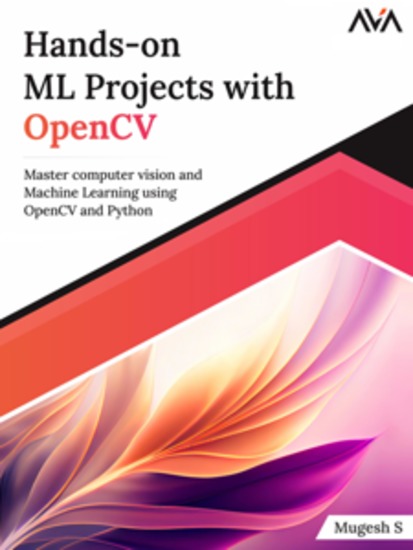
Hands-on ML Projects with OpenCV: Master Computer Vision and Machine Learning using OpenCV and Python - cover

Hands-on ML Projects with OpenCV: Master Computer Vision and Machine Learning using OpenCV and Python

Mugesh S.

Maison d'édition: Orange Education Pvt Ltd

  • 0
  • 0
  • 0

Synopsis

Be at your A game in building Intelligent systems by leveraging Computer vision and Machine Learning. 
 Key Features ● Step-by-step instructions and code snippets for real world ML projects.● Covers entire spectrum from basics to advanced concepts such as deep learning, transfer learning, and model optimization● Loaded with practical tips and best practices for implementing machine learning with OpenCV for optimising your workflow.Book DescriptionThis book is an in-depth guide that merges machine learning techniques with OpenCV, the most popular computer vision library, using Python. The book introduces fundamental concepts in machine learning and computer vision, progressing to practical implementation with OpenCV. Concepts related to image preprocessing, contour and thresholding techniques, motion detection and tracking are explained in a step-by-step manner using code and output snippets. Hands-on projects with real-world datasets will offer you an invaluable experience in solving OpenCV challenges with machine learning. It’s an ultimate guide to explore areas like deep learning, transfer learning, and model optimization, empowering readers to tackle complex tasks. Every chapter offers practical tips and tricks to build effective ML models. By the end, you would have mastered and applied ML concepts confidently to real-world computer vision problems and will be able to develop robust and accurate machine-learning models for diverse applications. Whether you are new to machine learning or seeking to enhance your computer vision skills, This book is an invaluable resource for mastering the integration of machine learning and computer vision using OpenCV and Python.What you will learn● Learn how to work with images and perform basic image processing tasks using OpenCV. ● Implement machine learning techniques to computer vision tasks such as image classification, object detection, and image segmentation. ● Work on real-world projects and datasets to gain hands-on experience in applying machine learning techniques with OpenCV. ● Explore the concepts of deep learning using Tensorflow and Keras and how it can be used for computer vision tasks. Who is this book for?This book is for everyone with a basic understanding of programming and who wants to apply machine learning in computer vision using OpenCV and Python. Whether you're a student, researcher, or developer, this book will equip you with practical skills for machine learning projects. Some familiarity with Python and machine learning concepts is assumed. Table of ContentsChapter 1: Getting Started With OpenCV Chapter 2: Basic Image & Video Analytics in OpenCVChapter 3: Image Processing 1 using OpenCVChapter 4:  Image Processing 2 using OpenCVChapter 5: Thresholding and Contour Techniques Using OpenCV Chapter 6: Detect Corners and Road Lane using OpenCVChapter 7: Object And Motion Detection Using OpencvChapter 8: Image Segmentation and Detecting Faces Using OpenCVChapter 9: Introduction to Deep Learning with OpenCVChapter 10: Advance Deep Learning Projects with OpenCVChapter 11: Deployment of OpenCV projects
Disponible depuis: 11/02/2025.
Longueur d'impression: 336 pages.
D'autres livres qui pourraient vous intéresser

  • Uncertain Climes - Debating Climate Change in Gilded Age America - cover

    Uncertain Climes - Debating...

    Joseph Giacomelli

    • 0
    • 0
    • 0
    Uncertain Climes looks to the late nineteenth century to reveal how climate anxiety was a crucial element in the emergence of American modernity. 
     
    Even people who still refuse to accept the reality of human-induced climate change would have to agree that the topic has become inescapable in the United States in recent decades. But as Joseph Giacomelli shows in Uncertain Climes, this is actually nothing new: as far back as Gilded Age America, climate uncertainty has infused major debates on economic growth and national development. 
      
    In this ambitious examination of late-nineteenth-century understandings of climate, Giacomelli draws on the work of scientists, foresters, surveyors, and settlers to demonstrate how central the subject was to the emergence of American modernity. Amid constant concerns about volatile weather patterns and the use of natural resources, nineteenth-century Americans developed a multilayered discourse on climate and what it might mean for the nation’s future. Although climate science was still in its nascent stages during the Gilded Age, fears and hopes about climate change animated the overarching political struggles of the time, including expansion into the American West. Giacomelli makes clear that uncertainty was the common theme linking concerns about human-induced climate change with cultural worries about the sustainability of capitalist expansionism in an era remarkably similar to the United States’ unsettled present.
    Voir livre
  • AI - The Ultimate Marketing Game Changer - Holy Grail or Effective Sidekick - cover

    AI - The Ultimate Marketing Game...

    Dr. Deepak Renganathan

    • 0
    • 0
    • 0
    The launch of ChatGPT in November 2022 threw the entire business world into disarray. Not many businesses were prepared for a technological shift that was so sudden and drastic. Moreover, similar to the early days of the World Wide Web, the Artificial Intelligence revolution also comes with a fair share of hype. The overwhelming developments in the field of Artificial Intelligence, coupled with the mushrooming of AI firms, tools, and platforms, are enough to baffle even the most astute marketing managers. As if all these were not enough, radically divergent views from industry stalwarts fuel a raging debate:  
    “AI will continue to get way more capable… People are using it to create amazing things. If we could see what each of us can do 10 or 20 years in the future, it would astonish us today.” 
    Sam Altman, Cofounder and CEO of OpenAI 
    I can't see a path that guarantees safety. We're entering a period of great uncertainty where we're dealing with things we've never dealt with before. And normally, the first time you deal with something totally novel, you get it wrong. 
    Geoffrey Hinton, 'The Godfather of AI'  
    This book is an attempt to evaluate both sides of the view and present a middle path, that of a cautious optimism. Dive into this essential guide to navigate the promises and complexities of AI to ensure you are not just a bystander but a leader in the next technological era. 
    Dr. Deepak Renganathan, a Doctorate in AI and an Advisory Board Certified Chair™, is a seasoned marketing professional with over 22 years of experience across industries such as automobile, luxury real estate, fashion, and 5-star hospitality. Deepak has delivered positive turnarounds for Fortune 500 companies across the Americas, China, EMEA, and APAC regions. His expertise lies in creating impactful, data-driven marketing strategies by leveraging AI, big data, and automation for business growth.
    Voir livre
  • Inclusive Transportation - A Manifesto for Repairing Divided Communities - cover

    Inclusive Transportation - A...

    Veronica O. Davis, Tamika L. Butler

    • 0
    • 0
    • 0
    Transportation planners, engineers, and policymakers in the United States face the monumental task of righting the wrongs of their predecessors while charting the course for the next generation. This task requires empathy while pushing against forces in the industry that are resistant to change. How do you change a system that was never designed to be equitable? How do you change a system that continues to divide communities? 


    In Inclusive Transportation, transportation expert Veronica O. Davis shines a light on the inequitable and often destructive practice of transportation planning and engineering. She calls for new thinking and more diverse leadership to create transportation networks that connect people to jobs, education, opportunities, and to each other. Inclusive Transportation is a vision for change and a new era of transportation planning. Davis explains why centering people in transportation decisions requires a great shift in how transportation planners and engineers are trained, how they communicate, the kind of data they collect, and how they work as professional teams. 


    Davis aims to disrupt the status quo of the transportation industry. She urges transportation professionals to reflect on past injustices and elevate current practice to do the hard work that results in more than an idea and a catchphrase.
    Voir livre
  • Regression Analysis Guide - Regression Analysis Guide - cover

    Regression Analysis Guide -...

    Daniel Garfield

    • 0
    • 0
    • 0
    In the age of artificial intelligence, data engineering plays a pivotal role in shaping the future. This comprehensive guide, "AI Data Engineering for Beginners," takes you on a journey through the core principles and practices that underpin the data-driven world of AI. Whether you're an aspiring data engineer, a curious enthusiast, or a student eager to understand the inner workings of AI, this book is your passport to the realm of data. 
    This book bridges the gap between AI theory and practical implementation. With a wealth of real-world examples and hands-on guidance, you'll not only grasp the foundations of AI data engineering but also be ready to tackle your own AI projects. As the world becomes increasingly data-driven, your ability to shape, manage, and leverage data will be a sought-after skill, and "AI Data Engineering for Beginners" is your essential toolkit to step confidently into this exciting field. Whether you dream of revolutionizing industries or simply want to understand the tech shaping our world, this book is your starting point in mastering the data behind the AI revolution. 
      
     
    Voir livre
  • My Quest for Health Equity - Notes on Learning While Leading - cover

    My Quest for Health Equity -...

    MD David Satcher

    • 0
    • 0
    • 0
    Dr. David Satcher is one of the most widely known and well-regarded physicians of our time. A former four-star admiral in the US Public Health Service Commissioned Corps, he served as the assistant secretary for health, the surgeon general of the United States, and the director of the Centers for Disease Control and Prevention before founding the eponymous Satcher Health Leadership Institute at Morehouse School of Medicine. At the core of his impact on public health, he is also a lifelong leader for civil rights and health equity. 


    In My Quest for Health Equity, Dr. Satcher takes an inspiring and instructive look inside his fifty-year career to shed light on the challenge and burden of leadership. Explaining that he has thought of each leadership role—whether in academia, community, or government—as an opportunity to move the needle toward health equity, he shares the hard-won lessons he has learned over a lifetime in the medical field. 


    Drawing on his early memories, medical school days, and experience in the civil rights movement, Dr. Satcher touches on a number of topics, including the essential qualities of leadership; leading from science to policy to practice; the importance of clear communication and continual learning; the need for workplace discipline; confronting failure; team approaches to leadership; and much more.
    Voir livre
  • The Cholera Years - The United States in 1832 1849 and 1866 - cover

    The Cholera Years - The United...

    Charles E. Rosenberg

    • 0
    • 0
    • 0
    Cholera was the classic epidemic disease of the nineteenth century, as the plague had been for the fourteenth. Its defeat was a reflection not only of progress in medical knowledge but of enduring changes in American social thought. Rosenberg has focused his study on New York City, the most highly developed center of this new society. Carefully documented, full of descriptive detail, yet written with an urgent sense of the drama of the epidemic years, this narrative is as absorbing for general audiences as it is for the medical historian. In a new Afterword, Rosenberg discusses changes in historical method and concerns since the original publication of The Cholera Years. 
     
    “A major work of interpretation of medical and social thought . . . this volume is also to be commended for its skillful, absorbing presentation of the background and the effects of this dread disease.”—I.B. Cohen, New York Times 
     
    ”The Cholera Years is a masterful analysis of the moral and social interest attached to epidemic disease, providing generally applicable insights into how the connections between social change, changes in knowledge and changes in technical practice may be conceived.”—Steven Shapin, Times Literary Supplement 
     
    ”In a way that is all too rarely done, Rosenberg has skillfully interwoven medical, social, and intellectual history to show how medicine and society interacted and changed during the 19th century. The history of medicine here takes its rightful place in the tapestry of human history.”—John B. Blake, Science
    Voir livre