Join us on a literary world trip!
Add this book to bookshelf
Grey
Write a new comment Default profile 50px
Grey
Subscribe to read the full book or read the first pages for free!
All characters reduced
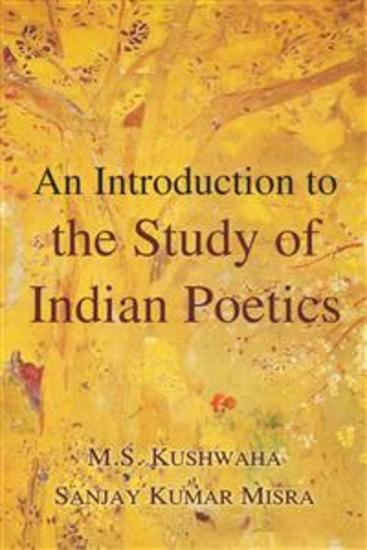
An Introduction to the Study of Indian Poetics - cover

An Introduction to the Study of Indian Poetics

M.S. Kushwaha, Sanjay Kumar Misra

Publisher: D.K. Printworld

  • 0
  • 0
  • 0

Summary

The book aspires to do for Indian poetics what Hudson’s book, An Introduction to the Study of English Literature did for English literature, though in a totally different manner and style. It provides the student with the essential knowledge about almost all aspects of Indian poetics. Based on the original Sanskrit sources, it presents the necessary information lucidly in precise and clear terms. Each chapter is self-contained and complete in itself, with explanatory notes, and a bibliography of relevant works. The Sanskrit terms used in the text are invariably explained or provided with English equivalents.
For quick reference, “A Glossary of Sanskrit Literary Terms” is given in the Appendices, which contain also “A List of Noted Indian Poeticians (including commentators) and Their Works” and “Notes on Major Texts in Indian Poetics”.
This handy volume, with its unique features, will prove invaluable to those who are going to embark on the study of Indian poetics, especially the ones who have no Sanskrit background. To a devoted student, it will prove a useful companion during his/her further studies. 
Available since: 03/09/2023.

Other books that might interest you

  • The Tattoo Collector - cover

    The Tattoo Collector

    Tim Tim Cheng

    • 0
    • 1
    • 0
    "I moved to a country called writing" declares Tim Tim Cheng in this striking debut collection. The Tattoo Collector explores family history, displacement, politics, protest, and, as it moves between East and West, the uses of language to illustrate and interrogate what lies in between. As these poems range from Hong Kong, Scotland, and London, they unravel the relationship between the body, ecology and class with precise and haunting tenderness.
    Here, in Cheng's illuminating and needle-sharp poems, the tattoo is a narrative, the body a radical means of expression. In states of flux, between resisting and belonging, we enter museums, hospitals, graveyards, and gigs. These intimate and polyphonic poems invite us to be troubled and enthralled by exhibits and the stories they have to tell, to look inside the glass box and study what is on display. Close-up, the poems bring into the daylight details that can be seen skin-deep on the surface, as well as those which point to another meaning, inked indelibly, beneath.
    Show book
  • The Charge Of The Light Brigade - and The Last of the Light Brigade - cover

    The Charge Of The Light Brigade...

    Alfred Lord Tennyson, Rudyard...

    • 0
    • 0
    • 0
    Alfred Tennyson's timeless poetic tribute to the Charge of the Light Brigade during the Battle of Balaclava in the Crimean War, first published in 1854, is collected here with Rudyard Kipling's poetic response, first published in 1890.
    Show book
  • The Slave Trade A Poem - Hugely influential activist and social reform poem - cover

    The Slave Trade A Poem - Hugely...

    Hannah More

    • 0
    • 0
    • 0
    Hannah More was born on February 2nd, 1745 at Fishponds in the parish of Stapleton, near Bristol. She was the fourth of five daughters. 
    The City of Bristol, at that time, was a centre for slave-trading and Hannah would, over time, become one of its staunchest critics.  
    She was keen to learn, possessed a sharp intellect and was assiduous in studying.  Hannah first wrote in 1762 with The Search after Happiness (by the mid-1780s some 10,000 copies had been sold). 
    In 1767 Hannah became engaged to William Turner.  After six years, with no wedding in sight, the engagement was broken off.  Turner then bestowed upon her an annual annuity of £200.  This was enough to meet her needs and set her free to pursue a literary career.   
    Her first play, The Inflexible Captive, was staged at Bath in 1775. The famous David Garrick himself produced her next play, Percy, in 1777 as well as writing both the Prologue and Epilogue for it.  It was a great success when performed at Covent Garden in December of that year.  
    Hannah turned to religious writing with Sacred Dramas in 1782; it rapidly ran through nineteen editions. These and the poems Bas-Bleu and Florio (1786) mark her gradual transition to a more serious and considered view of life. 
    Hannah contributed much to the newly-founded Abolition Society including, in February 1788, her publication of Slavery, a Poem recognised as one of the most important of the abolition period.   
    Her work now became more evangelical.  In the 1790s she wrote several Cheap Repository Tracts which covered moral, religious and political topics and were both for sale or distributed to literate poor people.  The most famous is, perhaps, The Shepherd of Salisbury Plain, describing a family of incredible frugality and contentment. Two million copies of these were circulated, in one year. 
    In 1789, she purchased a small house at Cowslip Green in Somerset. She was instrumental in setting up twelve schools in the area by 1800. 
    She continued to oppose slavery throughout her life, but at the time of the Abolition Bill of 1807, her health did not permit her to take as active a role in the movement as she had done in the late 1780s, although she maintained a correspondence with Wilberforce and others.  
    In July 1833, the Bill to abolish slavery throughout the British Empire passed in the House of Commons, followed by the House of Lords on August 1st. 
    Hannah More died on September 7th, 1833.
    Show book
  • The Hound of Heaven - An ode about faith and devotion to God - cover

    The Hound of Heaven - An ode...

    Francis Thompson

    • 0
    • 0
    • 0
    A gloriously talented poet who although now almost forgotten wrote verse that is still powerful and prescient
    Show book
  • One Visit - A gritty North Wales set psychological family drama - cover

    One Visit - A gritty North Wales...

    George Veck

    • 0
    • 0
    • 0
    In sleepy, rural North Wales, Frankie Gibbs, a recently laid off, aimless twenty-year-old on Universal Credit, wants nothing more than to keep his younger brother out of the care system. He single-handedly takes this upon himself while their alcoholic, cocaine-addict, single-parent father, Guy Gibbs, heaps misery on their lives through systematic abuse and his never-ending wild parties. After Guy is sent to prison, Frankie is coerced into opening his home to Justin, an acquaintance from his school days now turned drug dealer, while his own addiction and self-worth spiral beyond recognition. 
    ''One visit is an astonishing debut. It's raw, shocking, disturbing, insightful and dark, pretty much from start to finish. There are flashes of wit but, in the main, it's a full-frontal assault with the truth of physical, psychological, social and political deterioration in a beautiful part of Wales.'' 
    Narration by Hannah Price 
    Damo - Dominic Robinson 
    Alfie Fenner - Aidan Butler 
    Guy Gibbs - Robin Lee 
    Glesni & Delyth - Shannon Griffiths 
    Joss Gibbs - Victoria Simmonds 
    Gwyn - Jay Rolfe 
    Dolly – Heather Russell-Kay 
    Ben - Stephen Kelsall 
    Anthony Martin – Dyfrig Rowlands 
    Sir – Ian Chance 
    Bangor Mountain Dealer - Alan Gervin 
    Brenda – Kiara Kedare 
    Garage checkout assistant - Rebekah Allen 
    Ioan Ellis and Karl - Phillip Wright 
    Naboo - Zain Ali – Naboo (Got) 
    Jez – Julian Sudbury 
    Cowley and Hugh - Edward Osredkar 
    Meirion - Wayne Dobson 
    Stacey & Checkout server 2 - Amorette Frances
    Show book
  • The Haunting of Death- Extended - cover

    The Haunting of Death- Extended

    Rachel Lawson

    • 0
    • 0
    • 0
    This is a short poetic story based on characters from the Magicians series. 
    I am beyond life, 
    I am beyond strife, 
    I am long beyond my last breath, 
    I'm among the angelic host, 
    some call me a ghost, 
    I awoke one day dead or as good as dead, 
    I knew not how it was even possible me being a ghost 
    as I was the king of the grim reapers, so I cannot die in a normal way as this to become a ghost.
    Show book