Begleiten Sie uns auf eine literarische Weltreise!
Buch zum Bücherregal hinzufügen
Grey
Einen neuen Kommentar schreiben Default profile 50px
Grey
Jetzt das ganze Buch im Abo oder die ersten Seiten gratis lesen!
All characters reduced
My Guardian Angel - cover

My Guardian Angel

Mr. Adam Chase

Verlag: Spines

  • 0
  • 0
  • 0

Beschreibung

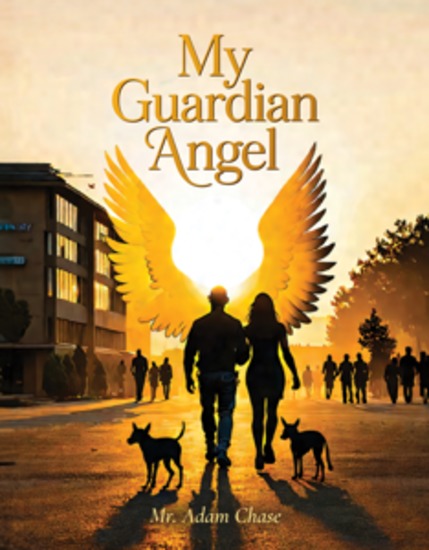
A Short Story of True Love, Hope, and the Power of the Human HeartIf you ask 100 readers what this story is about, you may receive 100 different answers—and that is exactly the point.My Guardian Angel is a deeply moving short story about true love in its many forms, inspired by real life, real relationships, and real emotions. At its core, this story is a tribute to unwavering devotion between a husband and wife—and to the quiet strength that sustains us when life hangs in the balance.Graham, a Vietnam veteran whose greatest joys are his wife and their beloved dogs, begins what seems like an ordinary day wrapped in comfort and routine. But in a sudden and devastating turn, he finds himself fighting for his life. As danger closes in, it is his wife—his lifelong “Guardian Angel”—who stands between him and the unthinkable.Set largely within the stark stillness of a hospital, the story unfolds as friends rally, time seems to pause, and love becomes both shield and salvation. Through moments of fear, hope, memory, and faith, My Guardian Angel explores how love endures even when life is fragile—and how the bonds we build may be stronger than fate itself.Though classified as fiction, more than 60% of this story is drawn directly from the author’s life and experiences. Every word comes from the heart—there is no AI-generated content, no shock value, and no explicit language. This is a story written for readers of all ages who believe in love, kindness, and the quiet courage found in everyday relationships.✨ Themes Readers Will Connect With:True love between husband and wifeHope in the face of mortalityGratitude, humility, and resilienceFaith, belief, and emotional connectionStories that inspire children and adults alikeMy Guardian Angel does not tell readers what true love is—it invites them to discover what it means through the lens of their own lives.If you are looking for a heartfelt, gentle, and profoundly human story—one that lingers long after the final page—this book offers a reminder that love, in all its forms, is life’s greatest gift.
Verfügbar seit: 28.10.2025.
Drucklänge: 108 Seiten.
Weitere Bücher, die Sie mögen werden

  • The Man that Corrupted Hadleyburg and Other Stories - cover

    The Man that Corrupted...

    Mark Twain

    • 0
    • 0
    • 0
    The Man That Corrupted Hadleyburg" is a piece of short fiction by Mark Twain. It first appeared in Harper's Monthly in December 1899, and was subsequently published by Harper Collins in the collection The Man That Corrupted Hadleyburg and Other Stories and Sketches (1900). This recording contains all the stories and sketches from the 1900 Harper Collins publication. (Summary from wikipedia and John)
    Zum Buch
  • The Short Stories of Leo Tolstoy - Epic collection of stories from the grandmaster of literature - cover

    The Short Stories of Leo Tolstoy...

    Leo Tolstoy

    • 0
    • 0
    • 0
    Leo Tolstoy was born in 1828 in the Russian province of Tula to a wealthy noble family. As a child, he had private tutors but he showed little interest in any formal education. When he went to the University of Kazan in 1843 to study oriental languages and law, he left without completing his courses.  Life now was relaxed and idle but with some writing also taking place.  Gambling debts forced an abrupt change of path and he joined the army to fight in the Crimean War.  He was commended for his bravery and promoted but was appalled at the brutality and loss of life.  He recorded these and other earlier experiences in his diaries which formed the basis of several of his works. 
     
    In 1852 ‘Childhood’ was published to immediate success and was followed by ‘Boyhood’ and ‘Youth’. 
     
    His experience in the army and the horrors he witnessed resulted in ‘The Cossacks’ in 1862 and the trilogy ‘Sevastopol Tales’. After the war he travelled around Europe, visiting London and Paris and meeting such luminaries as Victor Hugo and Charles Darwin.  
     
    It was now that Tolstoy began his masterpiece, ‘War and Peace’. Published in 1869 it was an epic work that changed literature. He quickly followed this with ‘Anna Karenina’.  
     
    These successes made Tolstoy rich and helped him accomplish many of his dreams but also brought problems as he grappled with his faith and the lot of the oppressed poor. These revolutionary views became so popular that the authorities now kept him under surveillance.  
     
    He led a life of asceticism and vegetarianism and put his socialist ideals into practice by establishing numerous schools for the poor and food programmes. He also believed in giving away his wealth, which caused much discord with his wife.  
     
    His writing continued to bring forth classics such as ‘The Death of Ivan Ilyich’ and many brilliant and incisive short stories such as ‘How Much Land Does A Man Need’.  
     
    In 1901 Tolstoy was excommunicated from the Church and controversially deselected for the Nobel Prize for Literature. 
     
    Whilst undertaking a pilgrimage by train in October 1910 with his daughter Aleksandra he caught pneumonia in the nearby town of Astapovo.  Leo Tolstoy died on November 9th, 1910, he was 82. 
    01 - Leo Tolstoy - A Short Story Collection - An Introduction 
    02 - Diary of a Lunatic by Leo Tolstoy 
    03 - A Dialogue Among Clever People by Leo Tolstoy 
    04 - Aloysha The Pot by Leo Tolstoy 
    05 - God Sees The Truth But Waits by Leo Tolstoy 
    06 - How Much Land Does A Man Need by Leo Tolstoy
    Zum Buch
  • Cruising for Love - A Steamy Vacation Short Story - cover

    Cruising for Love - A Steamy...

    Melanie A. Smith

    • 0
    • 0
    • 0
    The last thing Dakota Mitchell wanted to do was go on the romantic cruise she was supposed to take with her cheating now-ex fiancé. But it’s nonrefundable, and there are worse things than a couple of weeks in paradise, right? 
    The last thing Dakota ever thought she would do was have a one-night stand with a smoking hot stranger. But what’s the harm in just one night, right? 
    Though the mysterious and sexy Kade Ryan isn’t so easy to forget. Especially when they’re trapped on a private island together. Is Dakota unknowingly cruising for love or will discovering Kade’s secret scare her off? 
    Note: This book contains mature content and as such is only suitable for those 18 years or over.
    Zum Buch
  • Mutiny - A womans quest for social advancement meets a reporter investigating the truth aboard a ship - cover

    Mutiny - A womans quest for...

    Dorothy Edwards

    • 0
    • 0
    • 0
    Dorothy Edwards, an only child, was born on the 18th August 1902 at Ogmore Vale in Glamorgan. 
     
    Her father was a headmaster and an early activist in the Independent Labour Party.  At age 9 Dorothy, dressed in red, welcomed Keir Hardy on to the stage at Tonypandy during the national coal strike of 1912. She was taught that revolution was at hand, that class barriers would be a thing of the past. 
      
    Dorothy won a scholarship and boarded at Howell's School for Girls in Llandaff before moving to University College of South Wales and Monmouthshire where she read Greek and philosophy. 
     
    Her early hopes to be an opera singer were set to one side after graduating and the death of her father. Instead she took on part-time work to supplement her mother’s pension with whom she now lived. 
     
    Dorothy managed to write a number of short stories which appeared in the literary journals of the day.  She spent several months with her mother in Vienna, all the time revising or writing before embarking on ‘Winter Sonata’, a short novel published in 1928. 
     
    Introductions to several members of the Bloomsbury Group meant a move to London and a division of her time between child-care for the family of Bloomsbury author David Garnett and the promise of an advance payment for her work on a new volume of stories. 
     
    However, Dorothy’s life was starting to spiral out of control; she was attracted to the Welsh nationalist movement but felt that her Welsh provincialism made her, in London at least, feel socially inferior. Leaving her mother dependent on a hired companion consumed her with guilt as did the end of an affair with a married musician. 
     
    On the 5th January 1934, having spent the morning burning her papers, Dorothy Edwards threw herself in front of a train near Caerphilly railway station.  
     
    Her suicide note read: "I am killing myself because I have never sincerely loved any human being all my life. I have accepted kindness and friendship and even love without gratitude, and given nothing in return."
    Zum Buch
  • Srnedi Vastar - From their pens to your ears genius in every story - cover

    Srnedi Vastar - From their pens...

    Saki Saki

    • 0
    • 0
    • 0
    Hector Hugh Munro, more familiarly known by his pen-name ‘Saki’ was born in what was then Akyab in British Burma on 18th December 1870. His father was an Inspector General for the Indian Imperial Police, and his mother the daughter of a Rear Admiral. 
    When he was 2 his mother died and he and his siblings were sent back to England to be raised by their grandmother and paternal maiden aunts in a strict, puritanical household near Barnstaple, Devon. Educated by governesses Saki used many of these women as character models for his later writing. 
    At 17 his father retried and returned to England and then embarked on a series of European travels with Saki and his siblings. 
    After a short stint working in Burma with the Indian Imperial Police Saki decided to move to London to make a living as a writer. Initially he wrote as a journalist for a number of newspapers and magazines before attempting an historical study, ‘The Rise of the Russian Empire’, whose real value lay in directing him to writing short stories instead, the first of which, ‘Dogged’, he published in 1899. 
    From here it was a short stab of the pen to writing political satire before in 1902 he became the foreign correspondent for The Morning Post, first in the Balkans, then Russia, Paris and back to London in 1908, where 'the agreeable life of a man of letters with a brilliant reputation awaited him.'  
    Collections of his short stories full of witty, mischievous and often macabre stories that satirized Edwardian society and two novels now appeared in the years up to the Great War.  At its’ outbreak he was 43 but managed to join as an ordinary trooper. More than once he returned to the battlefield when officially too sick or injured.  
    On 14th November 1916 Hector Hugh Munro was sheltering in crater during the Battle of the Ancre, when he was shot and killed by a German sniper. According to several sources, his last words were "Put that bloody cigarette out!"
    Zum Buch
  • The Sensational Baron von Munchausen - Classic Tales Edition - cover

    The Sensational Baron von...

    Rudolph Erich Raspe

    • 0
    • 0
    • 0
    Surprising, sensational, inexorable. These are the adventures of Baron Munchausen. See him escape from the jaws of a hungry lion, shoot a stag with cherry stones, climb a beanstalk to the moon and many other fantastical fables. Each tale is taller than the last, as we enter the world of Baron Munchausen.
    Zum Buch