¡Acompáñanos a viajar por el mundo de los libros!
Añadir este libro a la estantería
Grey
Escribe un nuevo comentario Default profile 50px
Grey
Suscríbete para leer el libro completo o lee las primeras páginas gratis.
All characters reduced
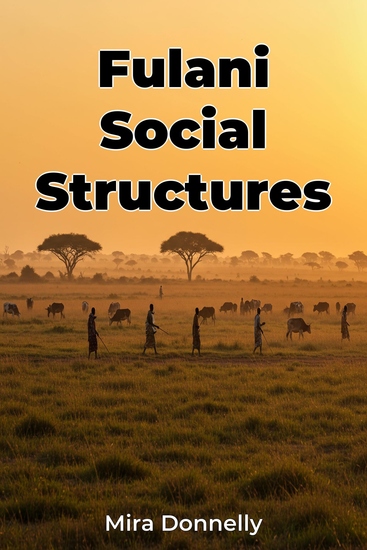
Fulani Social Structures - cover

Fulani Social Structures

Mira Donnelly

Traductor A AI

Editorial: Publifye

  • 0
  • 0
  • 0

Sinopsis

Fulani Social Structures delves into the fascinating ways the Fulani people, despite their widespread presence across West Africa, have maintained a distinct cultural and religious identity for centuries. The book argues that their success lies in a resilient social structure built upon adaptable leadership, a commitment to pastoral nomadism, and a shared dedication to Islamic scholarship. One intriguing aspect is how Fulani communities adapted their leadership models, ranging from clan-based systems to theocratic states, to suit different environments.

 
The book progresses by first introducing core concepts of Fulani social organization, such as lineage systems, before exploring how authority was maintained in various contexts. It then examines the economic and social implications of their mobile lifestyle and the unifying role of Islam in shaping their identity. By examining historical chronicles, oral traditions, and ethnographic studies, Fulani Social Structures offers a nuanced perspective on the interplay between social structures, mobility, and religious identity, making it a valuable resource for those interested in African history, Islamic studies, and social anthropology. This approach moves beyond simple narratives to provide a comprehensive analysis.
Disponible desde: 03/05/2025.
Longitud de impresión: 67 páginas.

Otros libros que te pueden interesar

  • A Suspicious Science - The Uses of Psychology - cover

    A Suspicious Science - The Uses...

    Rami Gabriel

    • 0
    • 0
    • 0
    From self-help to medication, therapy, and cognitive neuroscience, this book traces the uses and limits of psychology. Offering a systematic exploration of the ways in which psychology is used in contemporary society, it refines our understanding of the extent of the field. In addition to conceptual analysis of how science, truth, biology, mind, and meaning intersect and interact in the mind sciences, A Suspicious Science draws from history and anthropology to articulate an interdisciplinary multi-level form of psychology that may serve to orient the field. The book synthesizes debates in psychology and philosophy concerning methodology and the nature of explanation with debates about its practical context as a human science. Ultimately, it suggests psychology provides us myths and rituals that ground a particular sense of meaning and motivation in our lives. By aligning cultural, emotional, and philosophical uses of psychology, this book clarifies a synoptic, humanistic model of the mind within the human sciences.
    Ver libro
  • Behemoth - A History of the Factory and the Making of the Modern World - cover

    Behemoth - A History of the...

    Joshua B. Freeman

    • 0
    • 0
    • 0
    A sweeping, global history of the rise of the factory and its effects on society 
    We live in a factory-made world: modern life is built on three centuries of advances in factory production, efficiency, and technology. But giant factories have also fueled our fears about the future since their beginnings, when William Blake called them “dark Satanic mills.” Many factories that operated over the last two centuries―such as Homestead, River Rouge, and Foxconn―were known for the labor exploitation and class warfare they engendered, not to mention the environmental devastation caused by factory production from the beginning of the Industrial Revolution up to today. 
    In a major work of scholarship that is also wonderfully accessible, celebrated historian Joshua B. Freeman tells the story of the factory and examines how it has reflected both our dreams and our nightmares of industrialization and social change. He whisks readers from the textile mills in England that powered the Industrial Revolution and the factory towns of New England to the colossal steel and car plants of twentieth-century America, Eastern Europe, and the Soviet Union and on to today’s behemoths making sneakers, toys, and cellphones in China and Vietnam. 
    The giant factory, Freeman shows, led a revolution that transformed human life and the environment. He traces arguments about factories and social progress through such critics and champions as Marx and Engels, Charles Dickens, Alexander Hamilton, Henry Ford, and Joseph Stalin. He chronicles protests against standard industry practices from unions and workers’ rights groups that led to shortened workdays, child labor laws, protection for organized labor, and much more. 
    In Behemoth, Freeman also explores how factories became objects of great wonder that both inspired and horrified artists and writers in their time. He examines representations of factories in the work of Charles Sheeler, Margaret Bourke-White, Charlie Chaplin, Diego Rivera, and Edward Burtynsky. 
    Behemoth tells the grand story of global industry from the Industrial Revolution to the present. It is a magisterial work on factories and the people whose labor made them run. And it offers a piercing perspective on how factories have shaped our societies and the challenges we face now.
    Ver libro
  • My Fostering Experience as A Nigerian - cover

    My Fostering Experience as A...

    Chi Ose

    • 0
    • 0
    • 0
    Fostering children is a way of providing a temporary family for children who cannot live with their own parents. Fostering can be a rewarding and challenging experience for both the foster carers and the children. There are many reasons why children may need foster care, such as abuse, neglect, family breakdown, illness, or disability.  
    Foster carers are people who have the skills, patience, and compassion to care for children who have experienced trauma and loss. They offer a safe and nurturing environment where children can heal and grow. Foster carers receive training, support, and financial assistance from the fostering agency or local authority that places the children with them.  
    They work as part of a team with social workers, therapists, teachers, and other professionals to meet the needs of the children. Foster carers can choose the type of fostering that suits them best, such as short-term, long-term, emergency, respite, or specialist fostering. They can also specify the age range and number of children they can care for.  
    Fostering is not a permanent arrangement, and the goal is usually to reunite the children with their birth families or find them an alternative permanent home. However, some foster carers may adopt the children they foster if that is in their best interest. Fostering can make a positive difference in the lives of children and foster carers alike. 
    Fostering children can have many benefits, such as making a positive difference in their lives, learning new skills and expanding your family. However, fostering children can also have many challenges, such as dealing with emotional and behavioural issues, coping with loss and attachment, and balancing your own needs and responsibilities.  
    If you are interested in fostering children, you should contact your local fostering agency or social services department to find out more about the process, the requirements and the support available.
    Ver libro
  • Last Woman Hanged - cover

    Last Woman Hanged

    Caroline Overington

    • 0
    • 0
    • 0
    Two husbands, four trials and one bloody execution: Winner of the 2015 Davitt Award for Best Crime Book (Non-fiction) -- the terrible true story of Louisa Collins. 
     In January 1889, Louisa Collins, a 41-year-old mother of ten children, became the first woman hanged at Darlinghurst Gaol and the last woman hanged in New South Wales. Both of Louisa's husbands had died suddenly and the Crown, convinced that Louisa poisoned them with arsenic, put her on trial an extraordinary four times in order to get a conviction, to the horror of many in the legal community. Louisa protested her innocence until the end. Much of the evidence against Louisa was circumstantial. Some of the most important testimony was given by her only daughter, May, who was just 10-years-old when asked to take the stand. Louisa Collins was hanged at a time when women were in no sense equal under the law -- except when it came to the gallows. They could not vote or stand for parliament -- or sit on juries. Against this background, a small group of women rose up to try to save Louisa's life, arguing that a legal system comprised only of men -- male judges, all-male jury, male prosecutor, governor and Premier -- could not with any integrity hang a woman. The tenacity of these women would not save Louisa but it would ultimately carry women from their homes all the way to Parliament House. Caroline Overington is the author of eleven books of fiction and non-fiction, including the top-selling THE ONE WHO GOT AWAY psychological crime novel. She has said: 'My hope is that LAST WOMAN HANGED will be read not only as a true crime story but as a letter of profound thanks to that generation of women who fought so hard for the rights we still enjoy today.'Praise for LAST WOMAN HANGED'The story she tells ... is a useful challenge to any tendency to simple moral indignation' -- Beverley Kingston, Sydney Morning Herald'This is a fascinating book, a terrific read, and an excellent reminder of who tells the stories, and whose stories are forgotten' -- Frances Rand, South Coast Register'... what's ... interesting is Caroline Overington's even-handed appraisal of Collins's alleged crime(s) that led her to become the last woman hanged in New South Wales in 1889' -- Launceston Sunday Examiner 
    Ver libro
  • Beyond the Rubble - Stories from Gaza - cover

    Beyond the Rubble - Stories from...

    Alex Tusk

    • 0
    • 0
    • 0
    In "Beyond the Rubble," Alex Tusk invites listeners into the heart of Gaza, weaving together powerful narratives that reveal the resilience and humanity of its people amidst conflict. Through a series of poignant stories, Tusk captures the daily lives, dreams, and struggles of individuals often overlooked by the broader narrative of war. 
    Narrated by the compelling voice of Joanne Williams, this audiobook immerses you in the rich tapestry of Gaza's experiences. Williams’ nuanced delivery brings to life the laughter, sorrow, and hope that echo through the streets and homes, transcending the physical devastation that surrounds them. 
    Join Tusk on this transformative journey that goes beyond the headlines, exploring the strength of community and the indomitable spirit of those who call Gaza home. "Beyond the Rubble" is a testament to resilience, urging us to listen and understand the stories that lie beneath the surface.
    Ver libro
  • Guy Gibson: The Life and Legacy of the Royal Air Force’s Most Distinguished Bomber Pilot during World War II - cover

    Guy Gibson: The Life and Legacy...

    Editors Charles River

    • 0
    • 0
    • 0
    Given the RAF’s importance, it should come as no surprise that some of the pilots ranked among Britain’s most recognized war heroes, and Guy Gibson remains one of the most famous and highly decorated British soldiers in World War II. His exploits in the RAF as the leader of the audacious raid to blow up German dams in May 1943 remain renowned, and for generations of British boys after the war, he served as the benchmark of a legendary hero. His tragic death at the young age of 26 only served to deepen his mythology, but his war record was impressive even before his most famous missions, with three operational tours of duty under his belt. 
    The mythmaking aside, Gibson was a complex and controversial character, probably caused, in part, by a turbulent and disrupted upbringing. Although his bravery, self-sacrifice, and leadership in battle were undeniable and highly impressive, he could be demanding and difficult to get along with. It is probably fair to say he was not universally loved by the crews and service personnel who served alongside him, and he after the Dam Busters raid, he embarked on a months-long tour of the United States and Canada that many (including Air Officer Commanding Bomber Commander Arthur “Bomber” Harris) felt had gone to his head slightly. After the raid and the fame, he drifted somewhat, having been forbidden from flying in further operations (which he bypassed in the end). He wrote a book about his exploits as a bomber pilot, Enemy Coast Ahead, and was interviewed on radio programs. He flirted with politics, applying for and succeeding in becoming the Conservative Party’s prospective candidate for Macclesfield in 1944 before withdrawing, claiming the war still required his attention. After D-Day on June 6, 1944, Gibson seemed to feel an urgent need to get back into operations for fear of missing out.
    Ver libro