Rejoignez-nous pour un voyage dans le monde des livres!
Ajouter ce livre à l'électronique
Grey
Ecrivez un nouveau commentaire Default profile 50px
Grey
Abonnez-vous pour lire le livre complet ou lisez les premières pages gratuitement!
All characters reduced
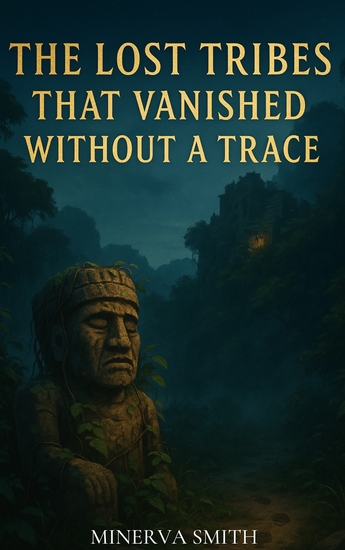
The Lost Tribes That Vanished without a Trace - cover

The Lost Tribes That Vanished without a Trace

Minerva Smith

Maison d'édition: Heritage Books

  • 0
  • 0
  • 0

Synopsis

What happens when entire tribes disappear — not into legend, but into silence?


The Lost Tribes That Vanished Without a Trace takes you on a gripping journey into history’s most haunting mysteries. From the cliff dwellings of the Anasazi to the alien-like relics of Sanxingdui, this book explores real civilizations that thrived and then suddenly vanished, leaving behind ruins, relics, and more questions than answers.


Blending archaeology, myth, and human curiosity, this is not just a record of lost peoples — it’s an invitation to wonder. Perfect for fans of historical mysteries, ancient secrets, and those who believe that the past still has untold stories waiting to be found.
Disponible depuis: 16/07/2025.
Longueur d'impression: 171 pages.

D'autres livres qui pourraient vous intéresser

  • Himalayan Doomsday Device - The Misplaced Weapon Threatening a Nation - cover

    Himalayan Doomsday Device - The...

    John Harpoon

    • 0
    • 0
    • 0
    In the vast expanse of the Himalayas, hidden beneath centuries of snow and ice, lay a secret that had been buried for generations. The towering peaks, once home to monks and ancient civilizations, now shielded a dark legacy that time itself had forgotten. The truth about this forgotten legacy, however, was about to resurface, altering the course of history and threatening the very future of a nation. 
    The story began long before the world had even begun to recognize the geopolitical importance of this remote region. Ancient texts, passed down through generations of sages, spoke of a powerful device buried in the heart of the mountains. These writings, written in a language long extinct, described an artifact of unimaginable power—an object designed to protect a kingdom, but one that, if misused, could bring about devastation on an unimaginable scale. 
    Over time, the knowledge of this device faded into obscurity. Wars, invasions, and the relentless march of history erased most traces of the past. Yet, the stories never fully disappeared. They were whispered by the elders, passed along in cryptic folklore, and tucked away in the corners of forgotten libraries. But for centuries, no one believed the legends were more than myths, the wild imaginings of storytellers and mystics.
    Voir livre
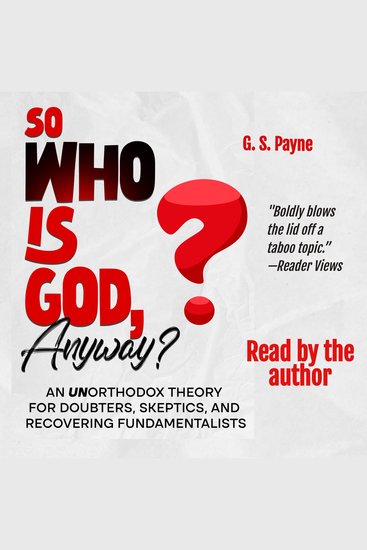
  • So Who is God Anyway? - An (UN)orthodox Theory for Doubters Skeptics and Recovering Fundamentalists - cover

    So Who is God Anyway? - An...

    G.S. Payne

    • 0
    • 0
    • 0
    "Boldly blows the lid off a taboo topic. If there’s one book on God to read this year, please make it ‘So Who is God Anyway?’ by G.S. Payne.” —Reader Views 
    "A well-written and convincing rumination on the divine." --Kirkus Reviews 
    GS Payne, writer, sleuth, and eternally curious ruminator, investigates 2,500 years-plus of philosophical thought on the subject of God. Using the tools of the philosopher (and a lot of humor), Payne traces the thinking of history's greatest brains to arrive initially at a conclusion on the matter of God's existence; then, a philosophical conception of God that is no less than startling, first because it is nothing like the traditional conception of God (he of the beard and sandals on his throne in the sky), and, second, because it is a conception that not only goes back to the beginning of recorded time, but is recognized by every major religion on earth, and yet has been tragically relegated to the fringes by the louder, more fundamentalist branches of mainstream religion. 
    So Who is God, Anyway? delivers splendidly-for doubters, skeptics, recovering fundamentalists, or anyone looking for a fun book to read about some damn big questions!
    Voir livre
  • Messerschmitts Over Sicily - Diary of a Luftwaffe Fighter Commander - cover

    Messerschmitts Over Sicily -...

    Johannes Steinhoff

    • 0
    • 0
    • 0
    A German air force officer’s first person account of aerial battle during the invasion of Sicily in WWII.   In an account of unusual power, Luftwaffe ace Johannes Steinhoff draws from his personal World War II diary to recount the final days of the German air force on Sicily in June and July 1943. Facing crushing odds—including a commander, Hermann Goring, who contemptuously treated his pilots as cowards—Steinhoff and his fellow Messerschmitt 109 pilots took to the skies day after day to meet waves of dreaded Flying Fortresses and swarms of Allied fighters, all bent on driving the Germans from the island. A captivating narrative and a piercing analysis, this book is a classic of aerial combat.
    Voir livre
  • For God and Liberty - Catholicism and Revolution in the Atlantic World 1790-1861 - cover

    For God and Liberty -...

    Pamela Voekel

    • 0
    • 0
    • 0
    The Age of Revolution has traditionally been understood as an era of secularization, giving the transition from monarchy to independent republics through democratic movements a genealogy that assumes hostility to Catholicism. By centering the story on Spanish and Latin American actors, Pamela Voekel argues that at the heart of this nineteenth-century transformation in Spanish America was a transatlantic Catholic civil war. Voekel demonstrates Reform Catholicism's significance to the thought and action of the rebel literati who led decolonization efforts in Mexico and Central America, showing how each side of this religious divide operated from within a self-conscious intercontinental network of like-minded Catholics. For its central protagonists, the era's crisis of sovereignty provided a political stage for a religious struggle. Drawing on ecclesiastical archives, pamphlets, sermons, and tracts, For God and Liberty reveals how the violent struggles of decolonization and the period before and after Independence are more legible in light of the fault lines within the Church.
    Voir livre
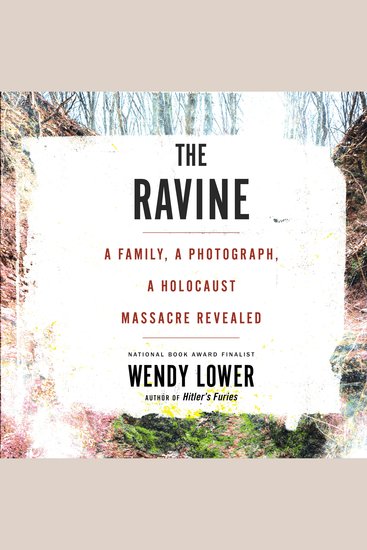
  • The Ravine - A Family a Photograph a Holocaust Massacre Revealed - cover

    The Ravine - A Family a...

    Anonyme

    • 0
    • 0
    • 0
    A single photograph—an exceptionally rare “action shot” documenting the horrific final moment of the murder of a family—drives a riveting process of discovery for a gifted Holocaust scholarIn 2009, the acclaimed author of Hitler’s Furies was shown a photograph just brought to the United States Holocaust Memorial Museum. The documentation of the Holocaust is vast, but there are virtually no images of a Jewish family at the actual moment of murder, in this case by German officials and Ukrainian collaborators. A Ukrainian shooter’s rifle is inches from a woman's head, obscured in a cloud of smoke. She is bending forward, holding the hand of a barefooted little boy. And—only one of the shocking revelations of Wendy Lower’s brilliant ten-year investigation of this image—the shins of another child, slipping from the woman’s lap.   Wendy Lower’s forensic and archival detective work—in Ukraine, Germany, Slovakia, Israel, and the United States—recovers astonishing layers of detail concerning the open-air massacres in Ukraine. The identities of mother and children, of the killers—and, remarkably, of the Slovakian photographer who openly took the image, as a secret act of resistance—are dramatically uncovered. Finally, in the hands of this brilliant exceptional scholar, a single image unlocks a new understanding of the place of the family unit in the ideology of Nazi genocide.         
    Voir livre
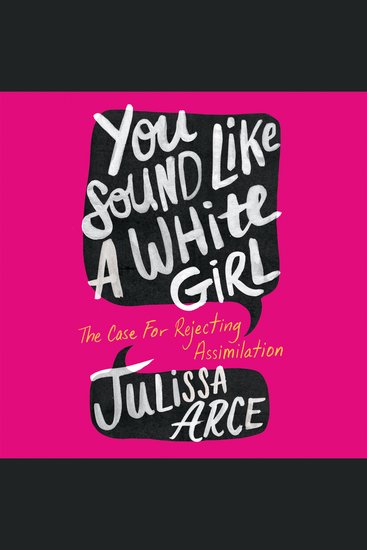
  • You Sound Like a White Girl - The Case for Rejecting Assimilation - cover

    You Sound Like a White Girl -...

    Julissa Arce

    • 0
    • 0
    • 0
    This program is read by the author and includes a bonus conversation with the author and Paola Ramos, a Vice News journalist, MSNBC Contributor, and author of Finding Latinx.“A love letter to our people—full of fury and passion."— José Olivarez, award-winning poet and author of Citizen Illegal"If you could take Rodolfo Gonzales epic poem 'I Am Joaquin' and explain it through compelling, personal narrative in twenty-first century America, You Sound Like A White Girl would be it.”— Joaquin CastroBestselling author Julissa Arce brings readers a powerful polemic against the myth that assimilation leads to happiness and belonging for immigrants in America. Instead, she calls for a celebration of our uniqueness, our origins, our heritage, and the beauty of the differences that make us Americans.“You sound like a white girl.” These were the words spoken to Julissa by a high school crush as she struggled to find her place in America. As a brown immigrant from Mexico, assimilation had been demanded of her since the moment she set foot in San Antonio, Texas, in 1994. She’d spent so much time getting rid of her accent so no one could tell English was her second language that in that moment she felt those words—you sound like a white girl?—were a compliment. As a child, she didn’t yet understand that assimilating to “American” culture really meant imitating “white” America—that sounding like a white girl was a racist idea meant to tame her, change her, and make her small. She ran the race, completing each stage, but never quite fit in, until she stopped running altogether.In this dual polemic and manifesto, Julissa dives into and tears apart the lie that assimilation leads to belonging. She combs through history and her own story to break down this myth, arguing that assimilation is a moving finish line designed to keep Black and brown Americans and immigrants chasing racist American ideals. She talks about the Lie of Success, the Lie of Legality, the Lie of Whiteness, and the Lie of English—each promising that if you obtain these things, you will reach acceptance and won’t be an outsider anymore. Julissa deftly argues that these demands leave her and those like her in a purgatory—neither able to secure the power and belonging within whiteness nor find it in the community and cultures whiteness demands immigrants and people of color leave behind.In You Sound Like a White Girl, Julissa offers a bold new promise: Belonging only comes through celebrating yourself, your history, your culture, and everything that makes you uniquely you. Only in turning away from the white gaze can we truly make America beautiful. An America where difference is celebrated, heritage is shared and embraced, and belonging is for everyone. Through unearthing veiled history and reclaiming her own identity, Julissa shows us how to do this.
    Voir livre