Begleiten Sie uns auf eine literarische Weltreise!
Buch zum Bücherregal hinzufügen
Grey
Einen neuen Kommentar schreiben Default profile 50px
Grey
Jetzt das ganze Buch im Abo oder die ersten Seiten gratis lesen!
All characters reduced
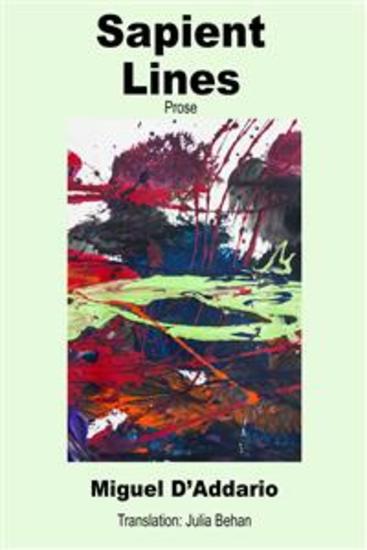
Sapient Lines - Prose - cover

Sapient Lines - Prose

Miguel D'Addario

Verlag: Babelcube

  • 0
  • 0
  • 0

Beschreibung

A book to discover new imaginative borders, subtle and unfathomable, mysterious and ecstatic; where the mission is to imagine the facts with a different vision and with sapient nuances.
Verfügbar seit: 16.05.2023.
Drucklänge: 365 Seiten.

Weitere Bücher, die Sie mögen werden

  • The Theogony - cover

    The Theogony

    Hesiod

    • 0
    • 0
    • 0
    The Theogony "the genealogy or birth of the gods" is a poem by Hesiod (8th – 7th century BC) describing the origins and genealogies of the Greek gods, composed c. 730–700 BC. It is written in the Epic dialect of Ancient Greek and contains 1022 lines. 
    Hesiod's Theogony is a large-scale synthesis of a vast variety of local Greek traditions concerning the gods, organized as a narrative that tells how they came to be and how they established permanent control over the cosmos. It is the first known Greek mythical cosmogony. The initial state of the universe is chaos, a dark indefinite void considered a divine primordial condition from which everything else appeared. Theogonies are a part of Greek mythology which embodies the desire to articulate reality as a whole; this universalizing impulse was fundamental for the first later projects of speculative theorizing.
    Hesiod appropriates to himself the authority usually reserved to sacred kingship. The poet declares that it is he, where we might have expected some king instead, upon whom the Muses have bestowed the two gifts of a scepter and an authoritative voice (Hesiod, Theogony 30–3), which are the visible signs of kingship. It is not that this gesture is meant to make Hesiod a king. Rather, the point is that the authority of kingship now belongs to the poetic voice, the voice that is declaiming the Theogony.
    Zum Buch
  • Songs of Innocence and of Experience - cover

    Songs of Innocence and of...

    William Blake

    • 0
    • 0
    • 0
    Songs of Innocence and Experience is a poetry collection by Blake. It contrasts childhood innocence (joy, wonder) with the harsher realities of adulthood (injustice, disillusionment). Imagine two sides of the same coin: one bright, one shadowed.
    Zum Buch
  • The Corridor - science fiction story - cover

    The Corridor - science fiction...

    Amr Mounir

    • 0
    • 0
    • 0
    When he decided to visit his friend in his quiet town, he did not expect to find everything had mysteriously changed. The streets, the faces, and even time itself… as if the place was no longer the same! In the midst of this terrifying mystery, he tries to understand what is happening, but the truth he will discover in the end may make him wonder: is he in the same world he knows… or is he lost in another parallel world?
    Zum Buch
  • twins (NHB Modern Plays) - cover

    twins (NHB Modern Plays)

    James Fritz

    • 0
    • 0
    • 0
    Twin girls. One grows up, has a full life packed with incident, only a few regrets. The other dies twenty minutes after being born.
    Both of them are here.
    James Fritz's short play twins was first performed at the Arcola Theatre, London, in November 2015 as part of the Miniaturists' 10th Birthday Bash.
    'Completely enthralling… a superb piece of writing that conveys the beauty and cruelty of life in a wonderful and completely non-sentimental way. A fabulous example of a short play at its best' - LondonTheatre1
    Zum Buch
  • Ode - The Age of Dryden' is a fitting marker for why he stood above all the others of his age - cover

    Ode - The Age of Dryden' is a...

    John Dryden

    • 0
    • 0
    • 0
    John Dryden was born on August 9th, 1631 in the village rectory of Aldwincle near Thrapston in Northamptonshire. As a boy Dryden lived in the nearby village of Titchmarsh, Northamptonshire. In 1644 he was sent to Westminster School as a King's Scholar.  
    Dryden obtained his BA in 1654, graduating top of the list for Trinity College, Cambridge that year.  
    Returning to London during The Protectorate, Dryden now obtained work with Cromwell's Secretary of State, John Thurloe. 
     At Cromwell's funeral on 23 November 1658 Dryden was in the company of the Puritan poets John Milton and Andrew Marvell.  The setting was to be a sea change in English history. From Republic to Monarchy and from one set of lauded poets to what would soon become the Age of Dryden. 
    The start began later that year when Dryden published the first of his great poems, Heroic Stanzas (1658), a eulogy on Cromwell's death.  
    With the Restoration of the Monarchy in 1660 Dryden celebrated in verse with Astraea Redux, an authentic royalist panegyric. 
     With the re-opening of the theatres after the Puritan ban, Dryden began to also write plays. His first play, The Wild Gallant, appeared in 1663 but was not successful. From 1668 on he was contracted to produce three plays a year for the King's Company, in which he became a shareholder. During the 1660s and '70s, theatrical writing was his main source of income.  
    In 1667, he published Annus Mirabilis, a lengthy historical poem which described the English defeat of the Dutch naval fleet and the Great Fire of London in 1666. It established him as the pre-eminent poet of his generation, and was crucial in his attaining the posts of Poet Laureate (1668) and then historiographer royal (1670). 
    This was truly the Age of Dryden, he was the foremost English Literary figure in Poetry, Plays, translations and other forms. 
    In 1694 he began work on what would be his most ambitious and defining work as translator, The Works of Virgil (1697), which was published by subscription. It was a national event.  
    John Dryden died on May 12th, 1700, and was initially buried in St. Anne's cemetery in Soho, before being exhumed and reburied in Westminster Abbey ten days later.
    Zum Buch
  • The Poetry of Edna St Vincent Millay - A poetry anthology from Pulitzer prize winning author and hugely impactful social figure and feminist during and after the roaring 20's Edna St Vincent Millay - cover

    The Poetry of Edna St Vincent...

    Edna St Vincent Millay

    • 0
    • 0
    • 0
    Elinor Morton Hoyt was born on 7th September, 1885 in Somerville, New Jersey and from age 12 grew up in Washington D C where her father served as assistant attorney general and later solicitor general.  Her early education together with her renowned beauty suggests she was being trained for life as a debutante but her life quickly found another route as she became absorbed in the world of books. 
     
    An early marriage following her graduation ended when, after being pursued by Horace Wylie, 17 years her senior and a married Washington lawyer with three children, she eloped to England with him.  His wife would not divorce him and the subsequent scandal was widely publicised further fueled by the suicide in 1912 of her abandoned husband. 
     
    With Wylie's encouragement she published in 1912, ‘Incidental Number’, assembled from poems of the previous decade. 
     
    Despite a child from her first marriage Elinor subsequently endured miscarriages, a stillbirth and a premature child who lived for only one week.  When Wylie’s deserted wife agreed to a divorce, the couple returned to the United States and married but they were already drawing apart. 
     
    In 1921, Elinor’s ‘Nets to Catch the Wind’, was published. It was an immediate success and a prize-winner.  In New York’s literary circles she found her next husband who acted as her agent – the poer William Rose Benét, brother of the famed Stephen. They married in 1923 and that same year ‘Black Armor’, was published. The New York Times said "There is not a misplaced word or cadence in it."  She also published her first of four novels, ‘Jennifer Lom’, to excellent reviews. 
     
    She worked for a time as the poetry editor of Vanity Fair, an editor of Literary Guild, and a contributing editor of The New Republic.  Her third book of poetry, ‘Trivial Breath’ arrived in 1928 as did the failure of her marriage with Benét.  
     
    She moved again to England and fell in love with a friend’s husband, to whom she wrote, and later published a series of 19 sonnets; ‘Angels and Earthly Creatures’. 
     
    Elinor Wylie suffered high blood pressure all her adult life and this eventually led to her death at Benet’s New York apartment on 16th December, 1928 where she suffered a stroke. She was 43. 
     
    1 - The Poetry of Edna St Vincent Millay - An Introduction 
    2 - The Ballad of the Harp-Weaver by Edna St Vincent Millay 
    3 - Dirge Without Music by Edna St Vincent Millay 
    4 - Renascence by Edna St Vincent Millay 
    5 - If Still Your Orchards Bear by Edna St Vincent Millay 
    6 - My Heart Being Hungry by Edna St Vincent Millay 
    7 - First Fig by Edna St Vincent Millay 
    8 - Feast by Edna St Vincent Millay 
    9 - Second Fig by Edna St Vincent Millay 
    10 - No Rose That in a Garden Ever Grew by Edna St Vincent Millay 
    11 - Three Songs of Shattering by Edna St Vincent Millay 
    12 - Rosemary by Edna St Vincent Millay 
    13 - I Too Beneath Your Moon by Edna St Vincent Millay 
    14 - Sonnet XLIII - What Lips My Lips Have Kissed, and Where, and Why by Edna St Vincent Millay 
    15 - Sorrow by Edna St Vincent Millay 
    16 - Departure by Edna St Vincent Millay 
    17 - Travel by Edna St Vincent Millay 
    18 - Journey by Edna St Vincent Millay 
    19 - Mist in the Valley by Edna St Vincent Millay 
    20 - Tavern by Edna St Vinent Millay 
    21 - Exiled by Edna St Vincent Millay 
    22 - A Visit to the Asylum by Edna St Vincent Millay 
    23 - Recuerdo by Edna St Vincent Millay 
    24 - The Philosopher by Edna St Vincent Millay 
    25 - Sonnet XXX -  Love is Not All by Edna St Vincent Millay 
    26 - Sonnet XVIII - I, Being Born a Woman by Edna St Vincent Millay 
    27 - The Betrothal by Edna St Vincent Millay 
    28 - When I Too Long Have Looked Upon Your Fa
    Zum Buch