Rejoignez-nous pour un voyage dans le monde des livres!
Ajouter ce livre à l'électronique
Grey
Ecrivez un nouveau commentaire Default profile 50px
Grey
Abonnez-vous pour lire le livre complet ou lisez les premières pages gratuitement!
All characters reduced
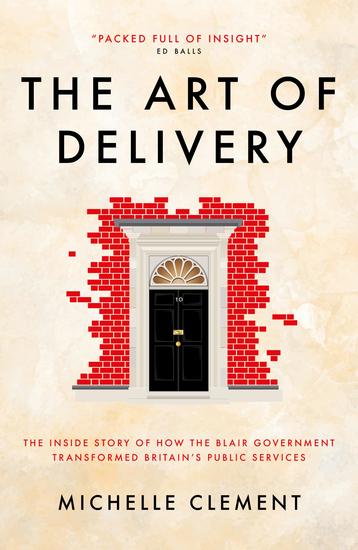
The Art of Delivery - The Inside Story of How the Blair Government Transformed Britain's Public Services - cover

The Art of Delivery - The Inside Story of How the Blair Government Transformed Britain's Public Services

Michelle Clement

Maison d'édition: Biteback Publishing

  • 0
  • 0
  • 0

Synopsis

The Art of Delivery ventures inside 10 Downing Street at the turn of the millennium to unveil how Tony Blair's government successfully transformed the public services we value most.
Though the Blair government had a huge mandate, there remained fundamental challenges to success – not least the Blair–Brown rivalry, which manifested itself in a proxy war over the direction of public service reform. Nevertheless, over four years, the Prime Minister's Delivery Unit, led by Sir Michael Barber, upgraded the way in which the British government implemented improvements to the NHS and the education system. It also represented a watershed for how Prime Ministers engage with the real-world delivery of their priorities.
Until now, much of this narrative has remained untold. Based on brand-new research and analysis, Michelle Clement uncovers the full story, drawing on 600,000 words of Sir Michael Barber's unpublished, handwritten private diaries as well as exclusive interviews and government papers. Filled with revealing insider detail, this is a human account of what it takes to effect change from behind that famous black door.
Disponible depuis: 27/05/2025.
Longueur d'impression: 432 pages.


D'autres livres qui pourraient vous intéresser

  • Lesbian BDSM Short Stories 2-in-1 Collection - First-Time BDSM Adventure & A Gentle BDSM Adventure - cover

    Lesbian BDSM Short Stories...

    Amber Carden

    • 0
    • 0
    • 0
    Book 1: A confident and curious 20-year-old girl, an experienced dominatrix, and a well-equipped dungeon. What can go wrong? 
    Book2: One is a successful businesswoman; the other is an innocent art lover. Both have a secret desire waiting to be explored.... 
    If you are into lesbian and BDSM stories and like podcasts such as: The lesbian romantic, The lesbian supper club, lesbian chronicles, we’re having gay sex, lesbian sex stories, conversations with a dom, and audiobooks such as: Nathan Rough, Eva Harmon, Nikki Crescent, priest, chelle bliss, throttle me, piper lawson, good girl, 50 shades, fifty shades, erotic sex stories for adults, deep fingers, irresistibly bound: the complete series, and more, get ready to buckle up! 
    Listen to the sample now.
    Voir livre
  • French Royalty - cover

    French Royalty

    Kelly Mass

    • 0
    • 0
    • 0
    This book consists of 2 titles, which are about the following topics:1 - Before the Reign of Terror, Marie Antoinette was the last queen of France. She was the penultimate kid and youngest daughter of Empress Maria Theresa and Emperor Francis I, and was born an archduchess of Austria. At the age of 14, she wed Louis-Auguste, the beneficiary evident to the French throne, and ended up being dauphine of France in May 1770. Her partner, Louis XVI, took the throne on May 10, 1774, and she ended up being queen.2 - From 768 to 800, Charlemagne, also referred to as Charles the Great, was King of the Franks, King of the Lombards, and Emperor of the Romans. Charlemagne combined many western and main Europe at the time of the Early Middle Ages. Since the fall of the Western Roman Empire 3 centuries before, he was the first acknowledged emperor to rule from western Europe. The Carolingian Empire is the name given to Charlemagne's broadening Frankish world. Antipope Paschal the Third later canonized him.
    Voir livre
  • 1980 Nomination Acceptance Address - cover

    1980 Nomination Acceptance Address

    Ronald Reagan

    • 0
    • 0
    • 0
    Cover Art Photo: Ronald Reagan giving his acceptance speech at the Republican National Convention at Joe Louis Arena, Detroit, Michigan. July 17, 1980. 
    In his acceptance speech, Reagan envisioned “a new consensus with all those across the land who share a community of values embodied in these words: family, work, neighborhood, peace and freedom.” Reagan’s acceptance focuses on “three grave threats to our very existence, any one of which could destroy us. We face a disintegrating economy, a weakened defense and an energy policy based on the sharing of scarcity.” 
    Reagan places responsibility on the “Democratic party leadership-in the White House and in Congress-for this unprecedented calamity which has befallen us.” He says his first act will be “to impose an immediate and thorough freeze on federal hiring” and “to conduct a detailed review of every department, bureau and agency that lives by federal appropriation.” Reagan calls for “a 30 percent reduction in income tax rates over a period of three years” and reminds us that “every major tax cut in this century has strengthened the economy, generated renewed productivity and ended up yielding new revenues for the government”. 
    On the issue of national defense, Reagan asserts that we “know only too well that war comes not when the forces of freedom are strong, but when they are weak. It is then that tyrants are tempted.” While calling for a strong military, Reagan reiterates his long-held belief that government is too big and the “time is now to limit federal spending; to insist on a stable monetary reform and to free ourselves from imported oil.” 
    Search online for “Ronald Reagan major speeches” to see both a text version and a video version of this speech. Audio recording courtesy of the Ronald Reagan Presidential Library. AspenLeafMedia.com
    Voir livre
  • The Rio Grande Sniper Killings - Caught in the Sights of a Drug Conspiracy - cover

    The Rio Grande Sniper Killings -...

    John Primomo

    • 0
    • 0
    • 0
    Untangle the complex conspiracy that led to the tragic deaths of Charlotte Kay Elliott and Kevin Edwin Frase on the banks of the Rio Grande. On the night of July 13, 1980, a hitman fired a high-powered rifle into the crowd at Pepe's On the River, an outdoor bar in Mission, Texas. He missed his target, a witness in the Loop 360 drug case, but killed two young bystanders. While state court prosecutions for capital murder inexplicably faltered, a federal court gave the assassin a life sentence for attempted murder of a grand jury witness. A member of the judge's staff who was present throughout the trial, author John W. Primomo revisits the dramatic twists and turns surrounding this murder on the Rio Grande.
    Voir livre
  • Native American Mythology - The Role of Nature Animals And Soul Regarding to Human Being - cover

    Native American Mythology - The...

    Wilson Bellacoola

    • 0
    • 0
    • 0
    This audiobook explores Native American mythologies to view the relationships between humans and animals. 
    Traditional Native Americans view animals as elder brothers who embody the knowledge sets necessary for survival on this Earth. This vantage point facilitates openness within humans to learn from animals. Animals play the roles of tutelary spirits, helpers, and guides, and sometimes shapeshift from Holy Person to animal or back. This emphasizes the fluidity between the worlds of spirit and matter and highlights animals as oriented toward being helpful to humanity in various ways. As expressed through language and ritual, respect details preserve the relationship between the community, the animals, and the natural landscape. 
    Animals push human beings into interiority. The spirits choose a person and then utilize animals to communicate and transmit spiritual understandings and abilities. It is then up to the individual to bring this vision to usefulness on Earth.
    Voir livre
  • Chernobyl - Details of the Worst Nuclear Disaster in History - cover

    Chernobyl - Details of the Worst...

    Kelly Mass

    • 0
    • 0
    • 0
    On April 26, 1986, the world witnessed one of the gravest technological disasters in human history: the Chernobyl nuclear catastrophe. Occurring at the Chernobyl Nuclear Power Plant's No. 4 reactor in Pripyat, then part of the Ukrainian Soviet Socialist Republic, the event not only claimed lives but also left a legacy of environmental and human suffering that persists to this day. This calamity stands as the deadliest nuclear accident in history, both in terms of its immediate human cost and its staggering financial implications. It remains one of only two incidents—alongside the 2011 Fukushima nuclear disaster in Japan—classified as a Level 7 event, the highest rating on the International Nuclear Event Scale.  
    Responding to the crisis required a monumental effort, involving over 500,000 personnel for emergency operations and subsequent environmental cleanup. This massive endeavor cost approximately 18 billion Soviet rubles, a figure equivalent to $68 billion in 2019 when adjusted for inflation. The scale of the response underscores the unprecedented challenges posed by the catastrophe, as well as the Soviet Union's desperate attempts to mitigate its consequences.  
    The disaster itself unfolded during a scheduled safety test designed to assess the reactor's ability to maintain critical operations during a power outage. The test was carried out on an RBMK-type reactor, a design already known to have significant safety flaws. During the test, a sudden and unexpected drop in power output brought the reactor to near-zero levels. The operators, unaware of the reactor's increasing instability due to incomplete and misleading operating instructions, attempted to bring the power back up to the required level. However, these efforts placed the reactor in a precarious and highly unstable state. 
    Voir livre