Begleiten Sie uns auf eine literarische Weltreise!
Buch zum Bücherregal hinzufügen
Grey
Einen neuen Kommentar schreiben Default profile 50px
Grey
Jetzt das ganze Buch im Abo oder die ersten Seiten gratis lesen!
All characters reduced
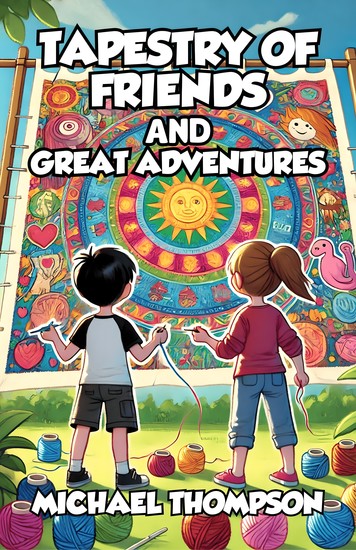
Tapestry of Friends and Great Adventures - cover

Tapestry of Friends and Great Adventures

Michael Thompson

Verlag: The Good Child Bookstore

  • 0
  • 0
  • 0

Beschreibung

In Tapestry of Friends and Great Adventures, a group of children embarks on a heartwarming journey to create a tapestry that celebrates their shared values. With each new thread they weave, they explore virtues such as kindness, courage, respect, and patience. Along the way, they face challenges, celebrate successes, and learn powerful lessons about friendship, teamwork, and embracing diversity. The tapestry they create symbolizes the beauty that comes from understanding one another's unique stories, dreams, and traditions. With colorful imagery and a lively plot, this story invites children to discover the magic of working together, the importance of kindness, and the power of shared experiences. This delightful tale shows that, while we may come from different backgrounds, we all have something precious to offer—and when we weave our differences together, we create something truly extraordinary.
Verfügbar seit: 18.06.2025.
Drucklänge: 131 Seiten.


Weitere Bücher, die Sie mögen werden

  • Earthquakes and Volcanoes - The Brite Star Kids Learn About Earthquakes and Volcanoes - cover

    Earthquakes and Volcanoes - The...

    Vincent W. Goett, Kathleen...

    • 0
    • 0
    • 0
    " 
    The Brite Star Kids Science Books are intended to introduce young children to the wonders of science. 
    In Earthquakes and Volcanoes the Brite Star Kids learn about volcanoes and earthquakes and work on a science project that demonstrates a volcano actually erupting. 
    Standard NGSS-ESS1-1"
    Zum Buch
  • Social Experiments in the 20th Century: The History of the World’s Most Famous and Infamous Psychological Experiments - cover

    Social Experiments in the 20th...

    Editors Charles River

    • 0
    • 0
    • 0
    The human psyche is one of the most complex, unpredictable, enigmatic, and therefore riveting phenomena in existence, one that psychologists have been working on deciphering since the dawn of modern science. To better understand the multifaceted intricacies of human behavior, and to unlock the secrets of the conscious mind and the subconscious, ambitious professionals in the field have conducted numerous groundbreaking – and at times, problematic – psychological experiments. The practice originated with German philosopher Wilhelm Wundt, one of the fathers of modern psychology and the creator of the world's first experimental psychology laboratory at the University of Leipzig. He sought to measure the average speed of thought processes by assigning a range of reaction time tasks to his subjects.  
    	As the nascent, yet fast-developing scientific discipline took hold around the globe, psychological experiments simultaneously diversified. As revolutionary and eye-opening as many of these experiments were, they often danced on the fine line between ethical and unethical. There was, for instance, the now-infamous Little Albert Experiment, conducted at Johns Hopkins University in 1920, in which a nine-month-old infant was deliberately manipulated into developing an irrational fear for the purpose of studying classical conditioning, and the correlation between adult fears and childhood traumas. The Monster Study, carried out at the University of Iowa in 1939, attempted to convert orphans into stutterers, half of whom were subjected to positive reinforcements and the others to negative ones. Then, there was arguably the most notorious psychological experiment in history: the 1971 Stanford Prison Experiment, in which participants were randomly assigned the character of either prisoner or prison guard. That role-playing study quickly spiraled out of control.
    Zum Buch
  • Pigsy Gets Married - cover

    Pigsy Gets Married

    Cheng’en Wu

    • 0
    • 0
    • 0
    In Gaolaozhuang Village, Mr. Gao wanted to find a son-in-law for his youngest daughter but ended up with a pig demon. Many were invited to subdue the demon but all failed. When Xuanzang and the monkey heard that there was a demon in the house on their way to the west, the monkey volunteered to help. The monkey met the pig demon and fought him out of his cave. When the pig demon realized that Xuanzang and the monkey were on a scripture pilgrimage, he immediately revealed to the monkey that he had been waiting for them after receiving instructions from Guanyin. The skeptical monkey demanded the pig demon burn his cave and took him to meet Xuanzang. Xuanzang untied the pig demon and took him as his second disciple. It turned out that the pig demon had been a heavenly marshal but was banished to the earthly world for his misbehavior and was given the religious name "Wuneng" by Guanyin. He was also called "Pigsy."
    Zum Buch
  • Dr Susie Animal Safari - Lion - cover

    Dr Susie Animal Safari - Lion

    Sammie Kyng

    • 0
    • 0
    • 0
    How would you describe a Lion to your young learner? 
    Well they roar for sure. Yet why do they roar? 
    And they hunt. Who IS the primary hunter in a Pride? 
    And they meow. Do you think they hissssss too? 
    Join Dr. Susie on her Lion Safari! 
    Doctor Susie and her friend Bash (He's a Frog) travel to Africa to: 
    - visit a Lion Pride 
    - learn a little Swahili 
    - and think about how long they should sleep each day! 
    Join Susie and Bash today and learn about which part of a Lion's body rhymes with Rain!
    Zum Buch
  • Saving Earth - Climate Change and the Fight for Our Future - cover

    Saving Earth - Climate Change...

    Olugbemisola Rhuday-Perkovich,...

    • 0
    • 0
    • 0
    A timely and inspiring nonfiction guide for middle grade readers about the history of our fight against climate change, and how young people today are rising to action.Inspired by Nathaniel Rich’s Losing Earth: A Recent History, the acclaimed book that grew out of an August 2018 issue of the New York Times Magazine solely dedicated to it, Saving Earth tells the human story of the climate change conversation from the recent past into the present day. It wrestles with the long shadow of our failures, what might be ahead for today’s generation, and crucial questions of how we understand the world we live in—and how we can work together to change the outlook for the better.Written by acclaimed author Olugbemisola Rhuday-Perkovich and enlivened with illustrations from Tim Foley, and filled with the voices of climate activists from the past and present, this book is both a call to action and a riveting dramatic history.A Junior Library Guild SelectionA Macmillan Audio production from Farrar, Straus and Giroux Books for Young Readers
    Zum Buch
  • Fee of The Frontier - cover

    Fee of The Frontier

    H. B. Fyfe

    • 0
    • 0
    • 0
    Fee of the Frontier by H. B. Fyfe	- They didn't think of themselves as pioneers. They simply had a job to do. And if they had to give up money, or power, or love—or life itself—that was the FEE OF THE FRONTIER 
    From inside the dome, the night sky is a beautiful thing, even though Deimos and Phobos are nothing to brag about. If you walk outside, maybe as far as the rocket field, you notice a difference. 
    Past the narrow developed strip around the dome, the desert land lies as chilled and brittle as it did for eons before Earthmen reached Mars. The sky is suddenly raw and cruel. You pull your furs around your nose and check your oxygen mask, and wish you were inside something, even a thin wall of clear plastic. 
    I like to stand here, though, and look out at it, just thinking about how far those ships grope out into the dark nowadays, and about the men who have gone out there on a few jets and a lot of guts. I knew a bunch of them ... some still out there, I guess. 
    There was a time when nearly everything had to be rocketed out from Earth, before they organized all those chemical tricks that change the Martian crops to real food. Domes weren't fancy then. Adequate, of course; no sense in taking chances with lives that cost so much fuel to bring here. Still, the colonies kept growing. Where people go, others follow to live off them, one way or another. It began to look like time for the next step outward. 
    Oh, the Asteroids ... sure. Not them. I did a bit of hopping there in my own time. In fact—on account of conditions beyond my choice and control—I spent too much time on the wrong side of the hull shields. One fine day, the medics told me I'd have to be a Martian for the rest of my life. Even the one-way hop back to Earth was "not recommended." 
    So I used to watch the ships go out. I still remember one that almost missed leaving.
    Zum Buch