Begleiten Sie uns auf eine literarische Weltreise!
Buch zum Bücherregal hinzufügen
Grey
Einen neuen Kommentar schreiben Default profile 50px
Grey
Jetzt das ganze Buch im Abo oder die ersten Seiten gratis lesen!
All characters reduced
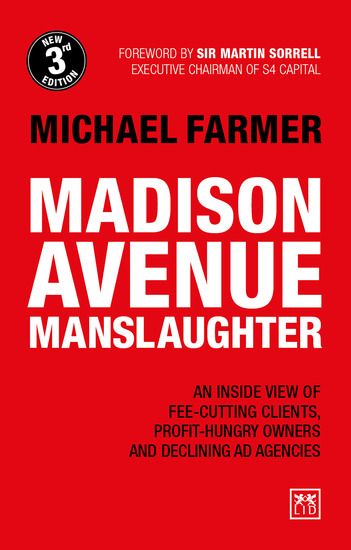
Madison Avenue Manslaughter 3rd Edition - An inside view of fee-cutting clients profit-hungry owners and declining ad agencies - cover

Madison Avenue Manslaughter 3rd Edition - An inside view of fee-cutting clients profit-hungry owners and declining ad agencies

Michael Farmer

Verlag: LID Publishing

  • 0
  • 0
  • 0

Beschreibung

The advertising industry has reached a critical, even dangerous point in its development – agencies destroy themselves by doing increased work for declining fees – so what are the logical consequences of the failure to act? Growing workloads and declining fees have created a ‘recipe for disaster’. For the first time, Michael Farmer offers a solution to avoid this seemingly inevitable disaster. This book offers the world’s first effective definition of “the real agency problem”. Once the problem is understood, then the author offers corrective solutions. This book is a call to action for the 21st century breed of ‘mad men’, to outline the industry problems and encourages agencies and their clients to take management actions to keep this disaster at bay. These actions form the basis of a strategic response by agency CEOs as well as corporate chief marketing officers.
Verfügbar seit: 24.04.2025.


Weitere Bücher, die Sie mögen werden

  • Things I'm Avoiding Doing - A four-week program to overcome procrastination and get [sh]it done - cover

    Things I'm Avoiding Doing - A...

    Michael ONeill

    • 0
    • 0
    • 0
    “Michael Neill is a pioneer thinker, capable of shifting paradigms in ways others don’t.” 
    -Jay Abraham.CEO, The Abraham Group, Inc 
    Does it ever feel like if you could just catch up on your backlog and clear the decks, you'd be able to enjoy your life and create more cool stuff in the world? 
    In this easy to read "workshop" style book, internationally renowned coach Michael Neill will be your companion and guide as you tackle your to-do list and finally reclaim the space in your head and in your world that you've been craving. 
    Whether you do the program over four weeks or in five minute intervals, you'll be surprised at how quickly you're able to make progress on the things you've been avoiding doing, even if in some cases you've been avoiding them for years! 
    Michael Neill is an internationally renowned transformative teacher, author, broadcaster, and speaker. He has spent more than three decades as a coach, adviser, friend, mentor, and creative spark plug to founders, CEOs, celebrities, royalty, and all those who are up to something in the world. 
    Learn more at: 
    michaelneill.org
    Zum Buch
  • Creative Insecurity - Lean Into the Unknown and Unleash Your Inner Misfit - cover

    Creative Insecurity - Lean Into...

    Rhonda Lauritzen, James M. Sweeney

    • 0
    • 0
    • 0
    Creative Insecurity is an entrepreneur's wisdom on embracing the unknown and bravely asking the question: "What am I missing?" 


    Is insecurity positive or negative? Answer: It's both. While fear-based toxic insecurity can undo even the brightest leaders, your strongest position comes from leaning into creative insecurity. This is the mindset of all who run contrary to the crowd and create what has never existed before. It means getting comfortable with discomfort, propelling an off-balance state into forward motion, and mitigating risk. 


    James M. Sweeney is a serial entrepreneur who started multiple companies that sold for billions, changed healthcare in America, and saved countless lives. Today, he mentors startup founders and other professionals in the art of failing your way to success. In this book, he will show you how to reframe anxiety and uncertainty into excitement for new beginnings. You will also learn the timeless wisdom of holding three crucial traits in balance: vision, humility, and the no-quit gene. 


    Discover why being first is more important than being right, why you should never marry a mistake, and why you should concentrate on the most prestigious target in your field.
    Zum Buch
  • What Could Go Right - cover

    What Could Go Right

    Justin Bean

    • 0
    • 0
    • 0
    WINNER: Nautilus Awards and Book Excellence Awards (Sustainability)Amazon BestsellerTired of all the doom and gloom? What Could Go Right invites you to ditch cynicism about the future, and build the one you want.Instead of worst-case scenarios or Pollyanna optimism, you can envision an ideal world and be empowered to build it. The opportunity of our era is to transition to a sustainable, equitable, abundant global economy. Rethink your mindset, understand tech and social trends, & design a future you want to live in, you can thrive through building a better future for us all. Packed with insights, tools, and ideas for what an ideal future might look like and how to build it, What Could Go Right helps you rethink:Your Mindset: Rather than accepting dystopian tropes about our future, we'll look at the reality of our current time as the most abundant and empowered humanity has ever been-and witness it getting better. You'll explore tools and frameworks like Design Thinking, Three Horizons, Five Dynamics, to turn inspiration into pragmatic thinking, planning, and execution. Trends and Opportunities: Explore the empowering tools, sustainable shifts in industry and technology, and social evolutions that are making a more equitable, distributed, democratic, cleaner economy possible. The economic, climate, and social crises around us are accelerating the urgency for change and are inspiring innovators to create new tools and approaches-all to make the transition to a better future. Your Vision of a Better Future: Start imagining what an ideal future might look like by making the most of existing technology and knowledge. With thought leaders and industry experts, you'll tour a future that is abundant, a Zero Marginal Cost Society, post-scarcity, and Omni-Thriving. Apply Maslow's hierarchy of personal needs to social needs. "We don't get the world we want simply by fighting the one we don't. We get the world we want by envisioning, designing, and building it."
    Zum Buch
  • Essential Enlightenment The (Essential Scholars) - cover

    Essential Enlightenment The...

    Douglas J. Den Uyl, Jacob T....

    • 0
    • 0
    • 0
    The political ideas that fully came together under the name “liberal” in the early nineteenth century—the ideas we often now refer to as “classical liberalism”—emerged out of major debates and developments from the late 1600s to the late 1700s, part of the broad European intellectual movement of that era that came to be known as “the Enlightenment.” 
    This volume shows how the Enlightenment and the development of liberal ideas were woven together by looking at three defining figures of the era: Baruch Spinoza (writing in the mid-1600s), the Baron de Montesquieu (mid-1700s) and Immanuel Kant (whose career reached its height in the final two decades of the 1700s). Both Spinoza and Kant were concerned with fundamental philosophical questions about what we could know about God, morality, the nature of the world, and humanity’s place in it. Montesquieu wrote almost nothing about such questions, drawing instead from global history and comparative law. 
    While the Enlightenment is associated with many things, one of them was the struggle to understand morality and human nature through the use of reason rather than relying on religious authority; another was the attempt to understand political and social orders in ways that would prevent a return to the wars of religion that had divided Europe in the 1500s and the first half of the 1600s. In various ways, Spinoza, Montesquieu, and Kant all argued for religious toleration—for the peaceful coexistence of different organized ways of understanding God within civil governments that didn’t enforce any one of those ways. Their support of freedom of religious thought also made all of them supporters of free inquiry and free speech. The three thinkers likewise shared commitments to the rule of law and to constitutional forms of government that would constrain the discretionary power of any one ruler.
    Zum Buch
  • The Innovation Mindset - A Proven Method to Fuel Performance and Results - cover

    The Innovation Mindset - A...

    Jennifer Kenny

    • 0
    • 0
    • 0
    Your team wants to change the world. Let them! 
    All humans have an innate drive to make great things. In The Innovation Mindset, Jennifer Kenny shows you exactly how to implement practices that will drive greater innovation, differentiate your products and solutions through better innovation, and maximize the innovation capacity of your team. 
    With her 25 years of experience in innovation practices that have driven measurable and sustainable results for customers, Kenny can prove that even the most complex technical industries—from robotics to medical research to international finance—can maximize success through empathetic innovation interventions. 
    Kenny’s Six Step Practice Model gives you a tangible ladder to climb by first discovering the innovative drive within yourself and then harnessing it to build a cooperative ecosystem designed to celebrate unplanned discoveries. 
    Her Three Levels of Innovation Capacity teaches you how innovation not only upscales the impact of your team but also the caliber and reach of your products and services. 
    Her revolutionary design-thinking and regenerative leadership frameworks give you the language and the road map to steer your business towards a buzzing, thriving future where “Eureka!” moments are the norm.
    Zum Buch
  • Success and Ethics - Implementation and Measurements of Ethical Principles in Management - cover

    Success and Ethics -...

    Georg F. Sievers

    • 1
    • 0
    • 0
    In einer groß angelegten europaweit durchgeführten Studie – mit einem besonderen Schwerpunkt auf die den sog. Visegrád-Staaten – war es Zielsetzung, die Unternehmensethik als Wettbewerbsfaktor zu erforschen. Dies mit dem Ziel, die Voraussetzungen für den nachhaltigen Transfer ethischer Werte in die unternehmerische Praxis (das unternehmerische (Personal-)Management) zu untersuchen und daraus portable Modelle für die Implementierung und Validierung (Zertifizierung, Messung) ethischer Schlüsselwerte zu entwickeln. Leitfrage der Untersuchung war es dabei, wie sich der Bezug zwischen ökonomischem Interesse und ethischer Normenorientierung so vermitteln lässt, dass die Etablierung ethischer Werte im Unternehmensmanagement anstatt zu einer Einschränkung zu einer Erhöhung der Wettbewerbsstärke (Ethik als Erfolgsfaktor) führt.
    Zum Buch